Portuguese
  Spanish


In 10 contaminated wells, the count reached 0 CFU per 100 mL after 10 minutes
Researchers placed contaminated well water under a plate in the sun in Madagascar, and the titanium dioxide helped eliminate indicator bacteria in 10 minutes. The test took place in Antananarivo, the country’s capital, with samples from 10 wells.
The information was released by arXiv, an open scientific repository for academic studies, in a study submitted on April 23, 2026. The central result was the complete inactivation of indicator bacteria, with the count reaching 0 CFU per 100 mL after solar exposure.
This means that the researchers tested a way to disinfect water using the sun and a special plate, without boiling and without chlorinating. This data is noteworthy because wells are still a source of water for many families in regions with limited access to safe treatment.
-
Scientists Used Space Particles to Reveal Structures Above a Submerged Tunnel Without Drilling

-
Astronomers Use James Webb Telescope Data to Trace the Path of Giant Exoplanet WD1856b, Which Survived Its Star’s Destruction and Migrated to a Close Orbit 80 Light-Years from Earth

-
After 79 Attempts, Students Create Corn Waste Bioplastic That Turns into Fertilizer and Grows Plants When Buried
-
Brazilian Public School Students Win $5,000 at World’s Largest Science Fair with Innovative Water Filter Made from Local Charcoal


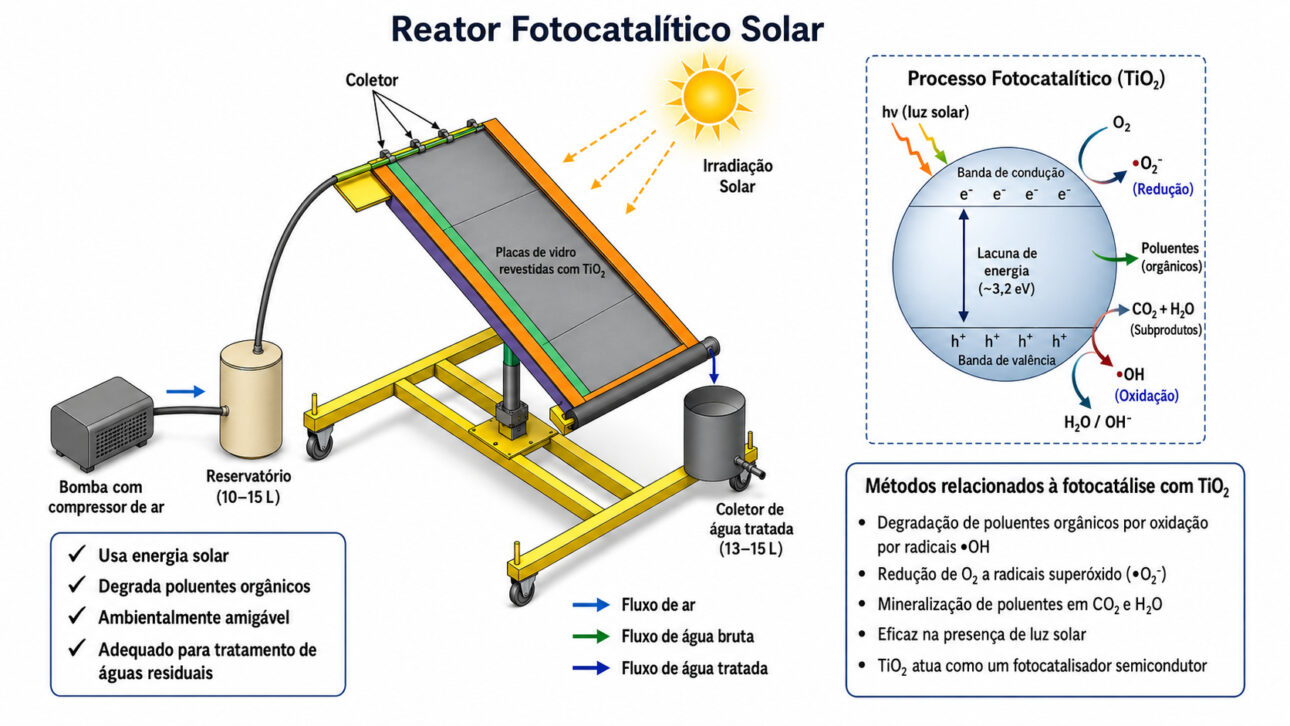
The technology used a glass plate coated with titanium dioxide
The test used a glass plate coated with titanium dioxide. This plate was placed in the system with the water and received natural sunlight.
Titanium dioxide is a material that helps light provoke reactions against microorganisms. In simple words, it acts as a surface that makes the sun’s action more efficient against bacteria.
The evaluated technique did not require boiling or chlorine during the experiment. This explains the interest in the study, as boiling water depends on fuel, energy, or wood, while chlorine is not always available or used correctly.
Even so, the result needs to be read carefully. The research showed a promising path in testing but did not turn the plate into a ready solution to replace public water treatment.
In 10 contaminated wells, the count reached 0 CFU per 100 mL after 10 minutes
The strongest data from the study came from samples of 10 contaminated wells. After 10 minutes of sun exposure with the coated plate, the count of indicator bacteria reached 0 CFU per 100 mL.
CFU means colony-forming unit. It is a laboratory measure used to count live bacteria capable of growing in a sample.
These bacteria are called indicators because they help point out contamination in water. When they appear, they may indicate a risk related to dirt, sewage, or feces.
The drop to 0 CFU per 100 mL does not mean that all water from any well automatically becomes potable. The result applies to the tested samples and the conditions described in the study.
Simple sunlight performed worse compared to the coated plate
The study also compared the plate with simple solar disinfection, done only with sunlight. In a representative sample, sunlight without the material reduced the initial count by approximately 51%.
This comparison helps to understand the role of titanium dioxide. Sunlight alone had an effect, but the coated plate accelerated the elimination of indicator bacteria.
arXiv, an open scientific repository for academic studies, recorded that the study evaluated real well water in Antananarivo. This point is important because the test was not restricted to an ideal water prepared only in the laboratory.
The difference between the two methods reinforces the potential of the plate. Still, the research does not eliminate the need for new tests, quality control, and guidance before widespread use.
What contaminated well water represents for families without safe treatment
Well water may seem clean when it is clear, but this does not guarantee safety. Bacteria invisible to the naked eye may be present even when there is no strong odor or apparent dirt.
Therefore, disinfection is an important step. It reduces microorganisms that can cause diseases, especially in places where the public treatment network does not adequately reach.
The study in Madagascar addresses this problem. It shows a simple way to use sunlight and titanium dioxide to reduce bacterial risk in well water.
The central point is not to sell a miraculous solution. The importance lies in studying accessible alternatives for contexts where boiling water, buying chlorine, or maintaining complex systems may be difficult.
Why Titanium Dioxide Drew Attention in the Study
Titanium dioxide drew attention because it helped sunlight act faster. Instead of relying solely on the sun, the coated plate created an active surface during exposure.
In the study, the material was attached to the glass plate. This is different from throwing a powder into the water.
This detail facilitates understanding of the system. The plate participates in disinfection and can then be removed, while the water undergoes the solar exposure process.
The result in 10 minutes stands out precisely because of the combination of simplicity and speed. Even so, factors like turbidity and pH can interfere with the technique’s performance.
Turbidity is when the water becomes muddier or cloudier. pH is a measure that indicates whether the water is more acidic, neutral, or alkaline.
The Result is Strong, But Still Requires Caution Before Use Outside the Study
The research showed complete inactivation of indicator bacteria in the samples evaluated. This is the most relevant point to understand the strength of the test.
But contaminated water can have other risks. Besides bacteria, there may be viruses, parasites, metals, or chemicals that require other forms of control.
Therefore, the titanium dioxide plate should not be presented as a total solution for any well. The study showed efficiency against indicator bacteria under the evaluated conditions.
The safe reading is this: the technology has potential for domestic treatment in low-resource areas, but still needs evaluation, repetition, and guidance to avoid creating a false sense of security.
A Simple Solution Can Pave the Way for New Research on Safe Water
The study in Madagascar shows how an apparently simple idea can have a practical impact. A plate in the sun, coated with titanium dioxide, managed to accelerate the disinfection of contaminated well water.
The data of 10 wells, 10 minutes, and 0 CFU per 100 mL places the research in a field of great interest for communities that rely on local water sources.
At the same time, caution is essential. The technology still appears as a result of study, not as a promise to replace treatment plants, public networks, or laboratory analyses.
The main contribution is in showing that sunlight can be more efficient when combined with a suitable material. In regions with limited access to treated water, this type of research can open new possibilities.
The experience conducted in Antananarivo reinforces a simple and important idea: clean water cannot rely solely on appearance. Science seeks cheaper and more accessible ways to reduce invisible risks.
Would you trust a technology that uses the sun and a special panel to improve well water safety, or do you think this type of solution still needs to prove itself before reaching families? Comment and share the post.