






 Portuguese
  Spanish


Kalyne Vitória Falcão and Lauanda Vitoriano Lima won an international award in the United States with a technology that uses a common tree from the sertão to treat water, spending cents where the market charges an average of R$ 100
A water filter assembled with black jurema charcoal, silicon fiber, sand, and stone took two students from Escola Estadual Antonio Rodrigues de Oliveira, in Pedra Branca, in the interior of Ceará, to the top spot of an international award at the Regeneron ISEF, held between May 14 and 19, 2023, in the United States. They competed with about 1,700 students from approximately 70 countries and returned home with a prize of 5,000 dollars paid by a U.S. government agency.
Kalyne Vitória Falcão and Lauanda Vitoriano Lima created an activated charcoal filter produced from black jurema, a plant abundant in the Brazilian semi-arid region. According to FEBRACE, the system adjusts the physical-chemical parameters of the water, such as conductivity, solidity, and pH, and requires only 50 cents in silicon fibers, while conventional filters cost an average of R$ 100.
Where the charcoal comes from: the tree that the sertão discards in fire
The central raw material of the invention is black jurema, a species identified by the scientific name Mimosa hostilis in the scientific article that the students published about the project in the Revista Ceará Científico, a journal maintained by the state education network of Ceará. The plant grows abundantly in the region of Pedra Branca and, precisely because it is so common and has little commercial application, it usually ends up being burned.
-
After 79 Attempts, Students Create Corn Waste Bioplastic That Turns into Fertilizer and Grows Plants When Buried

-
Xiaomi Launches 17T in Brazil with 120x Zoom, 6,500 mAh Battery, and Leica Cameras to Rival iPhone

-
Young Innovator Develops Low-Cost Synthetic Skin Using Buriti Oil to Aid Burn Victims, Gains International Recognition in the U.S.
-
Robot Developed to Navigate Sewers and Prevent Blockages and Flooding in Brazil


It is exactly this discard by fire that the duo transformed into an opportunity. Instead of letting the biomass turn into smoke in the fires, the students began to carbonize the wood in a controlled way and grind the material until it becomes granular charcoal, ready to function as a filtering element. What was a worthless residue became the heart of a water cleaning technology.
The choice was not aesthetic, but strategic. Using a plant that the region itself offers for free reduces the cost of the filter to almost zero and eliminates the dependence on industrial inputs that would need to travel hundreds of kilometers to the sertão.
How the water filter works, layer by layer
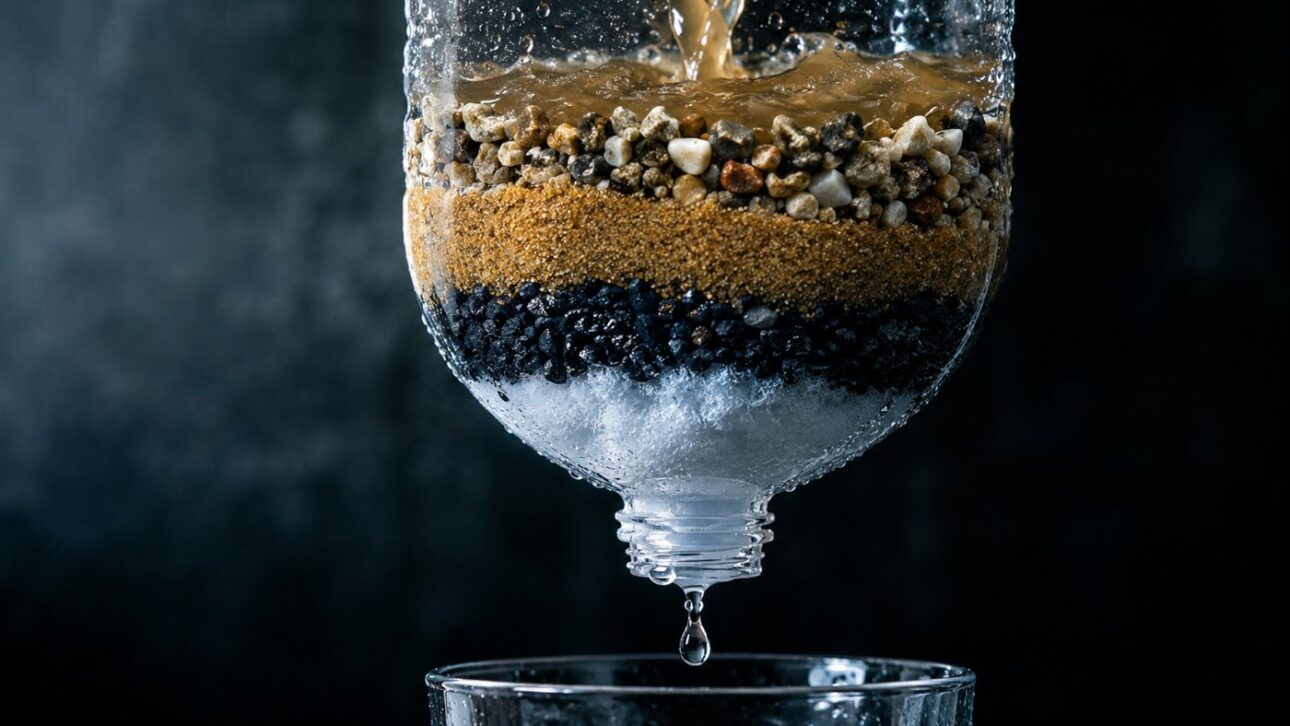
The structure of the water filter follows a logic of overlapping layers inside a PET bottle, described in the Ceará Scientific Magazine article: stones, sands, charcoal obtained from black jurema, and a silicone polymer. Each layer fulfills a function in retaining impurities, and the set conducts the water through successive stages of cleaning until the exit.
According to FEBRACE, the combination of black jurema charcoal with siliconized fiber, sand, and stone is capable of adjusting all the physical-chemical parameters of the water, such as conductivity, solidity, and pH, keeping the liquid within potability standards. In the study published by the students, the pH of the treated water resulted in 7, the value considered neutral on the scale that goes from 0 to 14.
The article also records that physical-chemical and microscopic analyses proved the system’s efficiency, with the liquid coming out of the prototype fit for human consumption. This is not a laboratory promise: the adsorption tests of the charcoal were conducted and documented before the project crossed the border to compete in the American fair.
Fifty cents against R$ 100: the calculation that impressed the judges
The number that sums up the strength of the project fits on a coin. According to FEBRACE, producing an industrial version of the filter requires investing only 50 cents in siliconized fibers, because all other components can be found in nature. On the other side of the scale, conventional filters sold on the market cost an average of R$ 100.
The scale difference is brutal: with the value of a single commercial filter, it would be possible to fund the fiber for 200 units of the system created in Pedra Branca. In a region where family income is tight and sanitation infrastructure is scarce, this kind of math decides who has access to treated water and who does not.
It was this cost engineering, combined with technical performance, that put the project ahead of competitors from around the world. The duo won first place in the USAID Science for Development award in the climate and environment protection category, offered by the United States government’s international development agency, with a prize of 5,000 dollars.
The stage of the achievement: 1,700 students from 70 countries
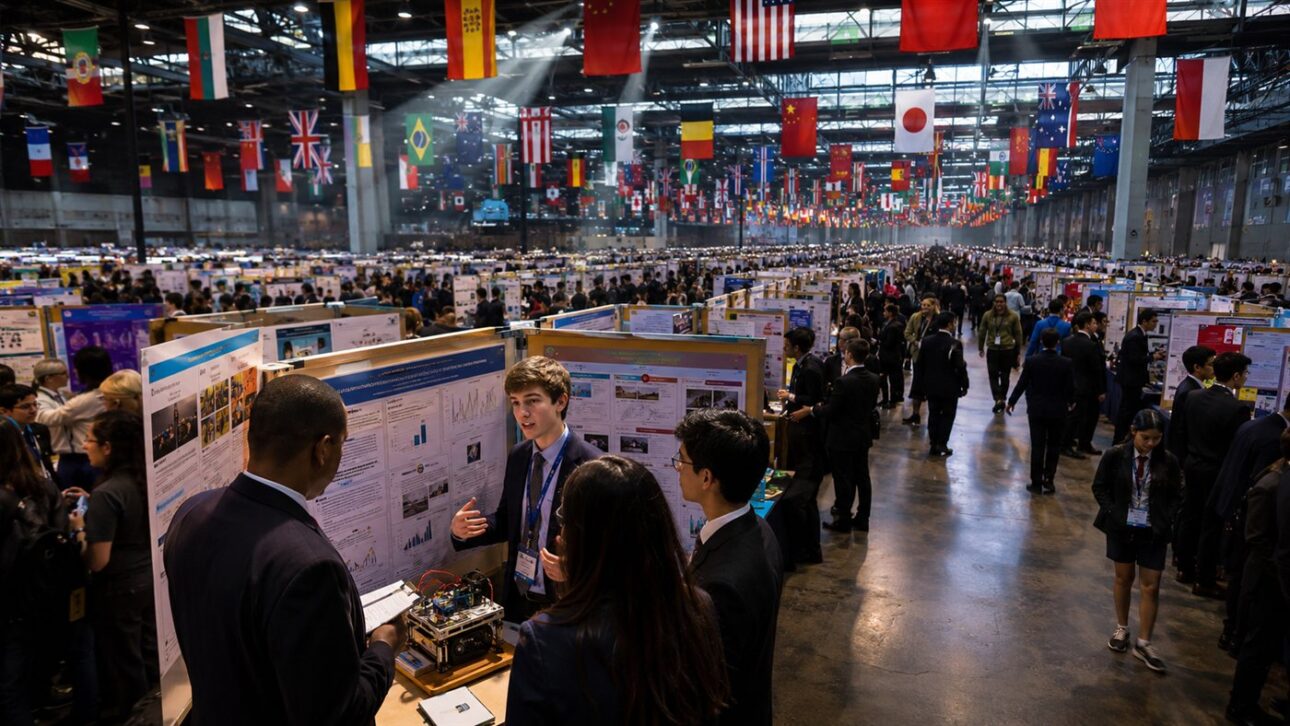
The Regeneron ISEF, short for International Science and Engineering Fair, is the largest international science and engineering fair in the world for students who have not yet reached university, according to FEBRACE. The 2023 edition brought together about 1,700 competitors from approximately 70 countries and distributed a total of 9 million dollars in prizes.
Brazil arrived at the fair with a delegation of 25 students, and 12 of them were selected by FEBRACE itself, the Brazilian Science and Engineering Fair, which serves as the national gateway to the American competition. At the end of the competition, the Brazilian delegation won 5 awards and also an honorable mention, and the filter from Ceará was one of the highlights of this achievement.
For a state school in a municipality in the interior of Ceará, being among the winners of an event of this size means winning a competition with elite schools and youth research centers from around the world, many of them with laboratories that cost more than the annual budget of a Brazilian public school.
The science behind the prototype, published in a journal
The project did not stop at the science fair bench. The two students, alongside Francisco Renato Moreira da Silva and Rafael Saraiva da Silva, signed the article Low-Cost Ecological Filter for Water Treatment, Made from Activated Charcoal Derived from the Biomass of Jurema Preta, published in 2023 in volume 2, number 2, of the Ceará Scientific Journal.
In the text, the group describes the initial problem, wastewater, and details the technical path: the biomass of jurema-preta was carbonized, the charcoal was crushed into a granular form, and the material underwent adsorption tests, those that measure the ability to retain impurities on the surface of the charcoal. Publishing the method in a journal is what separates a school experiment from a replicable technology, because any city hall, school, or organization can read the step-by-step and reproduce the filter.
The environmental argument: 87.5% less carbon dioxide than burning
Besides being cheap, the process created by the students carries an environmental advantage. According to FEBRACE, the production of charcoal for the filter emits 87.5% less CO2 than the burning that currently consumes the discarded jurema-preta in the Brazilian semi-arid region.
In practice, the invention tackles two problems with the same gesture: it reduces the smoke released into the atmosphere by the open-air burning of a plant treated as a nuisance and converts this same biomass into clean water infrastructure for those who need it most. It’s the kind of circular solution that large industries pursue with million-dollar budgets, designed here with a PET bottle, sand, and stone.
Why a penny solution matters so much in the interior of Ceará
Pedra Branca is located in one of the regions most affected by water scarcity in the country, where many rural families depend on cisterns, reservoirs, and wells whose water does not always arrive clean for consumption. A water treatment device that costs pennies, uses local raw materials, and requires no electricity changes the scale of the problem.
The logic of the project is the same that sustains the most successful social technologies of the semi-arid region: solving with what exists in the territory, instead of waiting for expensive solutions that depend on distant logistics. The students’ filter does not replace supply networks or treatment plants, but it covers exactly the gap where the public power has not yet reached.
What the victory says about science made in public schools
The result of Pedra Branca was not born by chance. It went through the circuit of science fairs that begins inside the classroom, advances to FEBRACE, at the University of São Paulo, and culminates in the international competition. It is a training pipeline that transforms a school project into real research, with method, panel, and publication.
Two students from a state school in the interior of Ceará competed on equal footing with the world and won in the category most connected to the planet’s future, that of environmental protection. For the Brazilian ecosystem of young science, each result of this magnitude serves as proof of concept: scientific talent exists in any ZIP code, what is lacking is a pipeline for it to run.
What comes next for the jurema-preta filter
The challenge now is to take the prototype out of the PET bottle and scale it up. The industrial version of the water filter, the one that consumes the 50 cents in silicon fibers, is the natural path to transform the award into a shelf product or into a public policy for rural sanitation. The article published in Revista Ceará Científico leaves the technical map open for anyone who wants to follow it.
If a pair of students solved a problem with cents that the market prices at R$ 100, how many other low-cost solutions are waiting for support within public schools in the Brazilian semi-arid region? Tell us in the comments what you think is missing for inventions like this to reach the homes that need them most.


