






 5 min of reading
  0 comments


Medieval sword found in the Warta River, near Wronki, was preliminarily dated to the 11th century and may be linked to the beginning of the Polish State.
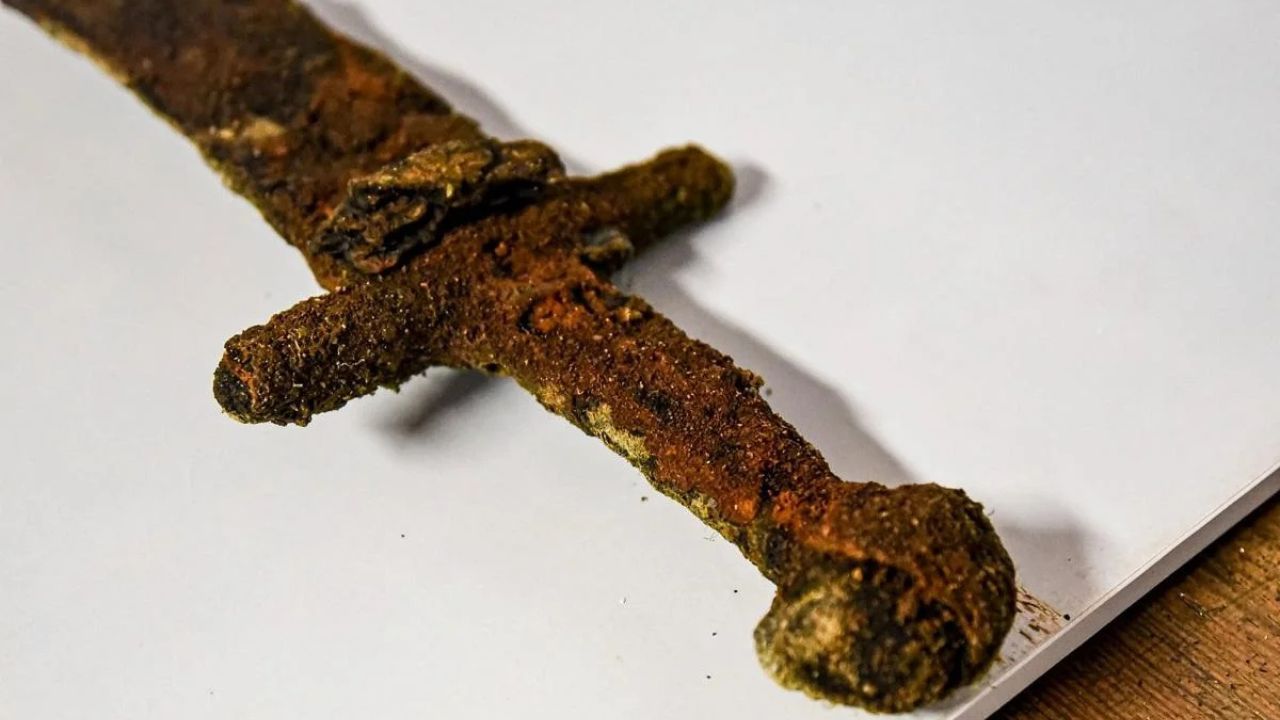
In June 2026, an archaeological discovery caught attention in Poland and quickly gained international repercussion. A medieval sword found in the Warta River, near the town of Wronki, in the west of the country, was preliminarily dated to the 11th century, a period linked to the initial formation of the Polish State under the Piast dynasty. According to the portal Archeologia Żywa, the object was located after a temporary drop in the river level and delivered to the Museum of the Wronki Region, which began the official procedures for preservation and analysis.
The find gained significance because the piece reached specialists in a condition that still allows the identification of important structural parts, despite centuries in a humid environment. According to Notes from Poland, the sword was considered authentic after an initial evaluation by archaeologist Ryszard Pietrzak, and the museum raised two main hypotheses to explain its presence in the river: loss in a conflict or crossing context, or ritual deposition in the waters of the Warta.
Medieval sword was found by local resident in the Warta River, near Wronki
The discovery was made by Mirosław Tucholski, a resident of the Wronki region. According to Archeologia Żywa, he saw the object among stones and sand in a reinforcement area on the riverbank, after the water level temporarily dropped. Instead of trying to clean or keep the piece on his own, he forwarded it to the local museum, which was decisive for the proper preservation of the find.
-
Far beyond simple shocks: scientists highlight how electric fish from the Amazon use complex bioelectric mechanisms to generate up to 860 volts, a natural evolutionary innovation that ensures an absolute advantage in dark and challenging ecosystems.

-
Embrapa takes cashew, peanuts, and sesame to the world’s largest seed bank in Norway, where Brazil has already stored more than 8,000 samples since 2012 against pests and climate change.

-
Almost 1 km beneath Albania, miners find an underground “jacuzzi” of nearly pure hydrogen, with bubbles emerging from a pool inside a chrome mine and the potential to reveal a rare natural reservoir beneath Europe.

-
After working as a waiter for ten years, he borrowed R$ 500 from his brother, created 40-minute lines with an açaí cart on the street, and today runs a farm with 600,000 trees in Pará and a network worth R$ 45 million.




This immediate reaction changed the fate of the artifact. The piece was taken to the Museum of the Wronki Region, where it underwent a preliminary inspection and was formally reported to the region’s heritage protection authorities. According to Notes from Poland, the Wronki city hall also declared support for the examination and conservation process of the material.
Preliminary dating places the sword in the 11th century and brings the find closer to the Piast dynasty
The historical importance of the piece is directly linked to the moment it may have been produced. According to Archeologia Żywa, the initial assessment points to the 11th century, a phase associated with the first Piasts, a dynasty that consolidated the core of the medieval Polish State in the Greater Poland region.
The Polish portal highlights that this period encompasses decades of strong instability, political reorganization, and assertion of power, in an interval that includes the legacy of Bolesław Chrobry, the crisis of the initial monarchy, and the reconstruction of government structures.
This does not mean that the sword can be linked to a specific event, but it reinforces that the object comes from a central phase of Polish history.
According to Notes from Poland, the piece dates back to the period when the House of Piast, the first ruling dynasty of Poland, was present precisely in the same region where the object was found. This enhances the symbolic and historical value of the find.
Archaeologists are still trying to understand how the weapon ended up at the bottom of the river
One of the most important questions now is to find out why the sword ended up in the Warta River. According to Notes from Poland, the museum considers two main explanations. The first is that the object belonged to a warrior and was lost during movement, crossing, or confrontation. The second is that the sword was thrown into the river as part of a ritual or symbolic gesture.


Archeologia Żywa notes that finds of weapons in rivers, lakes, and flooded areas are not uncommon in Polish archaeology, but they remain difficult to interpret with absolute certainty. In many cases, without a closed excavation context or associated material, the final answer may never be known with total precision.
Even so, the piece already provides valuable information about weaponry, social prestige, circulation of objects, and human presence in the Warta Valley during the High Middle Ages.
Conservation of the sword will be carried out in Toruń before public exhibition
According to Archeologia Żywa, it was decided in a meeting with regional heritage representatives that the sword will undergo conservation and specialized study in Toruń, at the Nicholas Copernicus University. This step is considered essential because iron objects removed from aquatic environments can deteriorate quickly after changes in humidity and temperature.
The goal now is to stabilize the piece, safely remove part of the corrosion layers, and try to identify more details about its shape, typology, and chronology. Archeologia Żywa itself emphasizes that the current dating is still preliminary and that more precise confirmation will depend precisely on conservation and more in-depth technical study.
According to Notes from Poland, the expectation is that the sword will be displayed to the public after the completion of this process, turning the find into a new historical point of interest for Wronki and for Polish medieval archaeology.
Find reinforces the archaeological importance of the Warta Valley in Polish history
The discovery goes beyond the visual impact of a well-preserved ancient weapon. It reinforces the historical value of the Warta River as a circulation, occupation, and material memory axis in a central area for the early centuries of Poland’s formation.
In regions like Greater Poland, where the power of the Piasts was consolidated, each artifact of this type helps reconstruct a phase when the territory was still defining its political and military foundations.
Therefore, the sword found in Wronki is not just an ancient object retrieved from the water. It can become a key piece to better understand the weaponry, movements, and social practices of the 11th century in Central Europe. And, as highlighted by the two publications, the fact that the find was correctly handed over to the authorities is what transformed a casual discovery into real historical heritage.







Be the first to react!