






 Portuguese
  Spanish


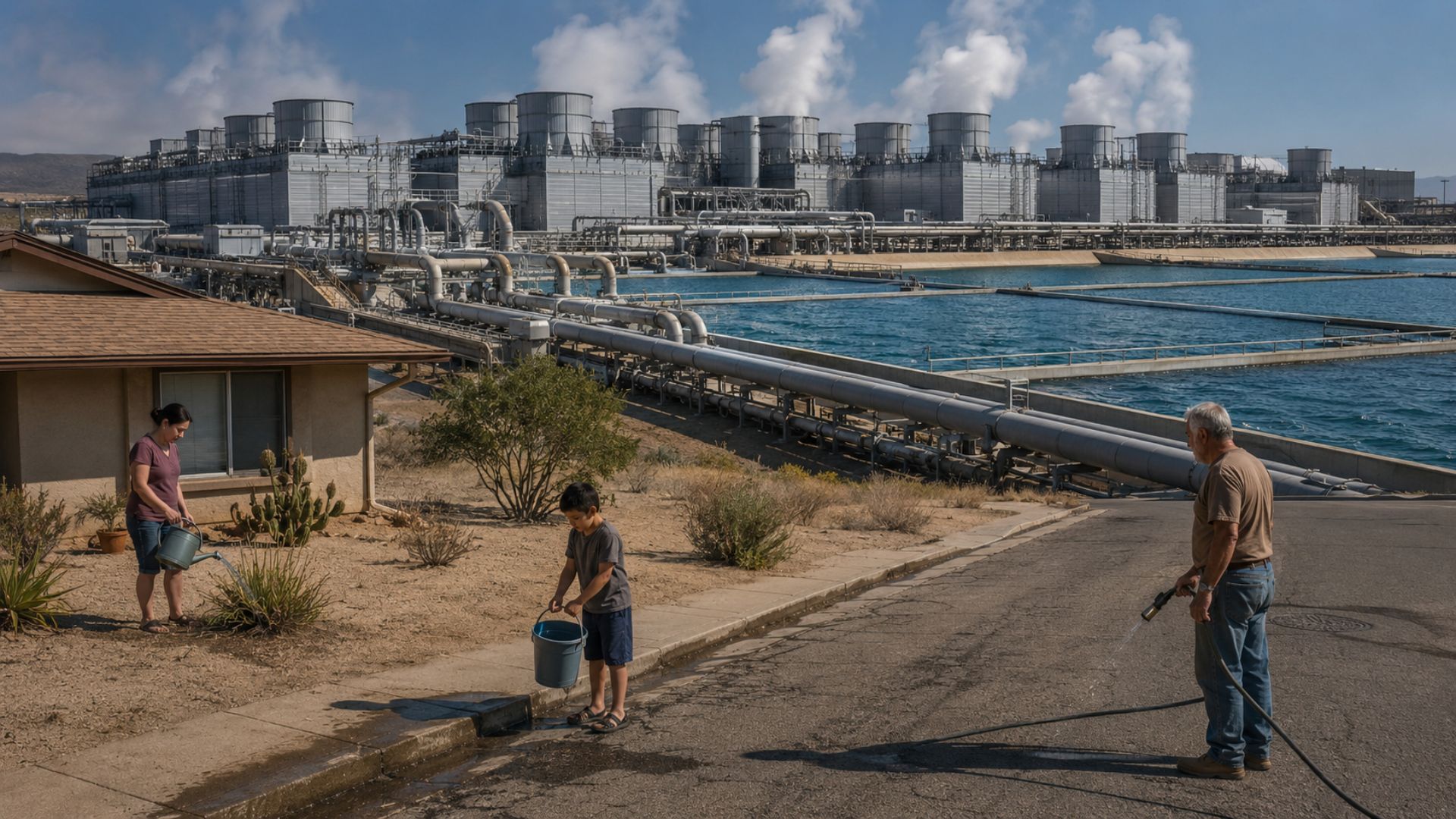
In Fayetteville, Georgia, QTS’s AI data center, a Blackstone Group company, used 29 million gallons through two connections the utility didn’t even know existed. Retroactive charge: US$ 147k. Fine: zero. County’s justification: “They are our biggest customer, we need to be partners.”
Residents of the Annelise Park subdivision in Fayetteville, Georgia, United States, began noticing low water pressure last year. At the same time, they received official county alerts asking them to stop watering their lawns to conserve water, amidst a drought classified as severe to exceptional by the official US monitor. When the Fayette County water system investigated the cause of the falling pressure, it found something no one expected: a data center campus 20 miles south of Atlanta had consumed, over up to 15 months, about 29 million gallons through two industrial connections the utility didn’t even know existed. The volume is equivalent to 44 Olympic swimming pools or approximately 110 million liters. The builder, Quality Technology Services (QTS), a company controlled by the Blackstone Group, was notified in May 2025 and paid US$ 147,474 in retroactive charges. The fine, however, was zero. The official justification came from the county’s water system director, Vanessa Tigert, in an interview with Politico published on May 9, 2026: “They are our biggest customer, and we need to be partners. That’s called customer service.”
The case came to light after a resident obtained the utility’s billing letter through a public transparency request and posted it on Facebook.
What you will understand in this text
- The paradox that became clear when the cross-referenced numbers were released.
- What 29 million gallons are in comparable terms.
- Why the county refused to fine the company.
- What this story reveals about what’s happening in 50 other US cities.
- Why the case directly concerns Brazil, which is experiencing its own data center boom.
The paradox, in numbers

Here’s what makes the case particularly sensitive.
-
Russia and India Lift 320-Ton Pressure Vessel into Kudankulam Nuclear Plant Reactor, Advancing Project That Has Already Prevented 112 Million Tons of CO2 Emissions

-
Brazilian Student Wins Global Science Fair in the U.S. with Sound Wave Method to Alter Alzheimer’s-Linked Genes
-
Bosch Unveils Revolutionary 2.3 kg Hub Motor for E-Bikes with 45 Nm Torque and 400 Watts Power, Eliminating Resistance Above 25 km/h in Historic Shift for German Manufacturer
-
Brazilian Engineer Develops Marine Bacteria from Ubatuba into a Mini Power Plant Generating 227 mW per Square Meter, Cleans Air by Capturing CO₂ and Releasing Oxygen


According to POLITICO, during the same period that the QTS data center was drawing 29 million gallons without being charged, Fayette County was publishing notices asking residents to reduce domestic consumption. Recommendations included suspending lawn watering, avoiding car washing, and reducing shower times. The official justification was the historic drought affecting all of Georgia. In April 2026, Governor Brian Kemp even declared a state of emergency due to wildfires exacerbated by the lack of rain.
Meanwhile, just a few miles from the homes in Annelise Park, the equivalent of 44 Olympic swimming pools was flowing through two industrial pipes with no accounting record.
The water system director, Vanessa Tigert, explained the error to Politico and other American outlets as an “administrative disconnect” caused by the utility’s transition to smart meters. According to her, one of the connections had been installed without the utility’s knowledge. The other existed but was not associated with the customer’s account, meaning it wasn’t generating charges. The result was a time window of between 4 and 15 months (the county says 4, QTS admits up to 15) during which consumption simply disappeared from the billing system.
“They are our partners”

And here’s the second point that outraged residents.
Even after the unmetered consumption was confirmed, the county decided not to impose a fine. The justification, repeated by Vanessa Tigert in several interviews, is straightforward: QTS is the county’s largest water consumer, generates between US$150 and US$200 million annually in property tax revenue for the city of Fayetteville, and the relationship needs to be “a partnership.”
QTS is controlled by Blackstone, one of the world’s largest private equity groups, with over US$1 trillion in assets under management. The company paid the retroactive US$147,000 immediately after notification. In an official statement sent to American media outlets, QTS stated that the unmetered consumption occurred during the utility’s transition to the smart meter system and that, as soon as it was notified, it regularized the situation.
What no one explains is how one of the two industrial water intakes was installed without the utility’s knowledge.
The scale of the complex

To understand why consumption grew so much, one needs to understand the scale of the undertaking.
The QTS campus in Fayetteville occupies 615 acres, equivalent to approximately 250 hectares, or about 350 soccer fields. It currently has 13 buildings already erected, totaling about 6.2 million square feet, or around 575,000 square meters of built area. The original plan foresees up to 16 buildings. It is one of the largest data center complexes under construction in the United States.
The operation is only partially functional. Construction is expected to last another three to five years. According to QTS, water consumption will decrease when the work is completed. But, even after full inauguration, artificial intelligence data centers continue to use substantial volumes of water for server cooling, especially in warmer months.
And here’s a fact that often shocks those who have never looked at the industry from the inside.
How much a data center drinks

Data centers essentially consume water to cool their servers, which heat up when processing data at high speed. The industry’s standard calculation estimates between 1 and 5 liters of water per kWh of electricity consumed, depending on the cooling system and the region’s climate. In data centers that use evaporative cooling (cheaper, but thirstier), consumption increases.
Researchers at the University of California, Riverside calculated, in a study published in 2023 and updated in 2025, that each average interaction with a language model like ChatGPT consumes the equivalent of half a liter of water, considering the entire data center cycle plus the electricity generation that sustains it. For the generative AI fields being built today, the number could rise even further.
It’s no coincidence that Georgia is already the second American state with the highest concentration of data centers (over 200 facilities), behind only Virginia. And it is also one of the states that suffer most from chronic drought.
The ongoing political backlash
The story isn’t just in Fayetteville. There’s an American wave of pushback against data centers.
At least 50 cities in the United States currently have active prohibitions on new data centers, according to the U.S. Data Center Moratorium Tracker. Four have adopted permanent bans. In January 2026, the Fayetteville city council approved Ordinance 26-0-12, which prohibits the construction of new data centers in all city zoning districts. In the same month, the city’s planning commission rejected a Crow Holdings project, which later withdrew its appeal in March.
Elsewhere, the reaction was even more political. In a small Missouri town in 2026, voters removed all council members who had approved an AI data center project. In Iowa, state authorities discovered last year that QTS itself had drilled 40 unlicensed wells at a data center in Cedar Rapids. In other words, the Georgia case is not the company’s first violation.
The Georgia Public Service Commission also took action. It froze Georgia Power’s base rates until 2028, specifically to prevent the electricity costs of new data centers from being passed on to residential consumers. It’s an implicit recognition that the AI race was starting to hit the pockets of those who don’t even use the service.
Why this matters in Brazil
And here’s the point that connects the story to the Brazilian reader.
Brazil is experiencing its own data center boom. Companies like Microsoft, Amazon Web Services, Google, and ScalaHub have announced investments totaling tens of billions of reais in new complexes in the country over the past two years. The preferred hubs are in São Paulo, Rio de Janeiro, Ceará, and, more recently, in the state of Goiás. The reason is geographical and regulatory: Brazil has cheap, partly renewable energy, available land, and regulation still in its initial phase for large digital ventures.
The current inflection coincides with at least three significant water crises in the country over the past five years, including the historic one in 2021 in the Southeast, which led to the return of red tariff flags. In parallel, water resource specialists have been pointing out that data center water consumption, although small in proportion to agriculture, is highly concentrated in specific points of the territory. A data center can, by itself, deplete local aquifer reserves or compromise smaller urban systems.
The Fayetteville case shows what happens when monitoring fails and oversight loosens. It also shows what happens when the power imbalance between a company controlled by a $1 trillion fund and a municipal water system is so great that the fine, even if applicable, is exchanged for “customer service.”
For Brazil, which is still regulating its own model for data center oversight and taxation, the lesson comes with the exact number: 44 Olympic swimming pools.
What will happen now
QTS states that it has regularized all connections and that the meters are integrated into the county’s system. It guarantees that water consumption will be lower after the construction phase, expected to finish by 2031. But most of the residents’ criticisms concern the future operation of the complex itself, not just the construction. When the 16 buildings are active, consumption will convert into continuous cooling demand.
In parallel, more administrative actions are expected to reach the American courts in the coming months. Discussions on the financial forum Motley Fool were already calling the case, in comments last week, a “natural candidate for a class action.” Annelise Park residents have not yet announced a class action lawsuit, but lawyers specializing in environmental and regulatory law are beginning to treat the case as a national precedent. For those who defend the industry, it is a specific administrative failure of a county with an old system. For critics, it is the symptom of an economic and political equation that, today, makes fresh water in the United States seem increasingly less democratic.
And the number that defines the size of the dispute remains there, solid and little discussed: 44 Olympic swimming pools.






Be the first to react!