






 Portuguese
  Spanish
  7 min of reading
  0 comments


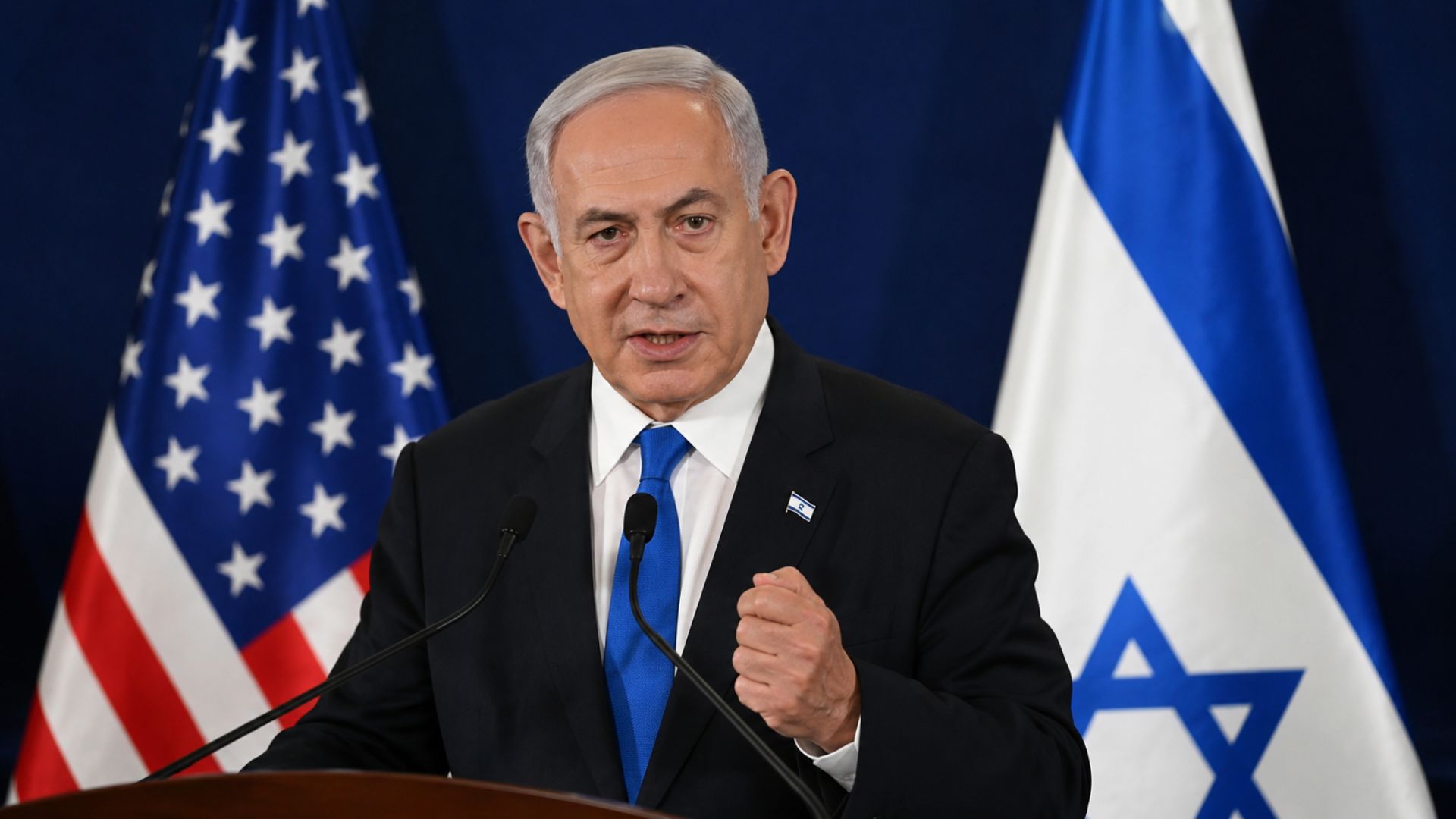
In an interview with CBS’s “60 Minutes” program aired on May 10, the Israeli premier proposed a gradual cut over ten years. The current agreement, signed in 2016, expires in 2028. The move brings Israel closer to the same logic of industrial sovereignty that Brazil pursues with SIATT.
Israel’s Prime Minister, Benjamin Netanyahu, announced in an interview with the American network CBS’s “60 Minutes” program, broadcast on May 10, 2026, his intention to gradually phase out military aid from the United States to Israel over the next ten years. The current Memorandum of Understanding between the two countries, signed in 2016 during the Barack Obama administration, provides for an annual transfer of US$ 3.8 billion to Israel, a value that converts to around R$ 21 billion at the current exchange rate, and expires in 2028. Netanyahu’s proposal is to fulfill the final three years of the agreement and then reduce the transfers to zero over the subsequent seven years. In accumulated values, the transition represents the end of at least US$ 38 billion in American aid over the next decade. “We want to move with the United States from aid to partnership,” Netanyahu stated in the interview, broadcast on the same Sunday that Tel Aviv and Washington were separately discussing the next steps for joint operations in the Middle East, according to UNN.
And there’s a detail in this equation that changes the complete meaning of the announcement.
What you will understand in this text
- How much, exactly, Israel receives today in American military aid and why part of it never leaves the United States.
- Why Netanyahu presents the end of aid as an advantage for Israel, and not as a concession.
- How the decline in American approval for Israel accelerates the move.
- What is the direct parallel with the Brazilian defense industry, and why it matters.
- What changes in the balance of the Middle East if the transition materializes.
The US$ 3.8 billion that returns to the USA

Here is the most surprising fact.
-
Petrobras sells the first batch of 3,800 m³ of aviation fuel made with certified soy, capable of reducing emissions by up to 70%, in an unprecedented project that anticipates the aviation sector’s requirements expected for 2027.

-
Brazil enacted a national minimum wage for teachers at R$ 5,130 for a 40-hour workweek, raised the minimum wage for basic education after a 5.4% adjustment, and established a rule that prevents increases below inflation in the coming years across the country.

-
Luciano Hang offers a R$ 40,000 prize at Havan, but it’s not exactly a job position: it’s an influencer contest for the network’s 40th anniversary, with a contract for the winner.
-
For years Star Wars led, but the most expensive film in history is now Jurassic World: Dominion, with a budget of $658.8 million and a box office that exceeded $1 billion.




The 2016 agreement between the United States and Israel provides for an annual transfer of US$ 3.8 billion to Tel Aviv in military aid. But there is a technical clause that completely changes the interpretation of the number. According to Reuters and the specialized portal IDNFinancials, most of these resources are not delivered in cash to the Israeli government. They return to the United States itself, in the form of payment for military equipment manufactured on American soil, obligatorily purchased by Israel from companies Boeing, Lockheed Martin, Raytheon, and General Dynamics.
In other words, the “aid” functions, in practice, as financing conditioned on the consumption of American weaponry. Tanks, missiles, F-35 fighters, helicopter parts, electronic systems. Everything must be purchased from US suppliers.
This is what Netanyahu unceremoniously called an “obstacle”.
His interpretation, according to the “60 Minutes” interview, is as follows. The obligation to spend in the United States prevents Israel from strengthening its own defense industrial base. Every dollar spent in Tel Aviv with an American company is a dollar that does not go to Rafael, Elbit Systems, or Israel Aerospace Industries (IAI), the three pillars of the Israeli military-industrial complex. And, in Netanyahu’s view, this has become a strategic problem.
The economy that changed the calculation
There is a second point, and it is less ideological than it seems.
The Israeli economy has grown significantly over the last decade, even with intermittent wars and internal political crises. In 2024, Israel’s GDP exceeded US$ 530 billion. Per capita income surpassed that of several Western European countries, including France and the United Kingdom. The technology sector, especially cybersecurity and artificial intelligence, became one of the country’s largest exporters. In parallel, Israeli arms exports broke successive records, with sales exceeding US$ 13 billion in 2024, according to official data from the Israeli Ministry of Defense.
In practical terms, Israel has become an exporter of cutting-edge military technology. Dependence on American aid, instead of generating security, began to generate limitation.
That’s what Netanyahu summarized in the interview. “Israel today has a thriving and fast-growing economy, and that allows us to gradually eliminate the financial component of American military assistance,” the prime minister told CBS, in remarks cited by Reuters and the Arab News portal on May 11.
The decline in approval, and its political interpretation
There is also a third layer, which few international reports are highlighting.
American approval of Israel has been in continuous decline since 2023. Gallup polls, released throughout 2025, showed that for the first time in decades, more Americans said they sympathized with Palestinians than with Israelis on the general empathy scale. Among Democrats, support for Israel plummeted to below 30%. Among young people aged 18 to 34, regardless of party affiliation, the drop was also sharp.
In the “60 Minutes” interview, Netanyahu did not hide his interpretation of the phenomenon. He attributed the decline in American support for Israel to “manipulation” on social media and “online propaganda campaigns,” rather than admitting a connection to military operations in Gaza and Lebanon. More than 71,000 Palestinians are said to have been killed since the start of the offensive, according to Gaza Health Ministry data cited internationally. In Iran, the American human rights agency Human Rights Activists News Agency reports 3,636 deaths caused by joint US-Israel attacks since March 2026, including 254 children. The Pentagon confirms 13 American military personnel killed and 415 wounded in the war against Iran.
The political interpretation, however, is more pragmatic. The more Israel’s approval falls in the United States, the riskier it becomes to depend financially on the American government. A future, more critical administration, whether Democratic or Republican, could use aid as a tool for pressure. Eliminating aid is eliminating that leverage.
It was this, more than any economic calculation, that seems to have sealed the announcement.
The three-stage plan
Netanyahu detailed the proposed timeline in the interview:
- First stage (2026-2028): fulfillment of the remaining three years of the current Memorandum of Understanding, with full transfer of the annual US$ 3.8 billion.
- Second stage (2028-2035): gradual and progressive reduction of transfers, in seven decreasing annual installments.
- Third stage (from 2035 onwards): zero transfer. Israel would then purchase American armaments under the same model as any other purchasing country, without subsidies, and would expand internal production to meet the demand of its own Armed Forces.
The transition would preserve, according to Netanyahu, technological cooperation, intelligence sharing, and joint research agreements between the two countries. What changes is the direct financial component.
The parallel with Brazil
And here’s the part that connects with what the Brazilian reader has seen happening within the country.
In the same week Netanyahu announced the transition, in Brazil, the company SIATT, formerly Mectron, completed the first industrial batch of the MAX 1.2 AC anti-tank missile for the Brazilian Army. It was the first time the country had produced, on an industrial scale, a guided missile with national technology. The Brazilian move follows, on a much smaller scale, the same logic as the Israeli announcement: reducing dependence on foreign suppliers and building its own industrial capacity.
SIATT also has as a strategic partner the EDGE Group conglomerate, from the United Arab Emirates, which also maintains relations with the Israeli industry. The global defense industrial geography is being redrawn towards a logic of multilateralism, where countries previously only buyers are beginning to position themselves as producers.
The transition is not just Israel’s. It is that of an entire generation of countries that understood that buying technology is not the same as mastering technology.
What changes in the Middle East
For regional balance, the announcement has effects that will still take time to materialize, but are worth observing.
First, by building more industrial autonomy, Israel will have more political freedom in relation to the United States. Military decisions currently moderated by diplomatic considerations (Washington’s approval or disapproval for this or that operation) may become less dependent on coordination. In theory, this expands Tel Aviv’s room for maneuver. In practice, it can also increase tensions with regional allies who have become accustomed to using the US as an interlocutor.
Second, by expanding its own export base, Israel becomes a direct competitor to the United States in markets where it previously complemented American supply. Countries that today buy Israeli Hermes drones or Iron Dome systems may stop buying Patriot missiles or F-35 fighter jets.
Third, the gradual reduction of transfers can be used politically by Washington as an argument to reduce the American military presence in the Middle East. If Israel no longer needs direct aid, part of the justification for maintaining bases and troops in the region loses strength. This may sound counterintuitive, but this is exactly the calculation circulating in analyses by Foreign Affairs and the Council on Foreign Relations, two of the main American strategic think tanks.
What still needs to happen
Netanyahu’s announcement, however detailed, still has no legal effect. Any change to the Memorandum of Understanding will depend on negotiation with the United States government, and the current American president, Donald Trump, has not yet publicly responded to the proposal. The American Congress will also have a say in the process, especially if a new agreement is negotiated to succeed the 2028 one with a different format from the current one.
Internally, in Israel, the announcement also faces debate. Opposition political forces and part of the Israeli high military command have already expressed, in interviews with outlets such as Times of Israel and Haaretz in recent months, concern about the speed of the proposed transition. The main argument is that ten years may be too short for the Israeli industry to independently achieve the capacity to replace fighter jets, anti-missile defense systems, and naval technology currently purchased from the United States.
But the signal has been given. And time has begun to run.


Be the first to react!