






 Portuguese
  Spanish


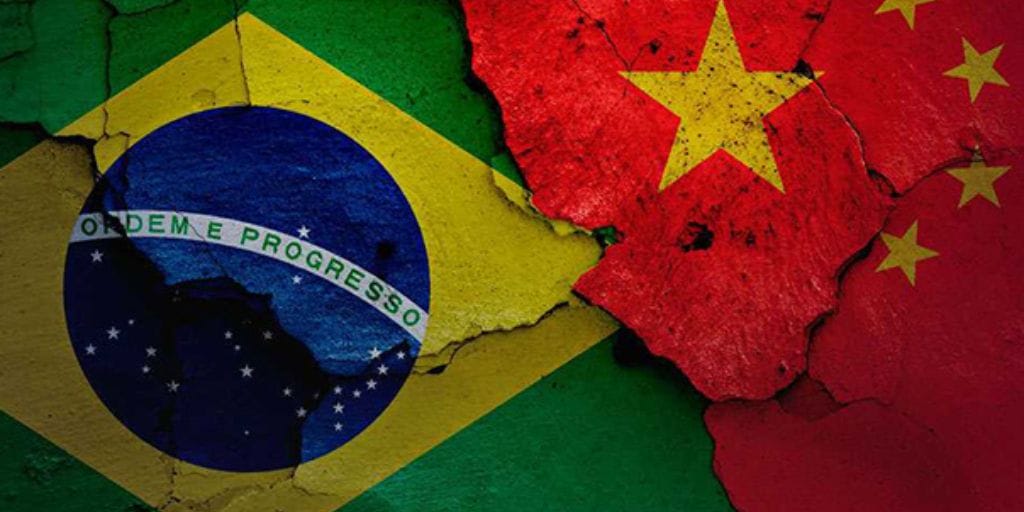

The Growing Influence of China in the Brazilian Energy Sector Raises Questions About National Sovereignty and Security. With Control Over Niobium and Investments in Infrastructure, the Asian Country Could Exert Political and Economic Pressure on Brazil. What Are the Risks of Relying So Much on a Single Partner?
At the beginning of the 21st century, the world witnessed an unprecedented economic phenomenon: the rapid rise of China as a global superpower. And, it seems, this rise has direct implications for Brazil, with rumors and suspicions that the Asian giant is plotting ambitious plans to dominate strategic sectors in the country.
According to an article published in Diálogo Américas, a military publication of the United States, Chinese interests in Brazil go far beyond a simple trade partnership.
This relationship is marked by a complexity that includes everything from the exchange of high-ranking military figures to the growing presence of Chinese companies in strategic sectors of the Brazilian economy.
-
Brazil’s Lula Government Allocates $463 Million Quota for Electric Car Parts, Waives Import Tax Until December, Sparking Competition Among BYD, Automakers, and Unions as Consumers Question Impact on Prices and Local Industry

-
Clarification and Right of Reply Notice

-
Elon Musk Becomes World’s First Trillionaire with $1.1 Trillion Fortune; Could This End Global Hunger?
-
Brazilian Executive Takes Helm of Heineken Amid Decline in Sales: 51-Year-Old Has Led Operations Across Four Continents and Managed a $7 Billion Empire




In July 2024, for example, the commander of the Brazilian Army, General Tomás Miguel Miné, visited China, a move that generated controversy on social media and was criticized by parts of the population. The visit, which included courses for senior officers in Beijing, raised questions about the true nature of this proximity.
The Growing Chinese Economic Presence
The economic influence of China in Brazil is not new. Since 2009, the Asian country has been Brazil’s main trading partner, with a record bilateral trade volume reaching US$ 157.5 billion in 2023.
Of this total, US$ 104.3 billion corresponds to Brazilian exports, while US$ 53.2 billion pertains to imports. In addition, China invested approximately US$ 70 billion in the Brazilian market, consolidating its presence in various sectors.
This partnership, although seemingly advantageous at first glance, raises concerns among experts. They warn of Brazil’s growing dependence on China, which could result in deindustrialization and economic slowdown. The situation is particularly critical in the energy sector, where Chinese influence is increasingly pronounced.
China’s Dominance in the Energy Sector
In 2023, the State Grid Corporation of China (SGCC) secured the largest energy transmission contract in Brazil’s history, valued at US$ 3.4 billion. The project involves the construction and operation of 1,513 kilometers of direct current transmission lines, consolidating China’s position in the Brazilian energy sector.
According to William Tobin, a security expert, this dominance may allow China to manipulate bidding processes and favor Chinese companies, raising concerns about national security and Brazil’s energy sovereignty.
One of the most alarming aspects of this situation is Brazil’s dependence on solar panels imported from China, which represent 98% of the national market. Ryan Berg, director of the Americas Program at the Center for Strategic and International Studies (CSIS), warned that China could use this influence to leave Brazil without power at strategic moments, given that control lies in a non-democratic system.
Social, Environmental, and Security Risks
Chinese investments, while promoting infrastructure development, also raise socio-environmental and national security questions, as pointed out in the article in Diálogo Américas.
The construction of new energy transmission infrastructures may impact indigenous communities and cause significant environmental damage. Furthermore, Chinese control over strategic sectors could create space for political pressure, putting Brazil in a vulnerable position.
Influence in Strategic Industries
Chinese influence is not limited to the energy sector. China is also expanding into other strategic industries in Brazil, such as the production of solar panels and electric vehicles. Consulting firm Wood Mackenzie estimates that China will control 80% of the world’s solar component production capacity by 2026. In Brazil, this dependence is evident, with 98% of imported solar panels coming from China, increasing the country’s cybersecurity vulnerability.
China and the Control of Niobium
Another point of concern is China’s control over niobium, a mineral essential for the high-tech industry. Brazil holds 91% of the world’s reserves of this mineral, crucial for the production of steel, semiconductors, and lithium-ion batteries.
In 2011, Chinese entities acquired 15% of Companhia Brasileira de Metalurgia e Mineração (CBMM), raising this stake to about 26% in 2020. This control could have profound implications not just for the technology and energy sector but also for national defense.
Thus, in light of so many elements, it is clear that the Brazil-China relationship is complex and full of nuances. While investments and partnerships may bring short-term economic benefits, it is crucial for Brazil to carefully assess the long-term risks associated with growing Chinese influence.
And you, reader, what do you think about this growing Chinese presence in Brazil? Share your opinion in the comments!




E realmente é preocupante pois a cada dia sentimos que o país esta nas mãos do chineses!!
Preocupante! Principalmente devido este governo fraco que o Brasil tem.
Também acho que todo cuidado deve ser tomado nesses setores citados e acrescentaria além desses setores o de comunicação