






 Portuguese
  Spanish
  4 min of reading
  0 comments


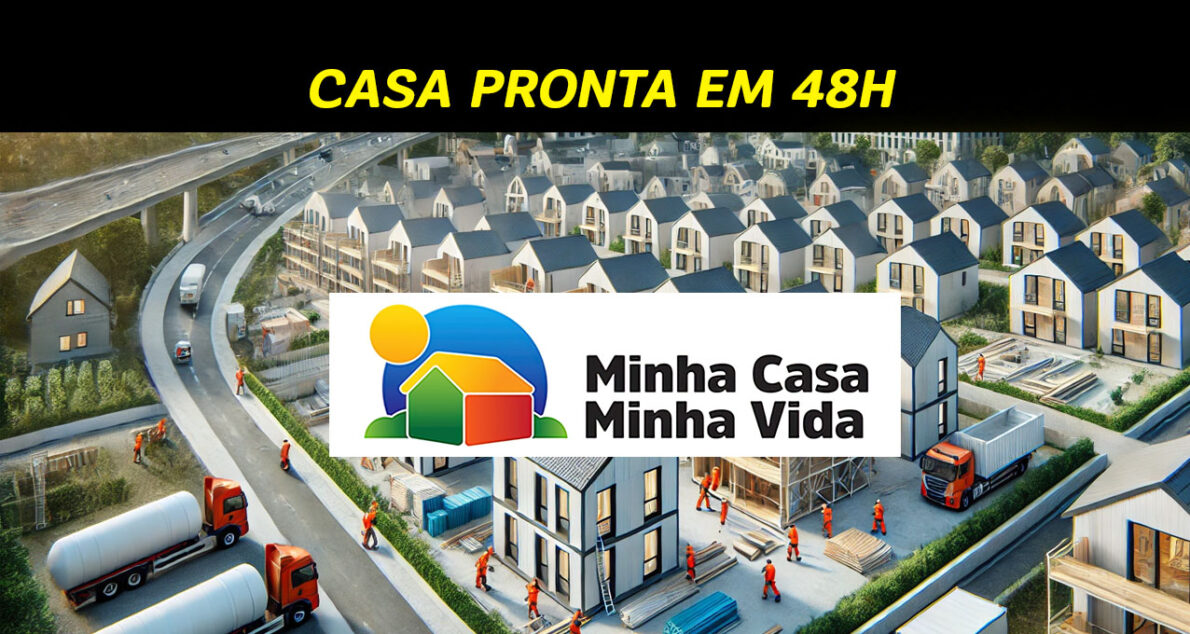
Company Promises To Revolutionize Minha Casa Minha Vida By Building Houses In 48 Hours. Using Light Wood Frame Technology, The Company Has Already Started Delivering The First Units And Plans To Build More Than 1,000 Houses In One Year.
Imagine if the low-income houses from the Minha Casa Minha Vida program could be built in just 48 hours.
The impressive speed, innovative technology, and practicality are some of the key points that could change the lives of many families.
-
Brazilian Joins Homeownership Consortium, Faces Decade of Dual Payments Totaling $141,000, Surpassing Traditional Mortgage

-
Land Rover to Halt Production in July, Putting 371 Jobs at Risk, as Chinese Automaker Negotiates to Convert Factory to 100,000 Vehicles Annually by 2027

-
Bolivian Female Construction Workers Form Association to Combat Discrimination and 38% Pay Gap in the Industry
-
Mexican Pest Threatens U.S. Cattle Herds at Historic Lows, Potentially Boosting Brazilian Beef Exports as Burger Prices Soar


Based in Lavras, in the south of Minas Gerais, Hauss Brasil has initiated an ambitious project: to build more than 1,000 low-income houses in Minas Gerais within a year. And the best part? The first houses have already started to be delivered.
But how is it possible to erect a residence in such a short time? The secret lies in a revolutionary construction technology that uses prefabricated panels, eliminating the need for traditional bricks.
The Revolution In Construction: The Technique That Accelerates The Process
Unlike conventional construction methods that can take months or even years, Hauss Brasil has developed a system that uses panels made of wood and cement derivatives.
These panels are produced in a factory in Paraná and transported to the assembly site, where the houses are assembled in just two days.
Hauss Brasil’s CEO, Junior Bergamin, explains that production is done on an industrial line, ensuring that each residence is identical to the others. “In just one day, we can assemble up to 12 houses at the factory,” emphasizes Bergamin.
The technique used is known as Light Wood Frame, a system that, in addition to accelerating the process, offers various advantages in terms of thermal and acoustic comfort.
“Even in extreme temperatures, the houses maintain a comfortable internal environment, between 22ºC and 23ºC, which is a significant difference compared to traditional constructions,” explains Bergamin.
Minha Casa Minha Vida: How Technology Can Transform The Program
Despite being an innovative technology, the cost for private constructions using Light Wood Frame is still higher – between 30% and 40% more expensive than the traditional method.
However, when applied on a large scale, such as in the Minha Casa Minha Vida projects, this price difference becomes competitive. “When we build from 50 units, we can equalize the costs,” says Bergamin.
The first project by Hauss Brasil using this technology is located in Itamogi, in the south of Minas, where 150 houses are being built for R$ 130,000 each.
The company has also won bids in other towns in Minas, such as Ingaí and Dores do Indaiá, and plans to expand its operations to more municipalities.
A Solution For Urban Challenges
In addition to the speed of construction, the houses built by Hauss Brasil offer a solution to one of the main problems faced by the Minha Casa Minha Vida program: the location of the homes.
Since the construction is done outside the construction site, the houses can be distributed across various parts of the city, which facilitates integration with the existing urban infrastructure.
“We can distribute the houses throughout the city, avoiding the creation of segregated communities distant from urban centers,” supports Bergamin.
The Future Of Civil Construction: What To Expect?
The company aims to develop solutions to build buildings up to four stories and intends to reach maximum production capacity, of 4,000 houses a year, by 2025.
“Our goal is to deliver more than 1,000 houses by July next year and continue growing,” projects the CEO.
However, the adaptation of municipalities to the new technology is still a challenge. Often, the bids restrict the materials that can be used, which can hinder the adoption of Light Wood Frame.
We are working to overcome these barriers and show that our technology is viable and advantageous for cities,” concludes Bergamin.
Do you believe that this technology can transform the popular housing market in Brazil?





Be the first to react!