






 Portuguese
  Spanish


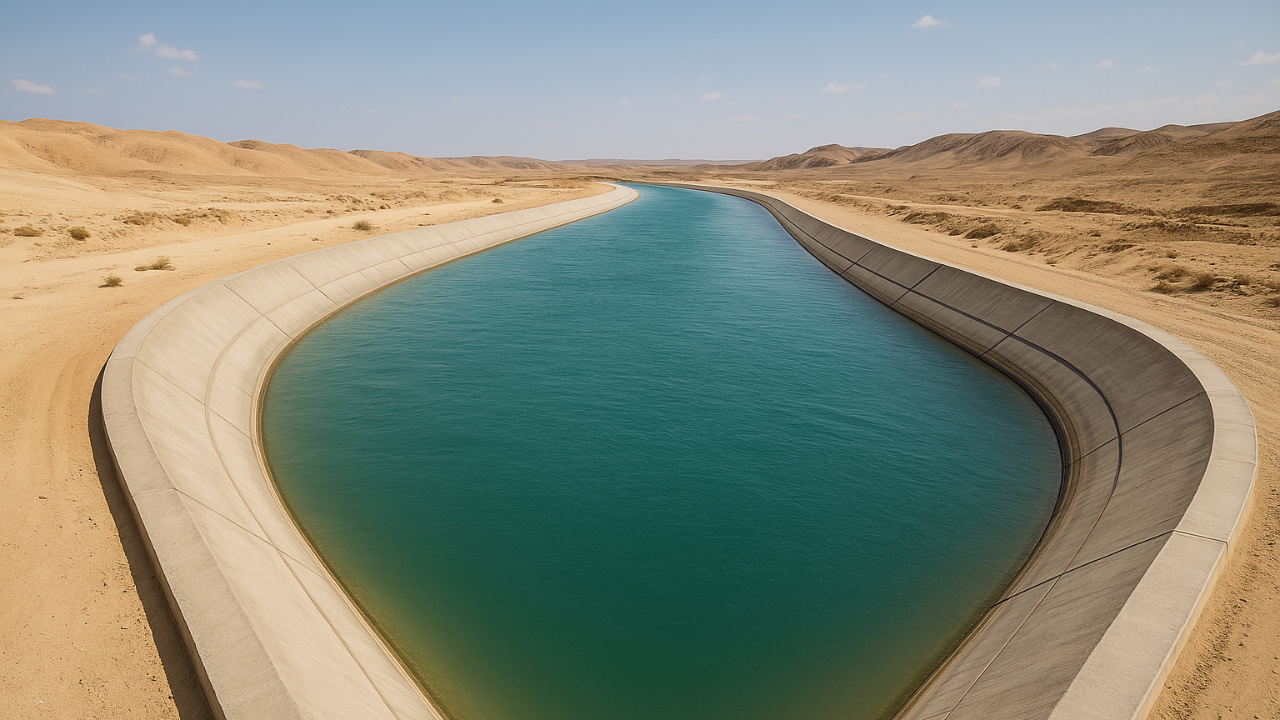


Water Engineering Project Uses Desalination to Bring Development and Agriculture to the Negev Desert in Israel.
Israel implemented, starting in the 2000s, an ambitious artificial river in Israel to bring water from the Mediterranean Sea to the Negev Desert, a region historically marked by water scarcity, extreme heat, and low productivity.
The project, conducted by engineers, scientists, and authorities in the country, utilizes advanced water engineering and desalination techniques to ensure continuous supply.
The central objective was to ensure water security, stimulate economic growth, and enable agriculture in the desert, transforming an arid area into a productive and urban hub.
-
The Axolotl: The Rare Amphibian That Can Regenerate Its Brain, Heart, and Limbs, Baffling Scientists Worldwide

-
Storm Chasers Get Too Close to Oklahoma Tornado, Record 128.8 mph Winds, and Attempt Drone Launch to Measure Pressure and Speed in Dangerous Operation

-
Iranian Scientists Develop Artificial Brain in Lab Using Living Human Neurons Capable of Learning and Forming Neural Networks

-
UK Selects Abandoned Nuclear Island for Rolls-Royce Reactors to Test Mini-Plant Viability Over 60 Years



A Historic Challenge in the Negev Desert
The Negev Desert has always represented one of the greatest obstacles to Israel’s development.
The combination of dry climate, scarce rainfall, and poor soil limited both human settlement and large-scale agricultural production.
For this reason, the country needed to seek solutions beyond traditional standards.
Instead of relying solely on aquifers or natural rivers, Israel bet on an innovative water management model, integrating technology, long-term planning, and robust investments in water engineering.
Billion-Dollar Investment and Long-Term Planning
The plan took shape in the year 2000, with investments exceeding US$ 3 billion.
From the beginning, the proposal was clear: to create a system capable of transporting large volumes of water safely, continuously, and efficiently inland.
Thus, the artificial river in Israel was not conceived as an isolated project, but as part of a national strategy for survival and growth in arid regions.
The initiative also aimed to reduce the country’s vulnerability to prolonged droughts.
How the Artificial River in Israel Works
To enable water transportation, Israel built an extensive network of over 12,000 kilometers of channels traversing the territory.
Thus, these channels carry seawater from the Mediterranean Sea to the heart of the Negev Desert, functioning as a true “water artery” in the midst of the desert.
The central element of the system is a large channel in a “U” shape, approximately 45 meters wide at the base and about 7 meters deep.
The design takes advantage of the natural flow of water, which significantly reduces the use of pumps and, consequently, energy consumption.
Water Desalination: The Heart of the System
After flowing through the channels, the water reaches modern desalination plants, where it undergoes advanced technological processes.
Among them, reverse osmosis and nanofiltration stand out, methods capable of removing salt and microscopic impurities.
In summary, the process includes seawater intake, sediment pre-filtration, salt separation through special membranes, and finally, fine treatment to ensure adequate quality for human consumption and agricultural irrigation.
Water Engineering Applied to Agriculture in the Desert
With desalinated water regularly reaching the Negev Desert, previously unproductive areas began to sustain orchards, vineyards, gardens, and high-tech farms.
Precision irrigation systems allowed for rational water use, preventing waste.
Thus, agriculture in the desert ceased to be an experimental exception and became an economically viable activity.
Furthermore, cities and rural communities grew, fueled by water security and job creation.
Economic and Social Impacts of the Project
In practice, the artificial river in Israel redefined land use.
Moreover, the project strengthened the local economy, increased food production, and enhanced the country’s resilience to climate change.
More than an infrastructure work, the initiative became a symbol of how science, technology, and water engineering can transform extreme realities.
The Israeli model, therefore, serves as a reference for other arid regions of the world facing similar challenges.
A Global Example of Innovation in Arid Regions
By integrating water desalination, strategic planning, and efficient management, Israel showed that the Negev Desert could be reinvented.
The project demonstrates that with investment and long-term vision, even hostile environments can become productive.
Thus, the case of the artificial river in Israel reinforces the role of innovation as an essential tool for ensuring water security.





Biota is my egg.
Biota e ****…
Toda a intervenção tem impactos não só positivos, mas também negativos.
Quais os possíveis impactos negativos dessa ação e o que tem sido feito para minorar isso??
O que é feito com o sal e produtos tóxicos tirados da água do mar??
A retirada desse volume de água do mar tem reflexos no bioma do Mediterrânea ?? Está ocorrendo mudanças micro climáticas – mudanças nos ventos, úmidade ?? Se há mudanças no clima, como isso impacta a biota original do local??
Há sempre um endeusamento da tecnologia e inovação, mas nem sempre isso está pautado em análises objetivas, muitas das vezes é paga por quem está fazendo ou ganhando com a intervenção, outras há falta de análise crítica.
Torço para que eles consigam dar o que estão prometendo com o mínimo de dano no presente e futuro
Um dos caminhos que sugiro é que o sal ou resíduo da dessalinizacao seja devolvido ao mar, haja vista que o imenso volume de água, va absorver e reintegra-lo ao sistema
Outras processos industriais possíveis como à combinação do sal e do eteno para fabricação do PVC, é uma idéia já consolidada. Outras combinações químico- físicas poder-se-ia ser pesquisadas para o descarte do sal!@
Q echen la sal sobrante al mar Muerto con más agua salada q este mar Muerto se está secando
Os caras tão resolvendo a escassez de alimentos e tornando um deserto produtivo ai vem um filosofo cheio de reflexões. Se dependesse desse tipo de atitude nenhum problema do mundo seria resolvido!!!