Portuguese
  Spanish




Isuzu Electric Pickup Enters European Market Focused on Heavy-Duty, Permanent Four-Wheel Drive, and Numbers That Place It in the Same Territory as the Hilux, in a Phase Where Electrification Begins to Advance Over Vehicles Targeted at Cargo, Towing, and Off-Road Use.
Isuzu has placed the D-Max EV at the center of the mid-size pickup competition by presenting an electric configuration that preserves the most sensitive numbers for this type of vehicle: permanent four-wheel drive, payload capacity above 1 ton, and towing of up to 3.5 tons.
The commercial debut in the United Kingdom is slated for 2026, following the start of mass production in Thailand and the shipment of the first left-hand drive units to Europe starting in the third quarter of 2025.
The comparison with the Toyota Hilux arises directly because the new Isuzu enters the same field of mixed-use pickups aimed at both work and off-road usage.
-
Hilux’s little sister: Toyota relaunches the Land Cruiser 70 in the 2027 lineup with over 40 years of production, a 2.8 turbo diesel engine with 201 hp and 51 kgfm, a six-speed automatic transmission, and a renewed retro look.

-
Automatic, economical, and known for reliability: with a 1.5 engine of up to 110 hp, CVT transmission, seven airbags, and fuel consumption of up to 15.9 km/l, this used hatchback appears as a rational alternative to Polo, HB20, and Onix; meet the Toyota Yaris XLS 2020.
-
He surpassed the Tera, Creta, and Tracker: With a TSI engine of up to 150 hp, 6-speed automatic transmission, and a 373-liter trunk, the Volkswagen T-Cross was the best-selling SUV in June, with 11,753 registrations.

-
It looks factory-made, but it came out of a workshop: a mechanic from Pernambuco builds a handcrafted “mini Toyota,” drives it through the streets, and the video goes viral on social media, leaving residents astonished.



In the British market, the Hilux continues with payload capacity between 1,040 and 1,085 kg and towing of up to 3,500 kg, a range that the D-Max EV seeks to reach without resorting to the diesel setup that has dominated the segment for decades.
Isuzu D-Max EV Preserves Payload and Towing Capacity
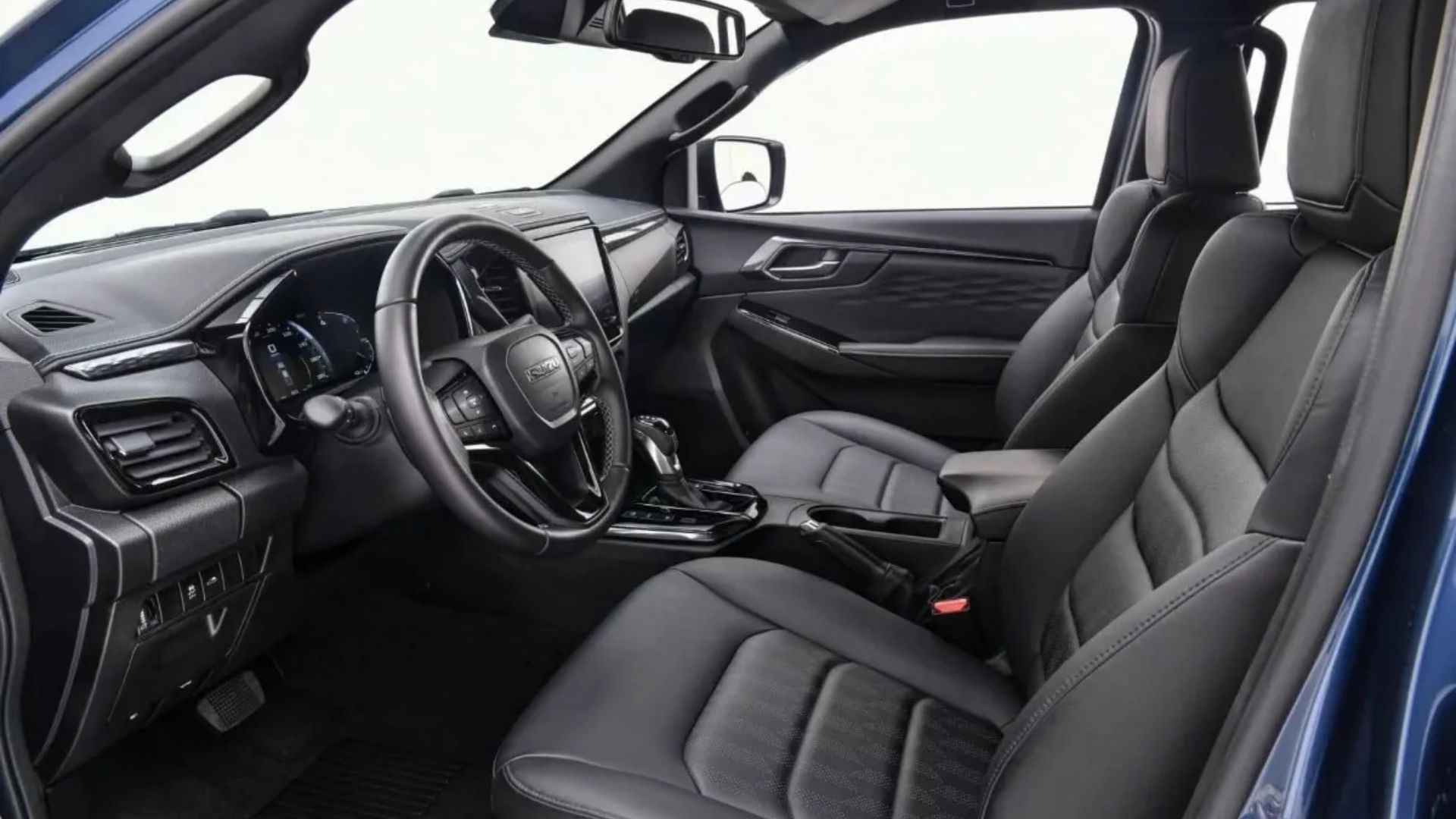
Instead of launching an electric pickup focused only on urban environments, the brand maintained the foundation of a work vehicle and adapted it with a system featuring two electric motors.
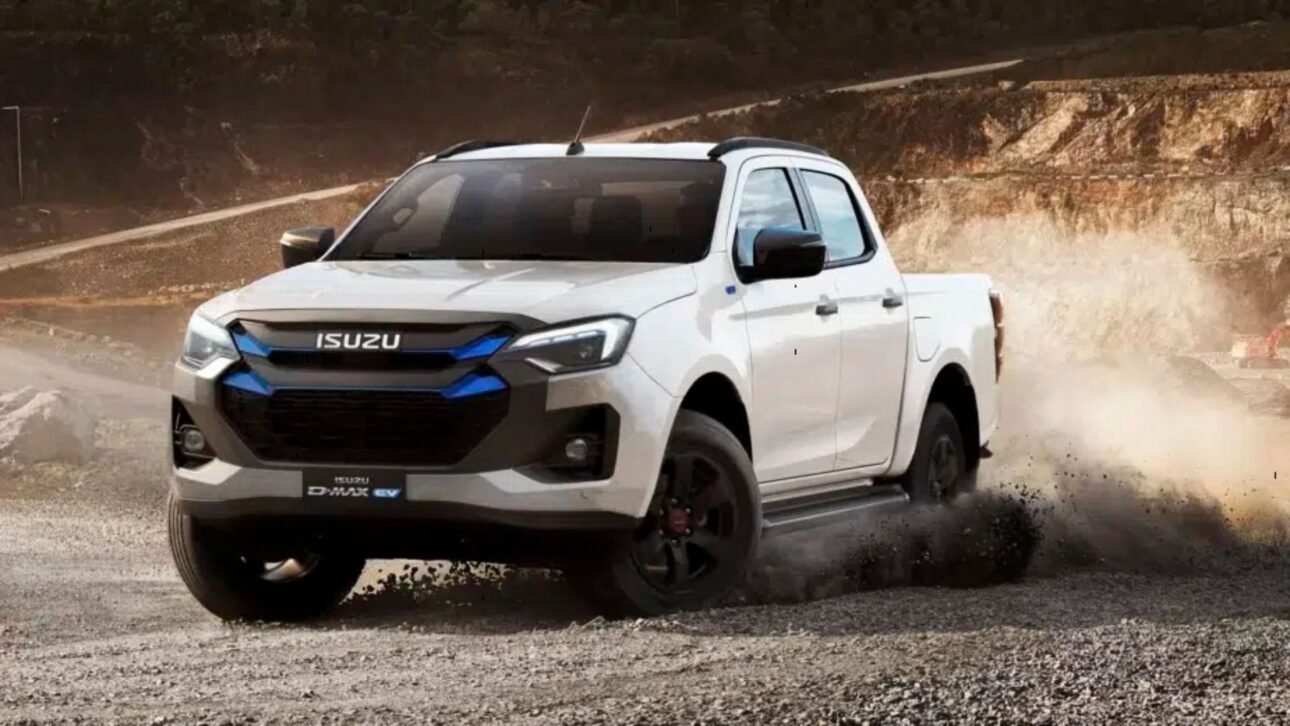
In the manufacturer’s global communication, the D-Max EV is listed with 140 kW of maximum power, 325 Nm of torque, speeds exceeding 130 km/h, and a 66.9 kWh battery.
The British page for the model provides detailed calibration for that market, with 149.3 kW of combined power and 347.6 Nm of total torque, as well as acceleration from 0 to 62 mph in 10.1 seconds.
This setup is supported by e-Axles on both axles, a solution adopted to sustain the integral 4×4 traction without abandoning the severe usage proposal.
Isuzu also reports four levels of regenerative braking, an Eco mode, and recharging in alternating current of up to 11 kW or in direct current of up to 50 kW.
In practice, the manufacturer speaks of about 10 hours to charge from 0% to 100% in AC and approximately 1 hour to go from 20% to 80% in DC, numbers compatible with a more planned professional usage routine.
The official range helps clearly define the role of the pickup.
The brand reveals 263 km in the WLTP cycle and 361 km in the urban WLTP City mode, without selling the idea of long, improvised crossings.
The proposal, at least at this initial moment, is to serve operations with predictable routes, technical fleets, and tasks where cargo, towing, and traction weigh more than range records.
Electric 4×4 Pickup Targets Professional and Off-Road Use
The heavy-duty use data is the main argument for the D-Max EV.
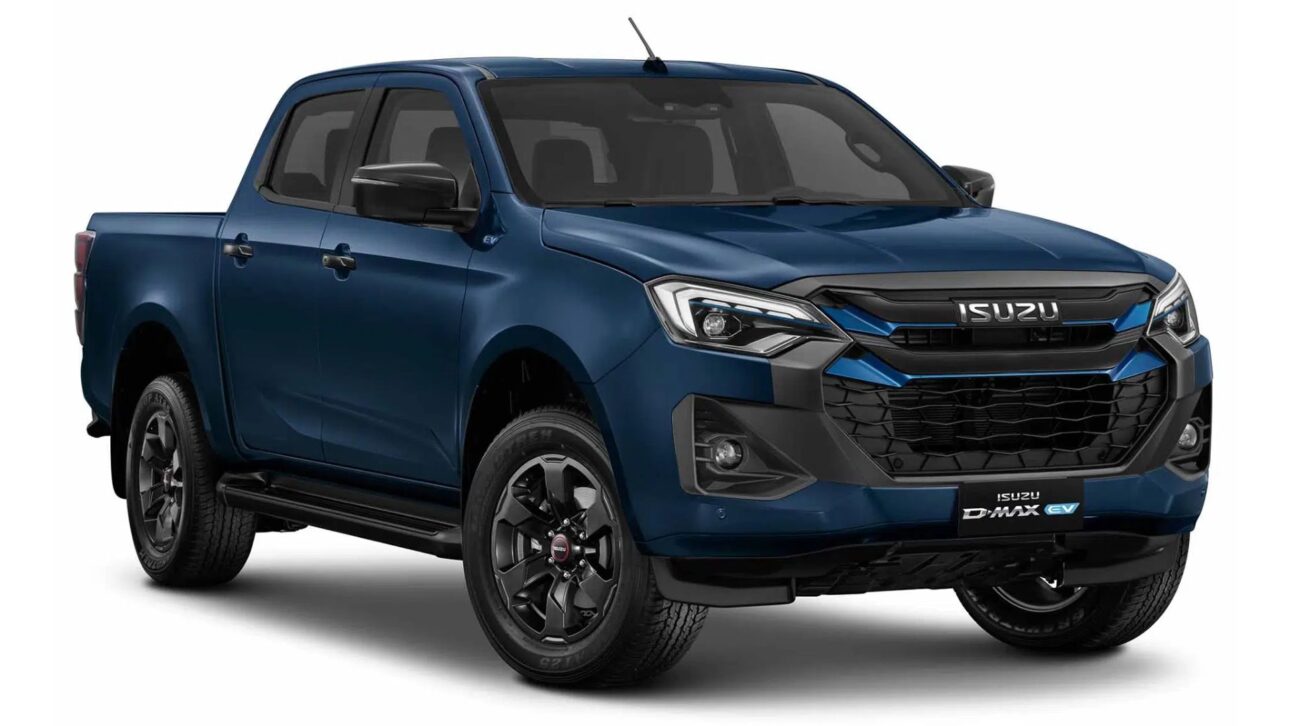
In the global specifications, Isuzu reports maximum payload of 1,010 kg and towing of 3,500 kg, precisely the two numbers that usually define the credibility of a mid-size pickup in commercial applications.
In the British materials, the company emphasizes that the model delivers over 1,000 kg of payload, with the same aim of preserving the functionality of the diesel versions.
Off the asphalt, the manufacturer also supports the proposal with typical measures of the segment.
The official D-Max EV page in the UK lists 210 mm of ground clearance, 600 mm of water crossing capability, an approach angle of 30.5 degrees, and a departure angle of 24.2 degrees.
In another communication to the British market, Isuzu repeats these figures while presenting the model as a work electric vehicle, not just a technological showcase.
The suspension engineering helps to explain this speech.
Isuzu states that it replaced the rear leaf spring with a De-Dion system, a solution used to improve dynamic behavior and refinement without sacrificing load capability.
In the British presentation, the brand claims that the new configuration contributes to reducing noise and vibration and making the pickup more stable, especially in daily use.
Isuzu D-Max EV Technology Focuses on Efficiency and Comfort
The offering expected for the UK also indicates that the D-Max EV will not arrive as a basic transition version.
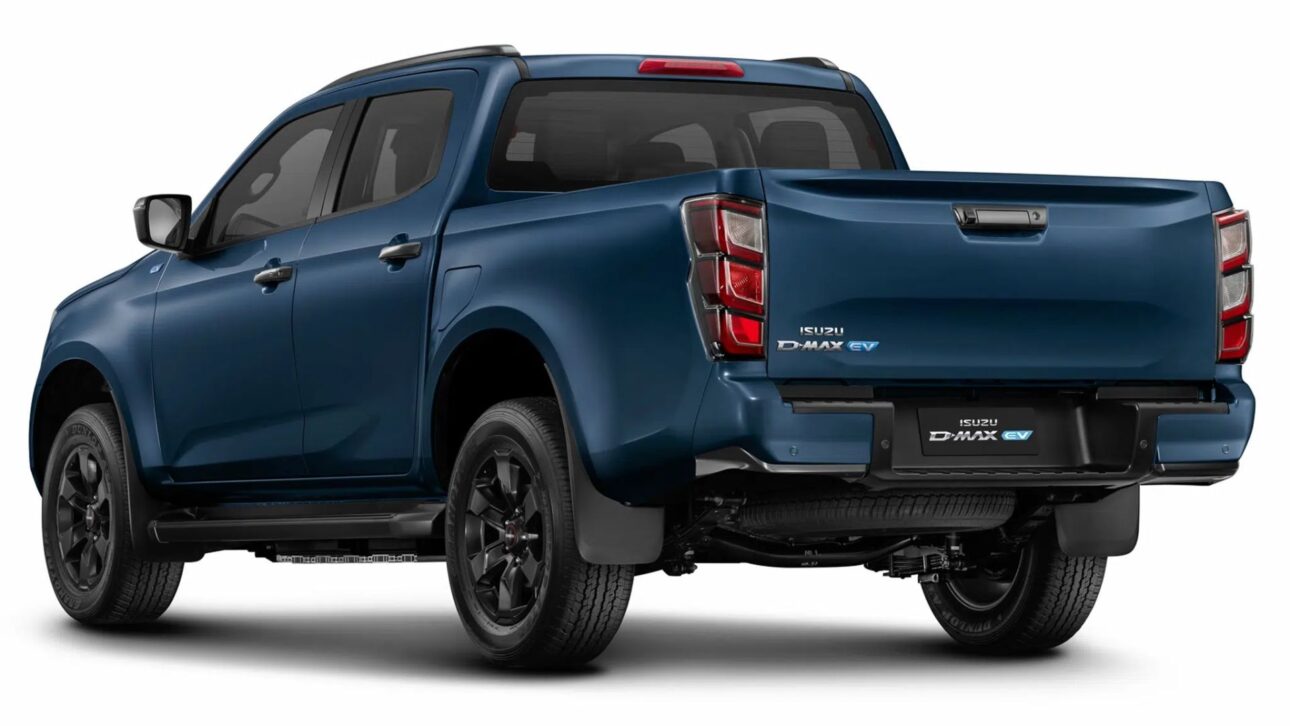
According to Isuzu UK, the pickup will be sold in variants equivalent to the current DL40 and V-Cross, which are among the highest trims in the D-Max line in that market.
This indicates a positioning strategy that combines commercial appeal and a broader convenience package, even though the main discourse continues to center on operational capacity.
The industrial schedule is already one of the most concrete signs of this offensive.
Isuzu announced on April 29, 2025 the start of mass production of the D-Max EV in Thailand.
At the same time, it confirmed the shipment of left-hand drive units to European markets in the third quarter of 2025 and stated that production of the right-hand drive version would begin at the end of that year, with sales in the UK starting in 2026.
In a subsequent statement, the UK subsidiary added that the first deliveries with right-hand drive are scheduled for February 2026.
The validation phase outside the launch environment has also already begun.
Isuzu UK confirmed a partnership with National Grid Electricity Distribution to test the D-Max EV with field professionals before reaching the end customer.
According to the company, eight engineers are using the pickup in regions of the Midlands, South Wales, and Southwest England, in routines that include difficult terrain, off-road travel, and the transportation of work equipment.
This type of testing helps to lend weight to the project in a segment that still approaches electrification with caution.
The market has already assimilated electric motors in hatchbacks, sedans, and SUVs, but remains more resistant when the conversation involves mid-size pickups with real demands for cargo, towing, and severe use.
By maintaining the combination of 1 ton of payload, 3.5 tons of towing, and integral 4×4 traction, Isuzu aims to demonstrate that the change in propulsion does not need to dismantle the logic that made the Hilux and other equivalent models global references among medium commercial vehicles.