






 Portuguese
  Spanish


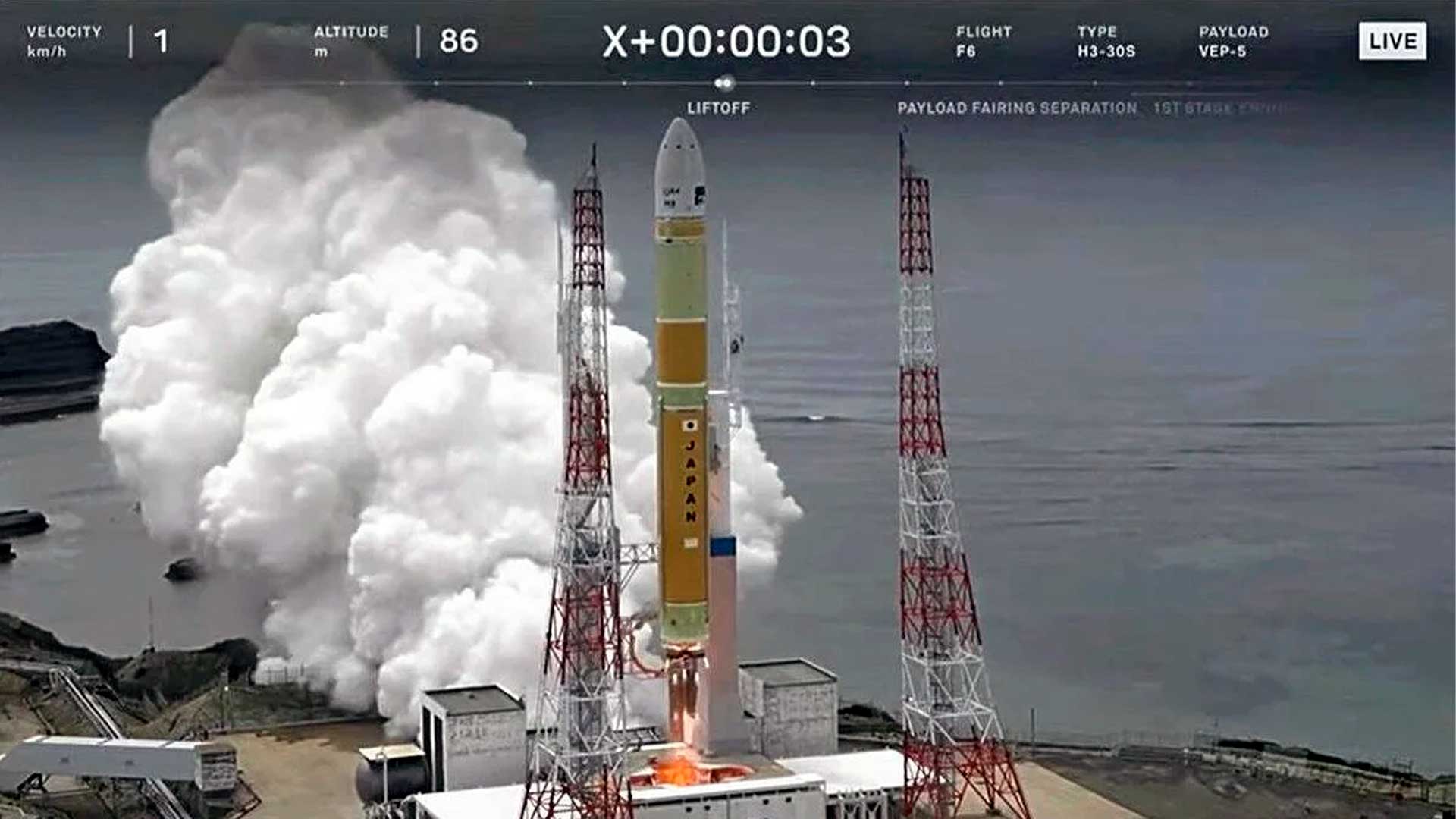

Launch conducted on June 12 marked the return of the main Japanese rocket and tested a configuration created to reduce costs and enhance the country’s competitiveness in the space market
Japan managed to launch its main rocket again after months of uncertainty caused by a failure that prevented a navigation satellite from reaching the planned orbit. The H3 successfully launched on June 12, 2026, carrying six small satellites and a payload intended to assess the vehicle’s performance.
The launch took place at 9:53:59 AM Japan time, from the Tanegashima Space Center in the south of the country. According to the Japan Aerospace Exploration Agency, JAXA, the rocket followed the planned trajectory and its second stage reached the orbit determined for the mission.
About 16 minutes after departure, the separations of the PETREL and STARS-X satellites were confirmed. The system also sent release commands for the other four payloads, called BRO-22, VERTECS, HORN-L, and HORN-R.
-
São Paulo Unveils Latin America’s Largest Underground Reservoir, Holding 900 Million Liters, in the Greater São Paulo Area

-
Chinese Teen Wins Gold in Germany for Invention Turning Air Moisture into Underground Irrigation in Drought-Stricken Areas

-
Desertification Threatens Brazil’s Caatinga: 85% of Semi-Arid Region Affected, 30 Million at Risk, and Efforts Underway to Restore 10 Million Hectares by 2045
-
Few People Realize Earth Spins at 1,670 km/h Unnoticed: Explained by Gravity and Brain Perception





The result carries more weight than a routine launch. The flight marked the debut of the H3-30 configuration, considered a simpler and more economical alternative, and represented a response from the Japanese space program after the loss of an important mission in December 2025.
H3 returned to flight after a second stage failure


The previous more problematic launch occurred on December 22, 2025, when another H3 rocket was carrying the Michibiki 5, a satellite part of the Japanese positioning and navigation system. The second stage engine failed to correctly perform a new ignition and ended its operation earlier than expected.
As a result, the satellite was not placed in the planned orbit. According to information released by AFP, the failure interrupted a sequence of advances in the program and increased pressure on those responsible for developing the new Japanese rocket.
After the accident, technicians conducted additional checks on the vehicle and components related to payload support. The June mission was also used to collect new flight data, necessary to increase the reliability of future operations.
The 2025 problem was not the first faced by the H3. In March 2023, during the inaugural flight, the second stage also experienced a failure, leading controllers to destroy the rocket and causing the loss of the ALOS-3 Earth observation satellite.
New configuration replaces side boosters with three main engines
The big news of the flight was the configuration known as H3-30. It uses three LE-9 liquid engines in the first stage and does not rely on the large solid boosters installed on the sides in other versions of the H3 family.
This structure was designed for missions that do not require the maximum power offered by heavier configurations. By removing the side boosters, engineers aim to simplify the vehicle, reduce the number of components, and lower the launch cost.
According to the Associated Press, the H3-30 was created as a lower-cost version capable of helping Japan compete in a market dominated by companies that launch rockets frequently. The model offers a capacity of over four tons for certain sun-synchronous orbits, mainly used by Earth observation satellites.
The LE-9 engines burn liquid hydrogen and oxygen and were developed with an architecture that seeks to reduce the number of parts. Some components also employ advanced manufacturing techniques, including 3D printing, to make production less complex.
The H3 family was designed to accept different combinations. Depending on the mission, the rocket can use two or three main engines, as well as none, two, or four solid boosters, allowing capacity, price, and performance to be adapted to each client’s needs.
Six satellites will test Earth observation and space debris combat
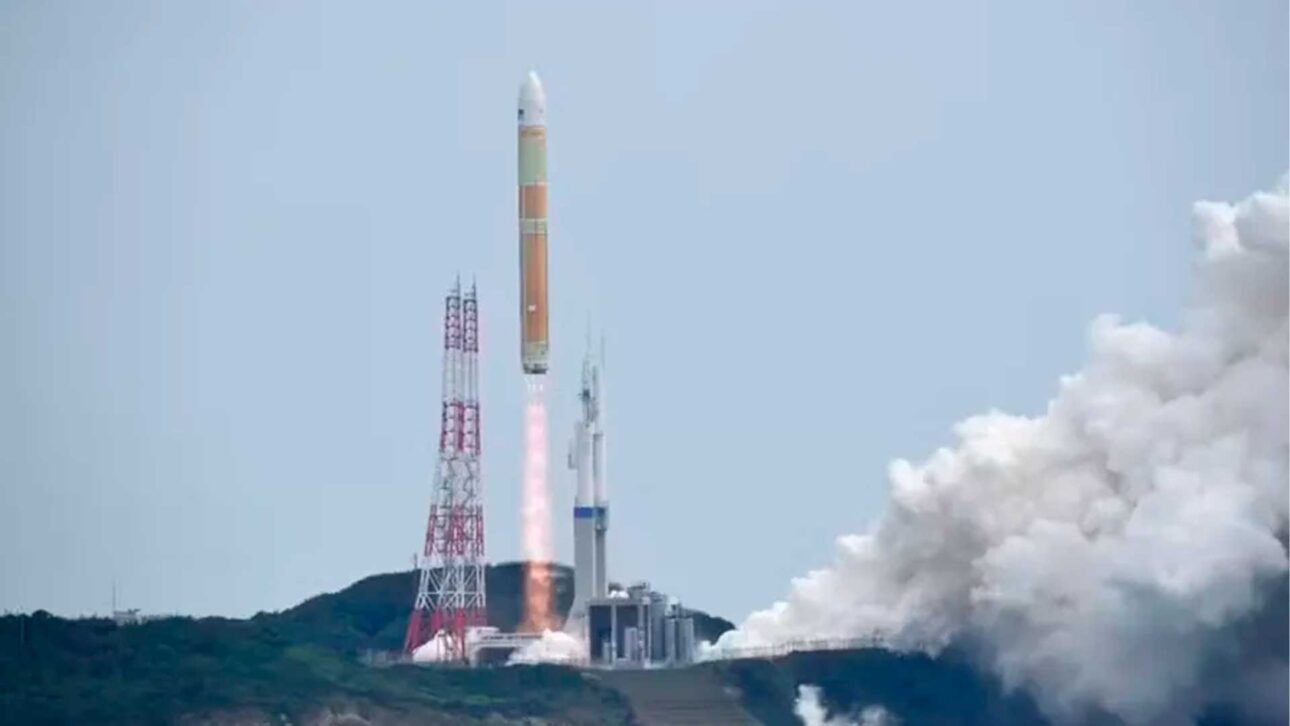
Although the main payload of the flight is an evaluation equipment for the rocket itself, the remaining capacity was used to transport six small satellites from universities, companies, and research centers. The payloads have quite different scientific, environmental, and commercial objectives.
The PETREL, also called Umitsubame, was developed by the Tokyo Institute of Science. Weighing approximately 65 kilograms, it carries multispectral and hyperspectral cameras to observe oceans and land areas, as well as an ultraviolet telescope intended for the study of astronomical objects.
The mission’s technical documentation states that the image data may be used in research and commercial applications. Sensors of this type can identify characteristics not easily perceived in common photographs, such as differences in vegetation, water, and materials present on the surface.
The STARS-X, from the University of Shizuoka, will conduct a more unusual experiment. The satellite will attempt to extend a cable of approximately one kilometer in space, over which a small robot can move to control the system.
The structure includes a net intended to demonstrate the capture of an object simulating space debris. The test does not mean that the satellite will immediately start removing real debris from orbit, but it may aid in developing future technologies to deal with abandoned equipment around Earth.
The BRO-22 is part of a commercial constellation specialized in detecting radio signals emitted by vessels. The technology can be used to monitor maritime traffic and identify suspicious activities, including possible illegal operations in oceanic areas.
Satellite will investigate a mysterious light present in the Universe
Another payload transported was the VERTECS, a small satellite developed with the participation of Japanese universities, institutions from Taiwan, and researchers linked to the space sector. Its objective is to observe the so-called extragalactic background radiation in different bands of visible light.
This radiation gathers luminous signals produced throughout the history of the Universe. Some measurements indicate that the observed brightness may be greater than explained solely by the sum of known galaxies, raising questions about the existence of yet unidentified sources.
The VERTECS is expected to observe a wide region of the sky with a telescope of a large field of view. Scientists hope that the information will help investigate the formation of the first cosmic structures, stars scattered around galaxies, and other possible origins of this “mysterious light”.
The HORN-L and HORN-R satellites, in turn, will test devices developed to accelerate the removal of equipment that has already ended its activities. Each unit can deploy a membrane to increase contact with the outermost layers of the atmosphere.
This increase in air resistance tends to gradually reduce the object’s altitude, causing it to re-enter the atmosphere more quickly. The proposal is to prevent small satellites from remaining for many years as space debris and increasing the risk of collisions.
Success eases pressure on the Japanese space program
The H3 was developed by JAXA in partnership with Mitsubishi Heavy Industries to replace the H-IIA, a rocket that accumulated a history of high reliability. The new vehicle needs to offer not only safety but also prices and timelines capable of attracting commercial missions.
The pressure is high because satellite companies can hire launches in the United States or other countries. Reuters reported that Japan is trying to expand its national launch capacity to support scientific, commercial, and security projects without relying excessively on foreign rockets.
The successful mission does not erase previous problems, but it shows that the program managed to resume operations after the December failure. Each new flight will be crucial to demonstrate that the H3 can function regularly, and not just complete isolated missions.
The long-term goal involves increasing the frequency of launches and transforming the H3 into a competitive international option. For this, Japan will need to reduce costs, meet schedules, and build a consistent track record of successful missions.
Space market demands cheaper rockets and frequent launches
The launch market has changed rapidly with the advancement of partially reusable rockets and shared services for small satellites. Universities and companies have started to seek cheaper trips, even when they need to share the rocket with various payloads.
In this scenario, the flexibility of the H3 can be an advantage. Japan will be able to use simpler versions for smaller payloads and configurations with solid boosters for heavy satellites or missions that require more energy.
The launch of six secondary satellites also demonstrates how an experimental flight can be leveraged to support different projects. This practice reduces the waste of capacity and allows smaller institutions to reach space without hiring an entire rocket.
However, price and capacity are not enough. Commercial operators need to know that the rocket will be available on the scheduled date and that the payload will have a high probability of reaching the correct orbit.
Upcoming flights will show if the recovery will be lasting
The data collected during the debut of the H3-30 will be analyzed to confirm the performance of the engines, the second stage, and the systems responsible for payload separation. The satellites will also need to establish communication and begin their operations for their objectives to be effectively fulfilled.
The launch represents an important victory for Japan, but the true test will be the repetition of this performance in the coming years. The country managed to return to space with a potentially cheaper version, but it will still have to prove that the H3 can combine reliability, frequency, and competitive cost against the industry leaders.


