






 Portuguese
  Spanish
  5 min of reading
  0 comments


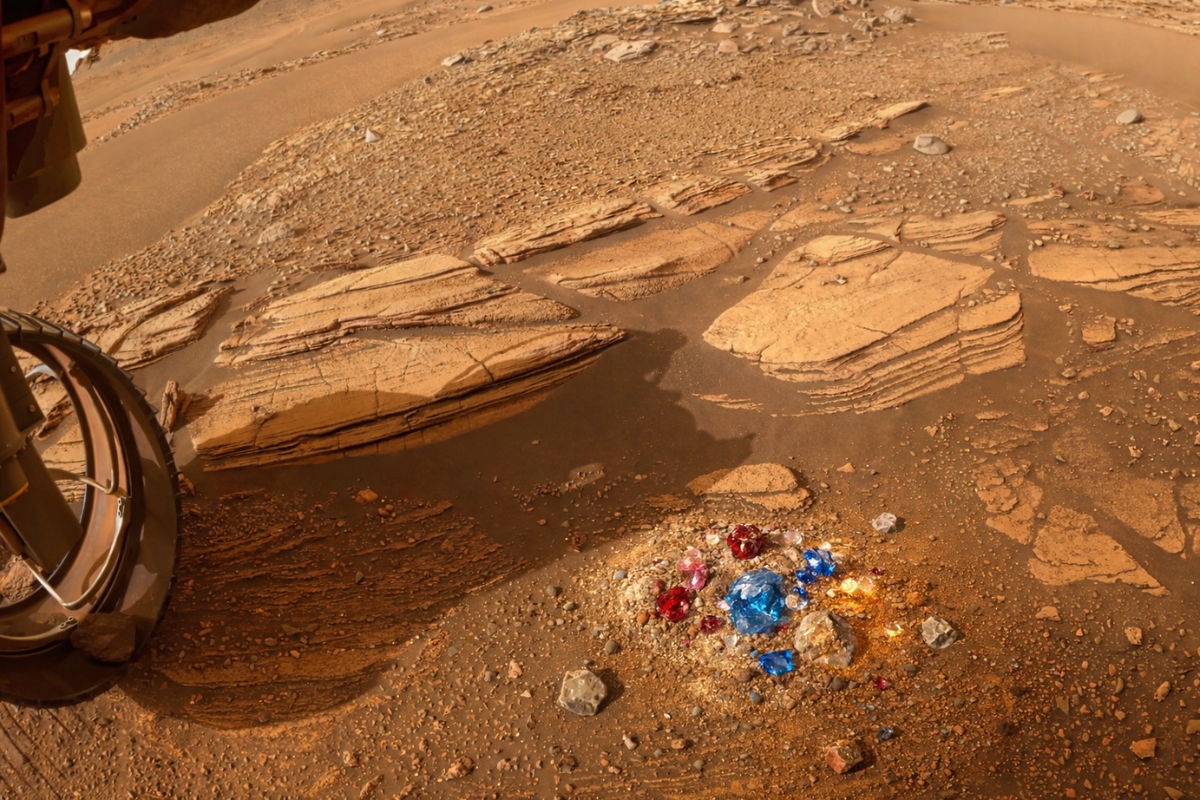
Perseverance detected chromium corundum in rocks at the edge of Jezero on Mars, and the finding intensifies the search for the planet’s oldest formations.
The Perseverance rover found a rare chemical signature on Mars in three light-colored rocks scattered along the edge of the Jezero crater. The signal points to chromium corundum, a combination linked on Earth to materials from the ruby and sapphire group.
The discovery appeared in one of the oldest areas ever visited by the mission, outside the crater’s interior, where the robot began studying terrain thrown to the surface by a colossal impact that occurred about 3.9 billion years ago. This places the finding at the center of the scientific debate about how primitive Mars was heated, fractured, and altered over time.
Researchers are still not treating the material as confirmed Martian jewels. The grains are tiny, estimated to be less than 200 micrometers, and do not appear directly in the rover’s images, which keeps the classification at the mineral level and not as confirmed gemstones.
-
Space technology used to search for water on Mars is now hunting for invisible leaks under the streets of São Paulo, using satellites, AI, and chlorine signals to help Sabesp recover up to 6.7 billion liters of water.

-
Japan sends ship to extract mud rich in rare earths at nearly 6,000 meters deep in the Pacific, attempts to lift 350 tons per day from the seabed, and transforms sediments near Minamitori Island into a strategic weapon to reduce dependence on China.
-
Venus Aerospace promises a rotating detonation hypersonic engine that takes the Stargazer to Mach 9 and crosses oceans in 1 hour, but the flight that made history barely surpassed the speed of sound.

-
Brazilian student creates a cheap formula that makes plants grow up to 90% faster and wins an award in a global scientific competition.





What triggered the alert on the rover
The clue emerged when the SuperCam fired its green laser at the rocks and measured the light emitted by the material. This Perseverance instrument was designed to examine chemical composition and mineralogy from a distance, reaching small targets with detailed analysis directly from the Martian surface.
It was this luminescence reading that distinguished the finding from a common rock. Instead of a broad and diffuse signal, the team saw a very specific signature, capable of indicating elements in small concentrations within the mineral.

The chemical signal behind the finding
According to the 57th LPSC, annual lunar and planetary science conference, the analysis recorded a double peak at 692.7 and 694.1 nanometers, a pattern consistent with chromium occupying aluminum positions in corundum. It is this chemical set that brings the Martian material closer to the realm of rubies and, under other conditions, also to sapphires.
In simple terms, corundum is a mineral primarily composed of aluminum and oxygen. On Earth, when this structure receives certain elements in small quantities, it can acquire the colors and characteristics associated with the most well-known gemstones.
Why it is not yet possible to confirm Martian jewels
The point that holds the scientific headline is the size of the detected material. As the grains are very small and do not appear directly in the high-resolution images from the rover, scientists still cannot finalize the fine composition needed to stamp the find as Martian ruby or Martian sapphire without a doubt.
In the practice of planetary laboratory, this makes a difference. The team can strongly assert that they found chromium corundum, but they are still working to understand if the material fits into a specific variety and in what environment it was formed within the Martian crust.

What the Jezero rim reveals about ancient Mars
The Jezero rim has become a priority because it marks the transition between rocks that filled the crater after the great impact and materials pulled from deeper regions of the planet. The mission itself describes this phase as an entry into very ancient terrains, capable of holding part of Mars’ early history.
In another line of research, Perseverance had already found very aluminum-rich light rocks in the region, a sign of intense alteration processes in the planet’s ancient history. The new record of corundum reinforces this interpretation and suggests that Jezero may be exposing rare materials that have been hidden for billions of years.
How these stones may have formed
The strongest hypothesis today links the find to giant impacts, extreme heat, intense pressure, and fluid circulation within the rocks. The scientific summary points out that, due to the position of the material near impact breccias and the very small size of the grains, the formation by impact metamorphism has gained traction within the team.
This is noteworthy because Mars does not provide conclusive evidence of plate tectonics like Earth. If corundum did indeed appear in this impact context, the discovery helps explain how complex minerals can arise on the red planet through different pathways than those found here.
What comes next for Perseverance
The next step is to expand the measurements and compare these readings with other targets on the crater rim. The mission is precisely in an area chosen to study some of the planet’s oldest rocks, which increases the value of each new chemical signature found by the rover.
Even without the final confirmation of rubies or sapphires in the strict sense, the result already weighs in on the scientific debate. Perseverance has opened a new line of investigation into rare minerals, ancient impacts, and the deep evolution of Mars.
The immediate effect of this discovery is on the geological map of the planet. Each new reading at the edge of Jezero increases the chance of reconstructing how heat, pressure, and water altered the Martian crust in the early chapters of solar history.
If the upcoming data confirms the origin and extent of this material, Mars may gain one of the most intriguing mineral signatures ever recorded by the mission. And this changes the significance of Jezero in the race for answers about the extreme past of the red planet.
With information from DailyGalaxy.


Be the first to react!