Portuguese
  Spanish


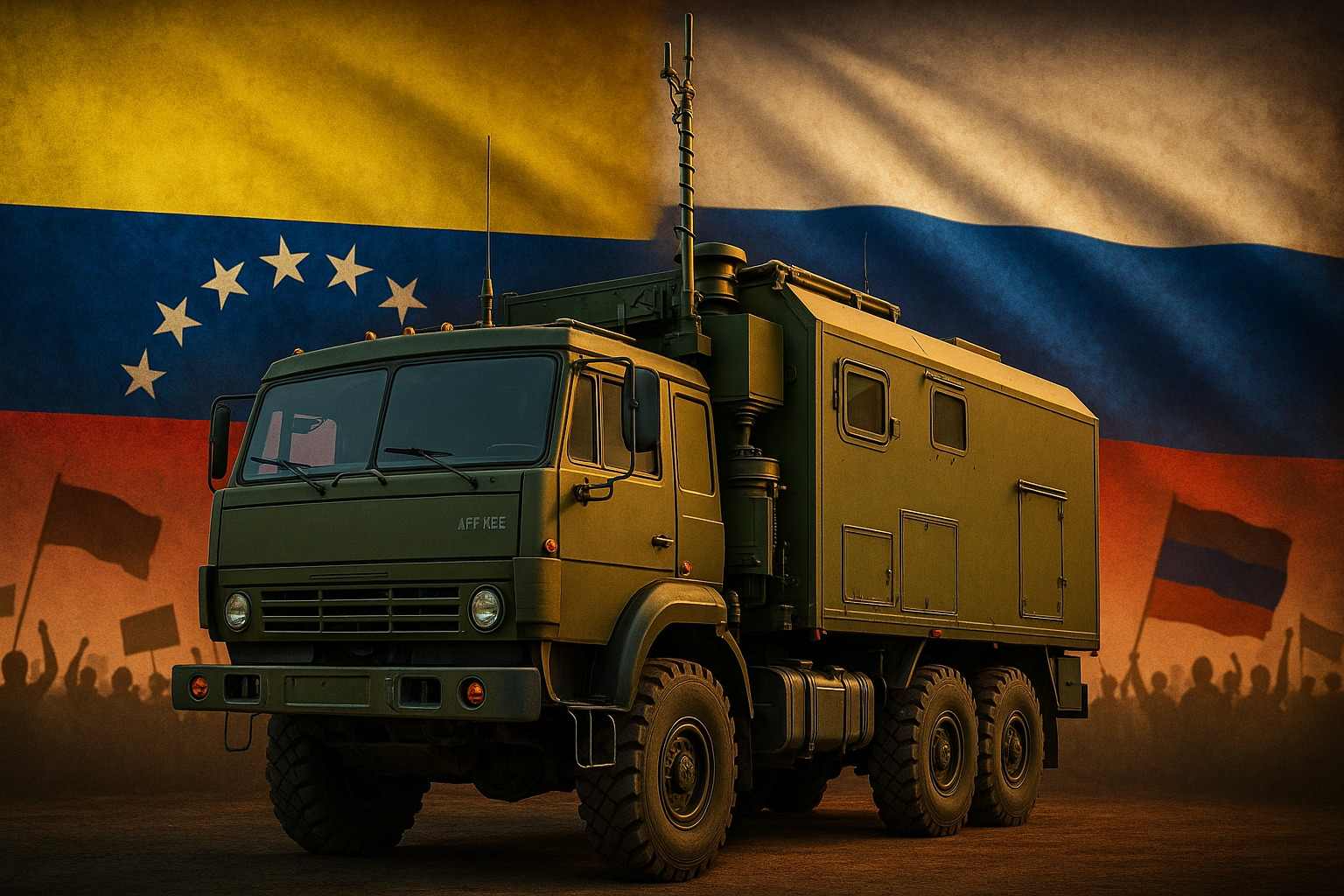

Classified Files Show That Moscow Transferred to Venezuela An Advanced Command and Surveillance System Used Only by Military Powers. The Technology Allowed Nicolás Maduro to Coordinate Operations Against Protests and Expand Control Over Security Forces
Leaked documents revealed that Russia secretly provided advanced military technology to the government of Nicolás Maduro to strengthen its internal control capacity and suppress mass protests.
The transfer involved components of the sophisticated C4ISR system — an acronym for command, control, communications, computers, intelligence, surveillance, and reconnaissance — considered one of the most powerful tools available to modern armed forces.
These systems integrate different military and technological layers into a single operational network, connecting troops, equipment, and strategic information in real time.
-
The Arctic is no longer just a frozen region and is becoming a new military board with the opening of maritime routes, expansion of bases, nuclear icebreakers, and competition among Russia, NATO, the United States, and China.

-
U.S. Dismisses Brazilian Foreign Ministry’s Military Risk Warning as “Absurd,” Cites Brazilian Criminal Gangs Operating in the U.S. Since May 2026
-
Ukraine War Impacts Brazilian Fuel Supply: Russian Diesel Imports Drop 65% in June, Brazil Turns to US and India Amid Market Concerns

-
Chinese Nuclear Submarine Launches Simulated Warhead Missile in Pacific, Heightening Regional Tensions Amid Naval Drills with Russia Near Qingdao; New Zealand and Papua New Guinea Warn of Persistent Chinese Military Presence



Only a limited number of countries, such as United States, Russia, China, and some NATO members, possess complete versions of C4ISR, whose development requires immense resources and highly specialized technological know-how.
Exports of this type of technology are extremely rare and usually restricted even to strategic allies.
Therefore, the revelation that Moscow transferred components of the system to Venezuela surprised international analysts and raised concerns about the use of these resources for internal repression.
The Secret Operation: From the SWORD Project to Caracas
The first revelation about the export of C4ISR emerged when the hacker group BlackMoon published documents regarding the transfer of Russian technology to China, under a project called “SWORD.” The operation attracted global attention, and experts from the Royal United Services Institute (RUSI) warned that such capabilities could be used in a potential future invasion of Taiwan.
However, additional investigations conducted by UNITED24 Media showed that China was not the only beneficiary.
Parts of the system, including the mobile command unit APE-MB-E, were sent to Venezuela, where they directly contributed to keeping Maduro in power even amid massive protests against his government.
The obtained documents contain internal correspondence between the Russian state arms export agency and its suppliers, proving that Moscow offered the systems to Caracas as early as 2018.
The decision represented a strategic exception, as until then similar technologies had only been shared with Belarus, a close ally of Russia.
The Use of APE-MB-E in Internal Control
The APE-MB-E unit received by Venezuela is described as a highly equipped mobile command post.
The vehicle contains integrated computers, satellite communication, video surveillance systems, and GPS navigation.
This structure allows for the creation of secure communication networks between military and security units, as well as providing leadership the ability to monitor troop movements and coordinate actions of police, army, and intelligence agencies in real time.
Although officially described as an “emergency response system,” the equipment can easily be employed for centralized control during demonstrations or civil disturbances. The analyzed letter confirms the readiness to deliver eight APE-MB-E units to the “Client No. 862” — codename used for Venezuela — and plans for the development of an adapted version with interface and documentation in Spanish.
Contract and Financial Concessions
The contract, with a duration of 25 months from the date of signing, was formalized by Rosoboronexport, the Russian state arms export monopoly.
Additionally, the company even requested a reduction in the price of the Venezuelan order, signaling the geopolitical importance of the agreement to Moscow.
The transfer of C4ISR technology to Venezuela exposes the depth of military cooperation between the two countries and reinforces the Kremlin’s strategy of supporting allied regimes outside its traditional circle.
For Maduro, the arrival of the system meant a decisive reinforcement of his ability to maintain internal control — even in the face of large-scale popular protests.