Portuguese
  Spanish


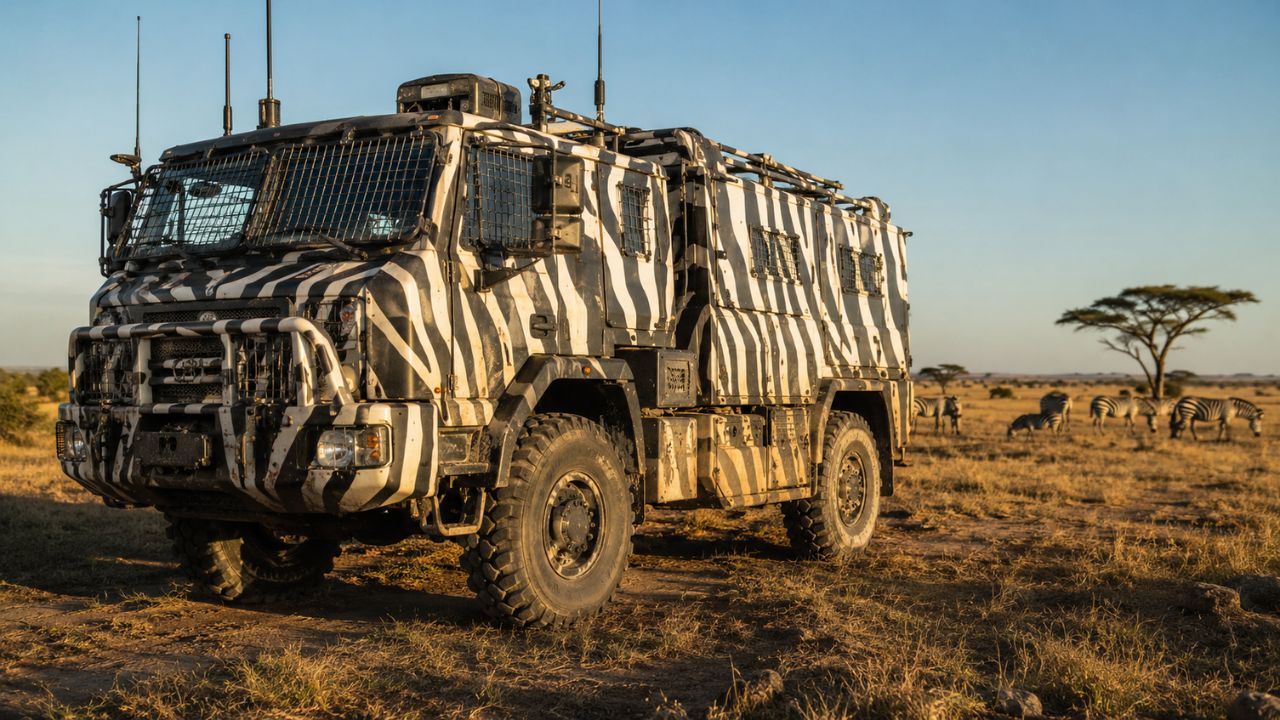


Discover how the zebra camouflage, created in 1917 to deceive submarines, became Russia’s new bet against Ukraine’s autonomous drones.
The zebra camouflage has drawn attention on European battlefields for its potential ability to confuse advanced reconnaissance systems used by military drones. The effectiveness of this strategy is directly related to the degree of autonomy of the unmanned aerial vehicles employed by Ukrainian forces.
According to artificial intelligence and aerospace sector expert Todd E. Humphries, the application of striped patterns can be effective in the short term, as autonomous systems are trained to identify specific visual shapes and characteristics of heavy vehicles. By fragmenting these predictable silhouettes with irregular lines, the zebra camouflage aims to hinder the automatic recognition of targets, reducing the efficiency of detection algorithms used in modern military operations.
The debate about the expiry date of the new visual barrier
Despite considering the tactic valid against digital optical sensors, Humphries issues an important warning and highlights that this protective advantage carries a short expiry date in the current military scenario.
-
Flushing Toilet Paper in Brazil Could Gradually Damage Home Plumbing, Experts Warn

-
Meet the Fascinating Cassowary: The Bird That Resembles a Dinosaur, Runs Like an Athlete, Crosses Rivers with Ease, and Plays a Crucial Role in Tropical Forests
-
Brazil Deploys Water-Landing Ambulance Planes in the Amazon, Cutting Travel Time from 3 Hours to 12 Minutes to Reach Isolated Communities

-
Early Commercial Flights Used Wicker Chairs Without Seatbelts to Save Weight Before Modern Safety Standards Transformed Air Travel


The debate among international analysts about the method’s limitations is based on the following key points:
- The computational neural networks that guide Ukrainian drones can be quickly retrained to learn to decode the new visual patterns.
- Ukraine also actively uses human operators to remotely guide their aerial equipment, and the contrasting lines cannot deceive the eyes of real soldiers.
- The painting tactic works only as a temporary protective barrier for the fleet, and not as a definitive and lasting defense solution in the field.
On the other hand, from the Ukrainian side, the response to the visual trick was met with total disdain and confidence by the forces operating on the front line. Demonstrating conviction in the destructive capability of their troops, Major Mykola Kolesnyk, commander of the 422nd Independent Unmanned Systems Regiment
of Ukraine, dismissed the effectiveness of the Russian tactic in an interview given to Army 3 magazine. The officer was emphatic in declaring that the bizarre painting will not protect enemy transport fleets against the firepower of his regiment:
“Let’s attack these zebras, ostriches, rhinoceroses, whatever they are painting for themselves. I state with full responsibility that this will not prevent us from burning this equipment if it is painted that way.”
Origin of the illusion technique
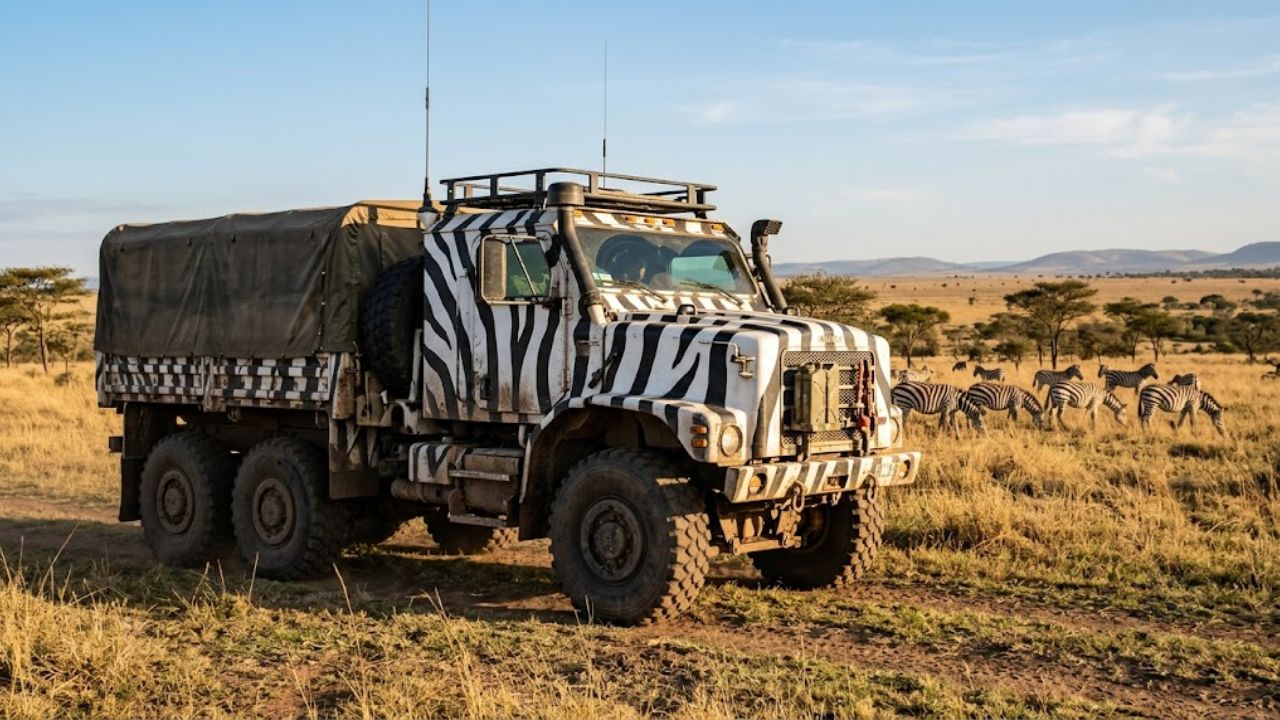
The curious Russian strategy that caused bewilderment on social media consists of applying a chaotic black and white paint on logistic trucks of the Kamaz and Ural models. This visual engineering technique, known as zebra camouflage or Dazzle, refers to concepts developed over a century ago by British naval artist Norman Wilkinson.
Created in 1917, the method was designed to protect allied ships from German submarine attacks during World War I. At the time, the main objective was not to hide the vessels, but to confuse the enemy regarding their speed, direction, and type.
For this, contrasting geometric patterns in black and white were used, capable of hindering human observation conducted through periscopes. The central concept of the technique was based on visual deception, making it more difficult for enemy operators to correctly estimate the ships’ trajectory.
In modern warfare, the logic remains similar, although the target of the strategy has changed. Instead of deceiving human observers, the chaotic paint applied to the Kamaz and Ural trucks aims to interfere with the computer vision systems used by drones.


The stripes and irregular shapes break the predictable contours of the vehicles, making it difficult for them to be identified by artificial intelligence algorithms programmed to detect, track, and automatically destroy targets.
In this way, zebra camouflage continues to be a tool of visual deception, but now aimed at sabotaging the reading done by machines instead of human perception.
Source: O Antagonista