






 Portuguese
  Spanish


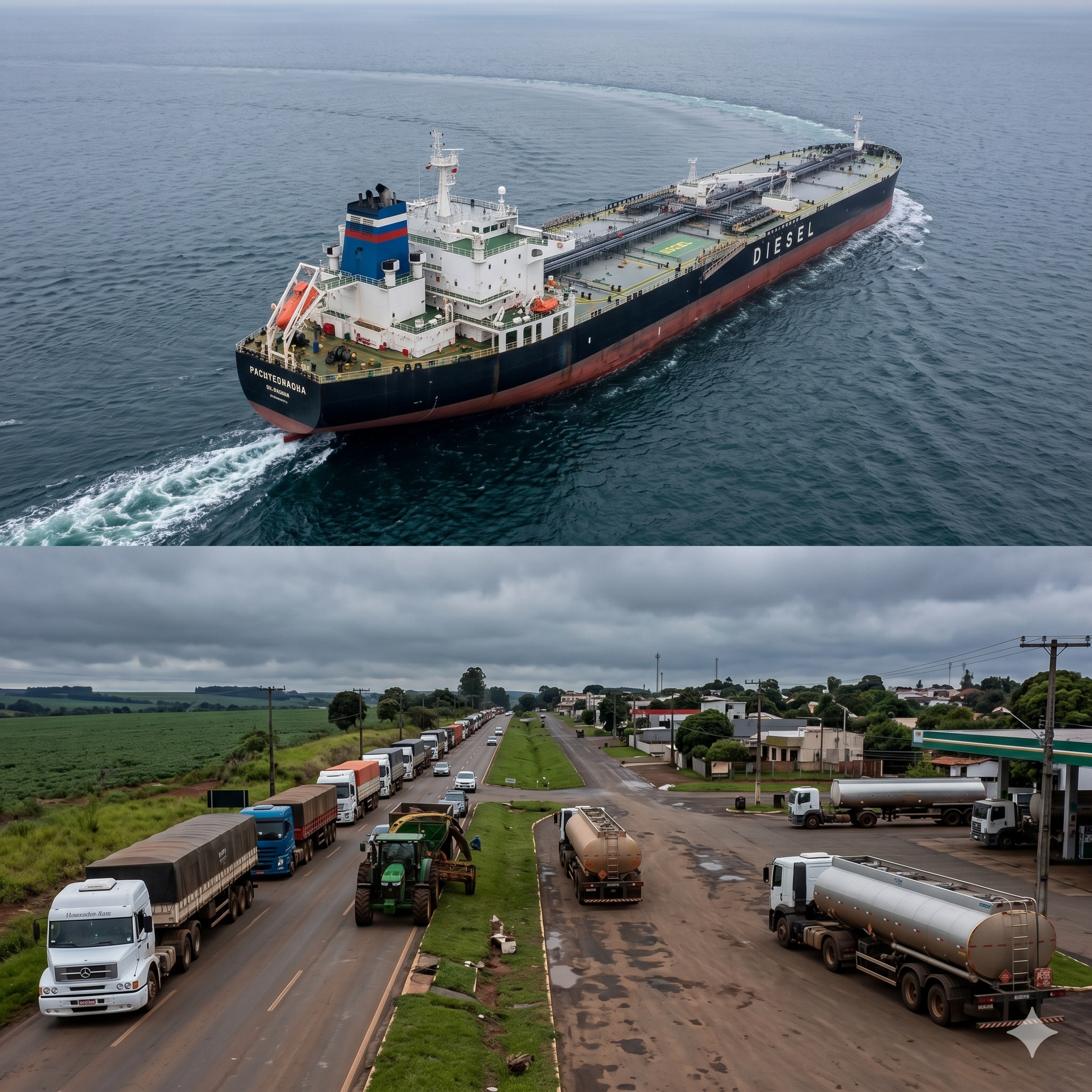

Ships with Russian diesel divert from Brazil amid global crisis, exposing supply risk and pressure on fuel prices.
On April 27, 2026, market data cited by the agency Reuters revealed an unusual and strategic movement in the global fuel trade: ships loaded with Russian diesel that had Brazil as their final destination changed course mid-voyage to serve other markets. The vessels had departed from the port of Primorsk, Russia, with fuel classified as low-sulfur diesel, a standard widely used in road transport and logistics. Each ship carried about 37,000 tons, and at least two of them altered their destination after traveling a significant part of the route towards Brazil.
In addition, two other ships, with about 106,000 combined tons, were left without a defined destination during transit, awaiting better market conditions for unloading. The total volume involved exceeds 140,000 tons, an amount sufficient to significantly impact supply in regions dependent on imports.
Route change was motivated by global price surge and competition for available cargoes
The redirection of the cargoes did not occur due to logistical problems but was a commercial decision. According to energy market operators, the change was driven by the abrupt rise in international diesel prices, caused by tensions in the Middle East, especially the conflict involving Iran and the risks associated with the Strait of Hormuz.
-
Chinese Nuclear Submarine Launches Simulated Warhead Missile in Pacific, Heightening Regional Tensions Amid Naval Drills with Russia Near Qingdao; New Zealand and Papua New Guinea Warn of Persistent Chinese Military Presence

-
Ayatollah Ali Khamenei’s Funeral Draws 15 to 20 Million in Tehran, Calls for Revenge Against Trump After Joint Israel-U.S. Attack

-
U.S. Establishes Permanent Embassy in Jerusalem, Reigniting International Debate Over Israel’s Capital
-
The world has nearly 12,000 nuclear warheads, with the majority held by the United States and Russia; see the figures for China, France, and the United Kingdom.


With the appreciation of the fuel, buyers from other markets began to offer higher prices, making it economically more advantageous to redirect the ships.
This type of movement highlights how the fuel market is highly dynamic and sensitive to geopolitical events.
Brazil depends on imports to supply up to 30% of diesel demand
The impact of diverting these cargoes becomes relevant when observing the structure of the Brazilian market. Brazil is not self-sufficient in diesel and depends on imports to meet a significant portion of domestic demand.
Estimates indicate that the country imports about 20% to 30% of the diesel consumed, depending on the period and the production dynamics of the refineries.


This dependence makes supply vulnerable to external shocks, such as route changes, international conflicts, or abrupt price variations.
Russia became the main supplier of diesel to Brazil after 2023
Since 2023, Russia has taken a central position in supplying diesel to Brazil. After sanctions imposed by European countries on Russian fuel, the trade flow was redirected to markets such as Latin America, Africa, and Asia.
Brazil emerged as one of the main destinations for this diesel, taking advantage of competitive prices and supply availability.
This movement helped reduce costs in certain periods but also increased the country’s exposure to external commercial decisions.
Diesel is the most strategic fuel in the Brazilian economy
Diesel is not just another fuel in the country’s energy matrix. It is responsible for driving a large part of the economy.
Trucks, agricultural machinery, food transport, goods distribution, and part of energy generation depend directly on diesel.
Any interruption in supply or abrupt price increase has an immediate impact on essential sectors.
Transport sector and agribusiness are among the most exposed to risk
Road transport accounts for the majority of logistics in Brazil. Agricultural, industrial, and consumer products are mostly transported by trucks.

The agribusiness, in turn, depends heavily on diesel for machine operation, harvesting, and distribution of production.
In this context, changes in the import flow can create chain effects, from cost increases to impacts on final prices.
Cargo diversion exposes structural vulnerability of the country in the fuel market
The episode of diverted ships highlights a structural fragility. Even being a major oil producer, Brazil still faces limitations in refining capacity, especially for diesel.
This forces the country to resort to the international market to complement its supply, making it subject to external variations. This dependence is often pointed out as one of the main challenges of the national energy sector.

Diesel is one of the products most sensitive to geopolitical crises. Unlike other fuels, its demand is directly linked to economic activity.
Any supply interruption or increased risk tends to generate a quick response in prices, as observed recently. The combination of conflicts, logistical restrictions, and competition for cargo intensifies this volatility.
Possible impact on internal prices depends on the continuity of the international scenario
Although the diversion of ships does not immediately cause a supply crisis, it serves as a warning sign.
If similar movements are repeated, the country may face greater difficulty in ensuring regular supply. This can pressure internal prices, especially if it coincides with increased demand or reduced local supply.
Episode reinforces debate on refining capacity and energy security
The case rekindles discussions about the need to expand refining capacity in Brazil. Investments in this sector are often pointed out as a way to reduce external dependence.
Energy security directly involves the ability to internally produce essential fuels, such as diesel.
The diversion of ships reveals how commercial decisions made thousands of kilometers away can directly impact a country’s supply.
In an interconnected global market, fuel follows the best price, not necessarily the original destination. This places importing countries in a more vulnerable position.
This episode raises a direct question: to what extent is Brazil prepared to ensure the supply of a fuel that sustains its economy in a scenario where cargo can change destination in the middle of the ocean?


