






 Portuguese
  Spanish


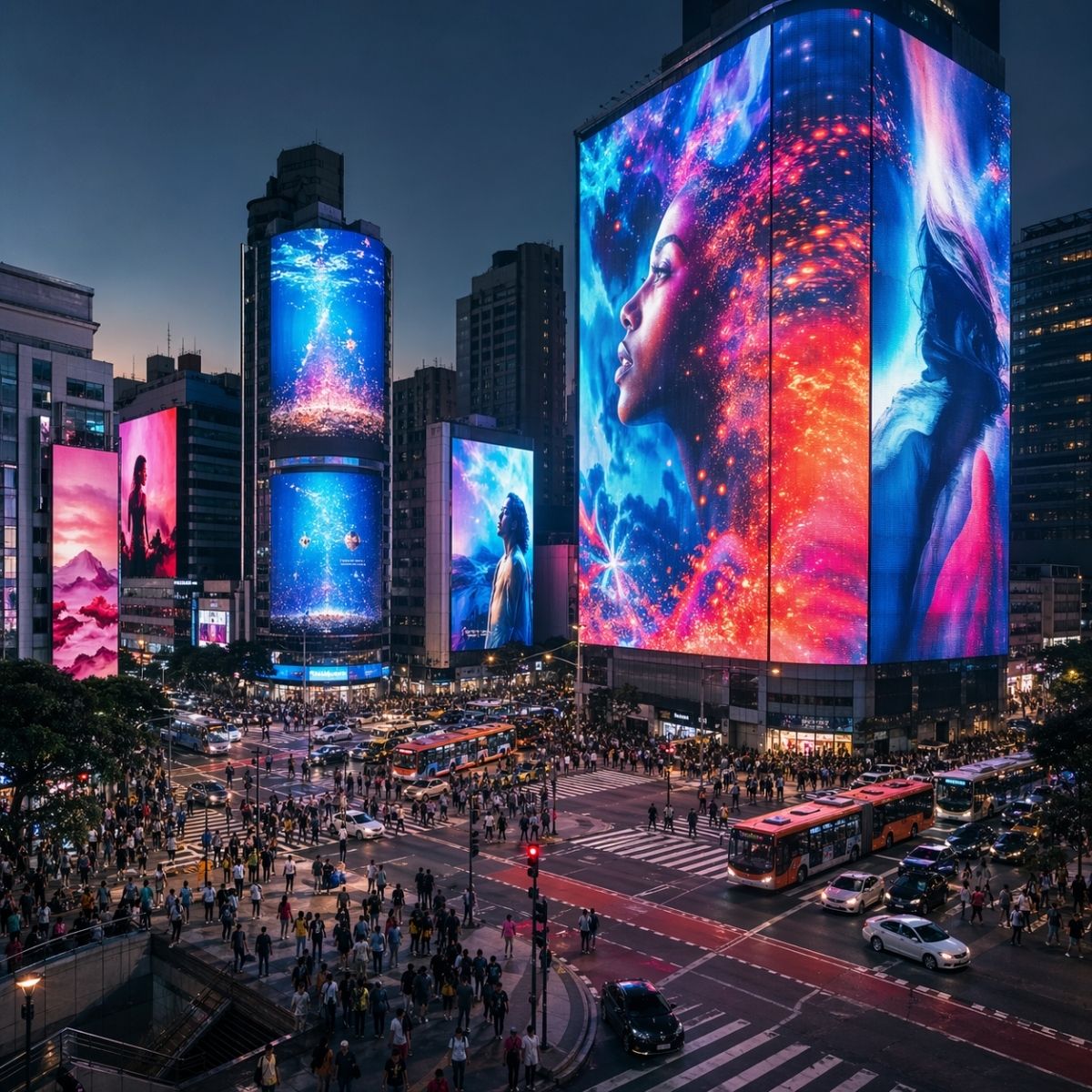

The Boulevard São João project foresees four LED screens between 300 and 1,000 m² in the center of São Paulo, inspired by Times Square, with an exception to the Clean City Law and an annual counterpart of R$ 2 million to revitalize the intersection of São João and Ipiranga avenues.
The São Paulo city hall formalized the Boulevard São João project, an initiative that will transform the intersection of São João and Ipiranga avenues into a São Paulo version of Times Square with the installation of four giant LED screens on building facades in the capital’s historic center. The largest of the screens will be 1,000 square meters and will be fixed on the New York Building, covering practically the entire facade with dimensions of 40 by 25 meters, a dimension equivalent to a ten-story building completely covered by a luminous panel. The proposal, made possible through exceptions provided for in the Clean City Law, should be implemented between August and September of this year, after the formalization of the cooperative agreement in an official municipal publication.
The LED panels will mainly display cultural and public utility content, which will occupy 70% of the broadcast time, while the remaining 30% will be allocated to sponsors. Fábrica de Bares, the company responsible for the investments and the execution of the interventions, must apply a minimum of R$ 2 million per year over three years, resources destined for urban reforms, restoration of historical heritage, and the creation of cultural spaces in the region. The project prohibits the display of retail advertisements, gambling, adult material, and political or religious propaganda on the screens, a restriction that differentiates the São Paulo proposal from the unrestricted commercial model of the original Times Square.
The dimensions of the screens and what they will occupy in the center of São Paulo
The four LED panels planned for the intersection vary between 300 and 1,000 square meters each. To dimension what this represents, the largest of the screens is equivalent to the complete facade of a ten-story building, a luminous LED surface that to the naked eye will produce a visual impact comparable to that of the largest screens in Times Square in New York, Tokyo, and Seoul. The New York Building, which will receive the main panel, is located on one of São Paulo’s most photographed corners, and the presence of the screens should drastically alter the region’s nocturnal landscape.
-
Scientists Create Lab-Made Cell with Only 36 Genes That Eats, Grows, Copies DNA, and Divides, Raising the Question: Is This Life?

-
World’s Largest Camera, with 3,200 Megapixels, Begins Operation, Capturing Sky Images Every 30 Seconds for the Next Decade

-
Canary Island with 11,000 Residents and Over 500 Volcanoes Uses Wind and Water as a Giant Battery to Demonstrate Remote Areas Can Survive Without Fossil Fuels

-
Brazilian Craftsman Builds Small Hydropower Plants Generating Over 1,000 kWh Monthly, Paying for Themselves in Just Over a Year




The choice of the intersection of São João and Ipiranga avenues is not casual. This corner is one of the most emblematic in the São Paulo capital, immortalized in songs and films, and concentrates an intense flow of pedestrians and vehicles that will guarantee a permanent audience for the content displayed on the screens. The strategic location reinforces the project’s intention to function as a cultural and tourist attraction hub, not just as a support for image display, a model that the city hall wants to replicate the effect that Times Square has on visitors in Manhattan.
What the screens will display and what is prohibited
The division between public and commercial content was defined to prevent the screens from becoming uncontrolled digital billboards. The 70% allocated to culture and public utility may include event broadcasts, digital art exhibitions, information on municipal services, and the city’s cultural programming, while the commercial 30% will be occupied by sponsors under rules that exclude retail, gambling, and sensitive content. This proportion attempts to balance the project’s financial sustainability with the public interest that justifies the exception to the Clean City Law.
The regulation on the operating hours of the screens is still under discussion. The Urban Landscape Protection Commission (CPPU) currently determines that the screens be turned off between 11 PM and 5 AM, a rule that the municipal administration is studying to make more flexible through technical evaluation and approval by the competent body. The luminous impact of the panels is one of the main concerns raised by urban planners and residents of the region, as 1,000 square meter screens produce a quantity of light that can affect the quality of sleep and visual comfort of those living in the surrounding buildings.
The counterparts that the screens bring to the center of São Paulo
The project is not limited to the installation of luminous panels. The company responsible for the screens has committed to investing at least R$ 2 million annually for three years in urban interventions that include the restoration of historical heritage such as the Church of Our Lady of the Rosary of the Black Men, the placement of benches and urban equipment, and the opening of areas dedicated to periodic events at the intersection. This counterpart is what legally justifies the exception to the Clean City Law and transforms the visual entertainment project into a revitalization program for the historic center.
Traffic at the intersection will also be affected. The project foresees that the corner may be closed to vehicles during certain periods, especially on weekends, to host shows, gastronomy fairs, and cultural programming that transform the thoroughfare into a living area. For a region that for decades suffered from nocturnal emptying and degradation, the presence of the screens and associated events can act as a catalyst for a reoccupation that previous initiatives failed to consolidate.
What the arrival of the screens means for São Paulo and for the Clean City Law
The Clean City Law, approved in 2006, prohibited billboards and large-format advertising panels in São Paulo, a decision that transformed the capital’s urban landscape and became an international reference for visual regulation. The installation of screens up to 1,000 square meters in the city center represents the largest exception ever granted to this legislation, and the precedent raises questions about how far public authorities can relax a law that the city itself considers an urban achievement. If the project is successful, it is likely that other regions of São Paulo will request similar exceptions, and the balance between urban revitalization and landscape preservation will be tested with each new request.
For those passing through the intersection of São João and Ipiranga avenues starting in September, the visual experience will be completely different from what exists today. Four giant LED screens illuminating facades like a ‘Paulistana Times Square’ will create a scenario São Paulo has never had, for better or worse, depending on how the execution reconciles spectacle and respect for the surroundings. The Boulevard São João project bets that the answer is yes, that it is possible to have a ‘Paulistana Times Square’ without destroying what the Clean City Law built, but only time and the residents of the center will tell if the gamble was worth it.
And you, do you think São Paulo needs giant screens in the center or should the Clean City Law be kept intact? Leave your opinion in the comments.


