Portuguese
  Spanish


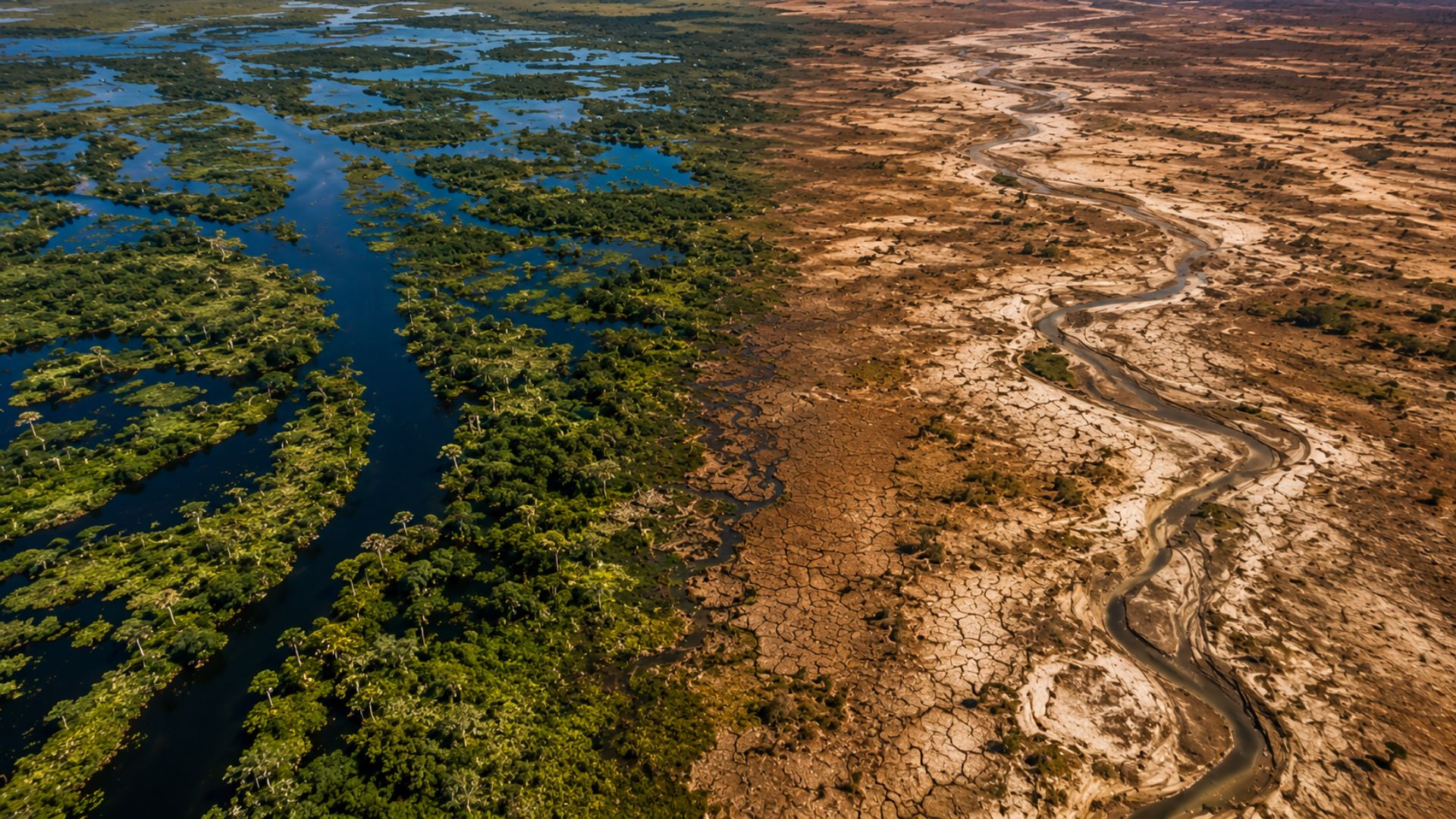


The data is from MapBiomas Water, which maps rivers and lakes by satellite and artificial intelligence since 1985 and was released on June 16. In 2025, 2,511 cities, 45% of the country, had water below their own average. The study measures the area seen by satellite, not the volume.
Satellite images show that Brazil shrank more than 2.5 million hectares of rivers and lakes in 40 years, and the Pantanal, which depends almost 100% on rain due to lack of dams, was 56% below the historical average in 2025. The portrait comes from MapBiomas Water, an initiative that uses satellite images and artificial intelligence to map, month by month, the entire surface covered by water in the country since 1985, in a survey released on June 16.
Almost half of Brazilian cities had less water than normal last year. According to information released by G1, in 2025, 2,511 municipalities, 45% of the total, had a water surface below their own historical average, in a scenario that experts associate with a combination of climate change, deforestation, extreme events, and changes in land use. An important alert is worth noting: the study measures the extent of areas covered by water seen by satellite, and not directly the available volume, water quality, or water security of each municipality.
The cities that lost the most rivers and lakes in 2025
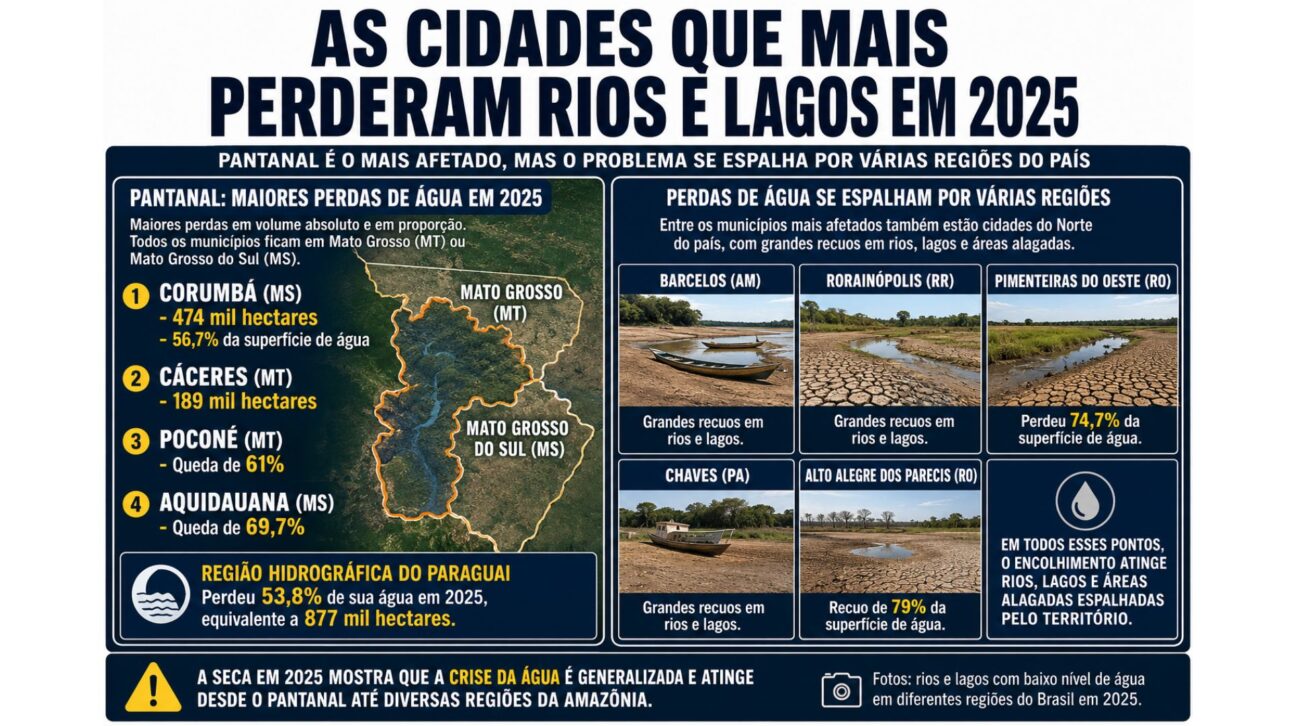
The greatest losses are concentrated in the heart of the Pantanal. In 2025, the strongest retreats of rivers and lakes, in absolute volume and proportion, appear in Mato Grosso and Mato Grosso do Sul, the two states crossed by the biome. Corumbá (MS) lost 474 thousand hectares, or 56.7% of its water surface, followed by Cáceres (MT), with 189 thousand hectares less, Poconé (MT), with a decrease of 61%, and Aquidauana (MS), which retreated 69.7%. Together, the two states form the Paraguay Hydrographic Region, which alone lost 53.8% of its water in 2025, equivalent to 877 thousand hectares.
-
Engineers Develop Fridge-Sized Machine to Produce 95-Octane Synthetic Fuel from Air and Water, Aiming to Sustain Combustion Engines Without Oil

-
Two-Armed Robot Uses AI to Reassemble Destroyed Pompeii Frescoes, Solving an “Impossible” Puzzle
-
New Law in Brazil Requires Breaks for Type 1 Diabetes Management at Work, School, and Public Exams

-
Scientists Confirm “Greening” of Antarctica: Ice on the World’s Coldest Continent Turns Green as Mosses Multiply Over Tenfold in Four Decades


The problem, however, spreads across various regions. Among the most affected municipalities are also cities in the North, such as Barcelos (AM), Rorainópolis (RR), Pimenteiras do Oeste (RO), which lost 74.7% of its water surface, Chaves (PA), and Alto Alegre dos Parecis (RO), with a retreat of 79%. In all these areas, the shrinkage affects rivers and lakes, as well as flooded areas spread across the territory.
Natural water disappears while reservoirs grow
The type of water that is disappearing changes the entire reading of the numbers. The survey separates the country’s water into two categories: natural bodies, such as rivers and lakes and flooded areas, and artificial ones, such as dams and reservoirs. Today, 76.7% of the mapped water surface is natural and 23.3% is artificial, but the two follow opposite directions. Since 1985, artificial water has grown 69%, gaining 1.7 million hectares, while natural water has shrunk 19%, losing 3.2 million hectares, precisely the one that supplies without relying on dams.
This contrast becomes evident when looking biome by biome. In the Cerrado, 55.1% of the mapped water is in hydroelectric reservoirs and only 34.4% is natural, while in the Atlantic Forest 61.5% comes from dams, the largest absolute area of artificial water in the country, with 1.3 million hectares. Proportionally, the Caatinga leads in artificial water, with 78%, and the Pampa still preserves natural water at 88.1%, although it concentrates the second-largest area of reservoirs. In the Pantanal, more than 99% of the water is natural, which leaves the biome almost entirely dependent on the rain cycle, without the reserve that reservoirs could offer.
Why Brazil has been drying up for 40 years
The analysis by decade shows a continuous retreat of water in the country. The average area covered by water fell from 19.86 million hectares between 1985 and 1994 to 18.71 million in the following decade, 18.16 million between 2005 and 2014, and 17.28 million between 2015 and 2024, a loss of 2.58 million hectares from the first to the last decade, an area larger than the entire state of Sergipe. In 2025 there was a slight improvement, with 18.2 million hectares, 5.3% above 2024, but still below the historical average of 18.5 million, meaning no complete recovery. “Even with occasional signs of recovery, the situation is still concerning in the long term,” says Juliano Schirmbeck, technical coordinator of MapBiomas Água.
The shrinking of rivers and lakes results from a combination of factors. Brazil is becoming drier due to changes in the rainfall regime, driven by elements such as El Niño, confirmed in 2026, which warms the Pacific Ocean and usually reduces rainfall in the North, Northeast, and part of the country’s center. Added to this is global warming, which increases evaporation and leaves less water on the surface even without a drop in rainfall volume, and deforestation, which reduces the moisture released into the atmosphere, as already documented in the Amazon, and alters the course and volume of rivers through fires and soil movement.
Pantanal in the Worst Scenario and Amazon in Recovery
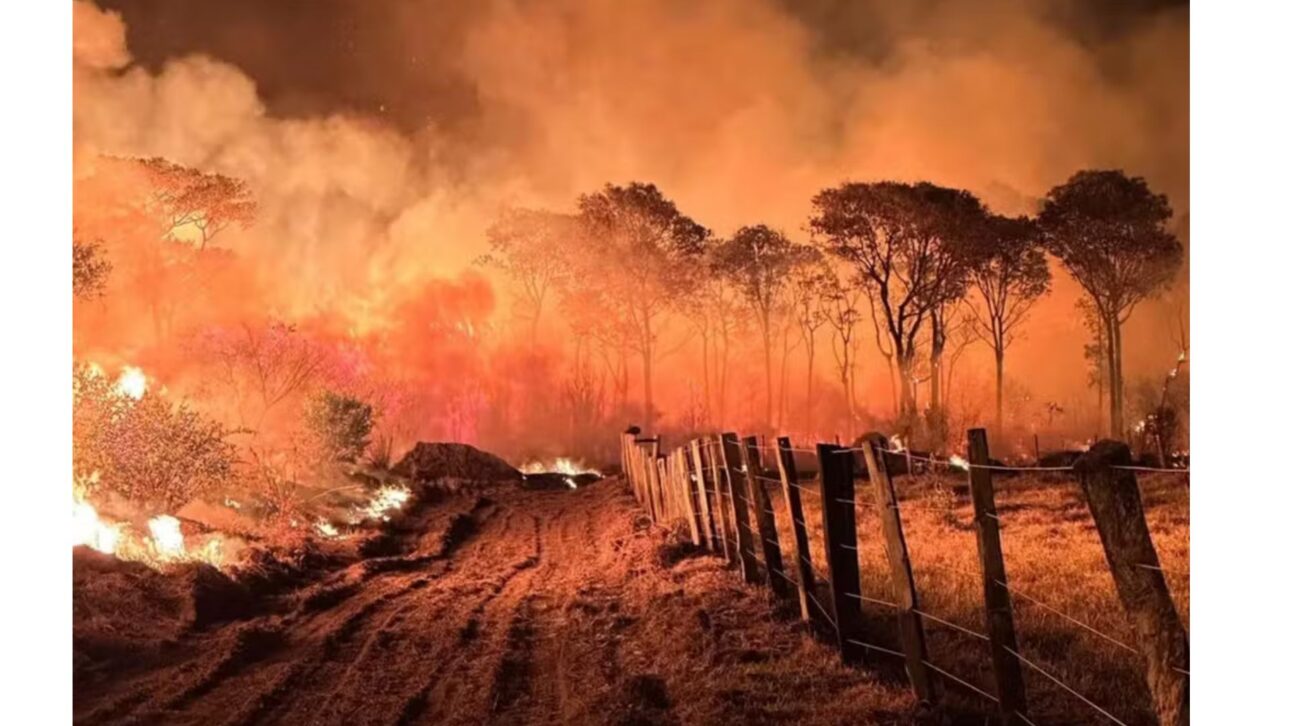
The Pantanal was the most affected biome in the country in 2025. The water surface was 56% below the historical average, in the only biome where all 12 months of the year were below expectations, after the worst drought ever recorded in Brazil in 2024, according to Cemaden, and fires that, by June of that year, had surpassed the previous record. The water grew by 34% compared to 2024, but the biome ended 2025 with 679 thousand hectares, far from the average of 1.56 million, and, according to researcher Mariana Dias, the hydrological dynamics also changed: floods marked the 1980s, but the region has experienced prolonged droughts since 2019.
The Amazon, on the other hand, had the best performance among the biomes. After two years of severe drought, the region closed 2025 with a water surface 2.6% above expectations, and Pará recorded the largest gain in the country, with 142 thousand hectares, in a biome that concentrates 61.4% of all Brazil’s water, an area larger than Pernambuco and almost entirely formed by natural rivers and lakes. However, the recovery was not uniform, as about 37% of the monitored basins in the Amazon remain below average, affecting riverine communities that depend on rivers for transportation, fishing, and supply. “The recovery of the water surface in the Amazon in 2025 is a positive sign,” explains Bruno Ferreira, a researcher at MapBiomas and Imazon.
Satellite data from MapBiomas Água shows that Brazil lost more than 2.5 million hectares of rivers and lakes in 40 years, an area larger than Sergipe, with natural water shrinking 19% while reservoirs grew. In 2025, 45% of the cities were below their own average, the Pantanal reached 56% below normal due to relying almost solely on rain, and the Amazon partially recovered, but unevenly. The scenario is linked to climate change, El Niño, deforestation, and extreme events, and researchers emphasize that a single better year does not reverse the downward trend, also noting that the study measures the area of water, not the volume, quality, or water security.
And you, have you noticed rivers and lakes shrinking near where you live, or observed rivers drying up during travels across the country? Share your experience and exchange ideas with other readers about the water crisis in Brazil, with respect for different viewpoints.