






 Portuguese
  Spanish


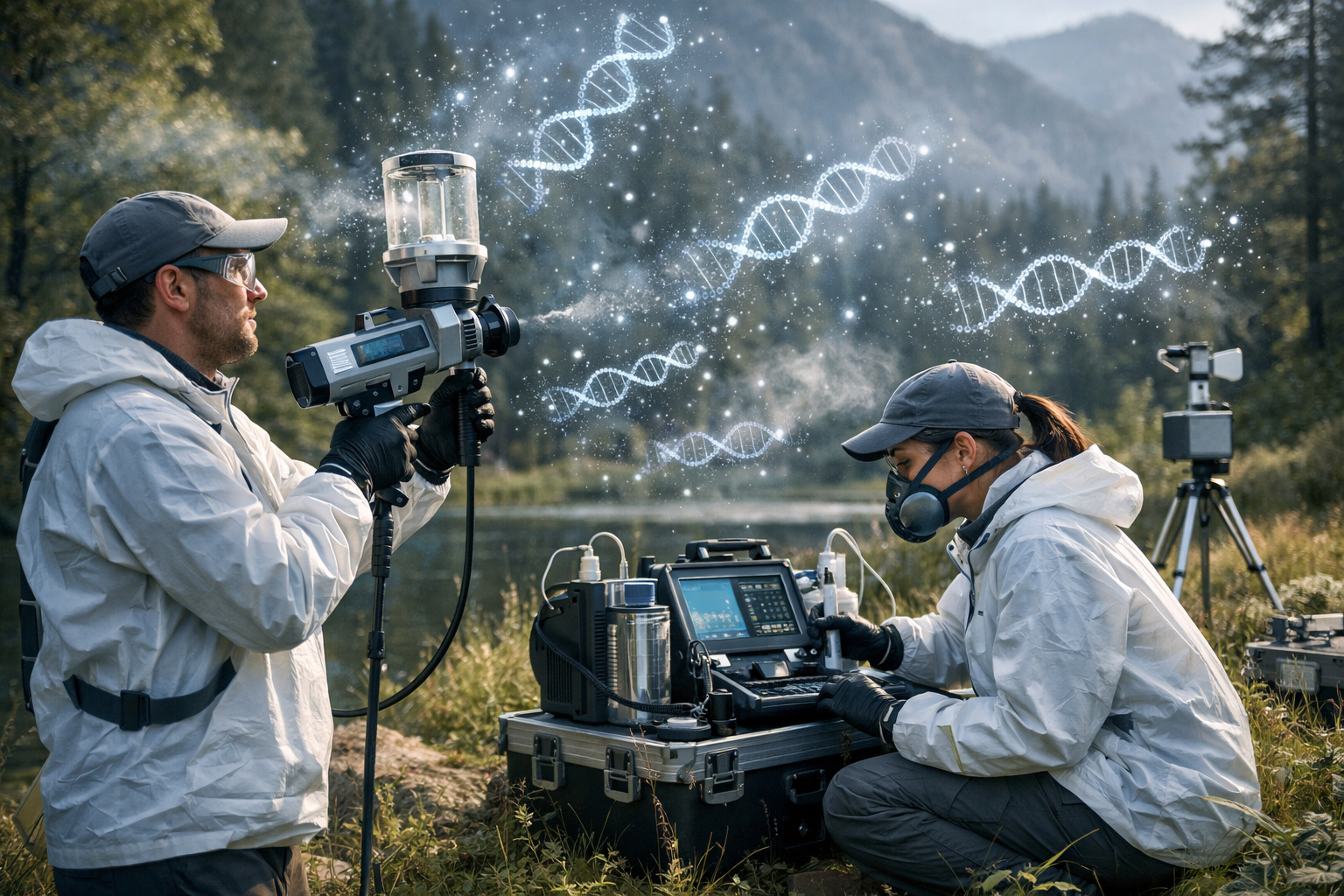


Each breath may contain an invisible portrait of the life around you, revealing species that have been in the environment even if they were not seen
There is a simultaneously fascinating and unsettling idea gaining traction in the scientific world: the air you breathe may carry genetic traces of practically everything living around you. Although it seems like something out of science fiction, it is a reality increasingly supported by researchers. Today, the atmosphere is beginning to be treated as a true “biological archive,” capable of revealing which species are or have been present in a given environment.
This information was disclosed by “Current Biology” and also by the journal “Environmental DNA,” created in 2019 specifically to keep up with the accelerated growth of research in this area, as various peer-reviewed studies have been confirming. Thus, the concept that once seemed just a distant hypothesis is now consolidating as one of the greatest recent revolutions in modern biology.
Environmental DNA technology transforms air into a global genetic database
To understand this advancement, it is essential to comprehend the role of so-called environmental DNA, known as eDNA (environmental DNA). This technology allows for the identification of species without the need to capture or even visualize them, merely by analyzing genetic fragments present in the environment — in this case, suspended in the air.
-
China Develops Custom 140-Ton Electric Mining Truck with 770 kWh Swappable Battery, Deploys 290 Units in Xinjiang’s Largest Zinc Mine

-
Meta to Launch Arena, a New Prediction App Targeting 3.56 Billion Users, Competing with Polymarket and Kalshi

-
Scientist Challenges Famous Human Evolution Theory, Argues Homo Sapiens Evolved Gradually Over Thousands of Years
-
15-Year-Old American Builds Ocean Generator with PVC Pipe and 3D-Printed Propeller for $12, Wins National Prize, Presents at White House, and Makes Forbes 30 Under 30 List




Moreover, this method functions like a true “molecular vacuum cleaner.” Specific devices capture invisible particles such as dust, pollen, skin flakes, and even microscopic fecal residues, to which DNA adheres. This material is then sequenced and compared with global databases, such as BOLD (Barcode of Life Data System) and GenBank, which together compile genetic information from millions of organisms.
As a result, scientists can reconstruct a true biological puzzle from tiny fragments. Consequently, biodiversity monitoring becomes faster, more comprehensive, and in some cases, automated — functioning as an “invisible census” of life on Earth.
This advancement is even more relevant when considering that less than 20% of the planet’s species have been formally cataloged. In other words, airborne eDNA can significantly accelerate the discovery of new forms of life.
Studies reveal that DNA can travel hundreds of meters — and even kilometers through the air
Although the concept of extracting DNA from the environment has existed since the 20th century, initially applied to water and soil, it was only in the 2010s that scientists began to explore the air as a relevant genetic source. From then on, the results began to surprise.
Experiments conducted in greenhouses and zoos, such as the pioneering study at the Copenhagen Zoo led by Kristine Bohmann from the University of Copenhagen, demonstrated that the method was more efficient than previously thought. It was possible to detect dozens of species, including animals located hundreds of meters away, using only air samples.
Subsequently, in 2022, a study published in “Current Biology,” led by Elizabeth Clare — who was at the University of York and is now at Queen Mary University of London — confirmed this potential. At Hamerton Zoo Park in the UK, air samples identified mammals and birds present at the site, including species detected up to 300 meters away from the collection points.
Additionally, in a national survey in the UK, using Malaise traps (originally designed to capture insects), the technique identified over a thousand different biological groups. Among them were fungi, microorganisms, and insects that typically go unnoticed by human observers but are essential for the balance of ecosystems.
Limitations, scientific doubts, and ethical concerns about the use of airborne DNA
Despite the growing enthusiasm, this new frontier of science still presents significant challenges. For example, it is still unclear how long DNA remains suspended in the air or what the maximum distance it can travel is. Studies indicate that genetic fragments can travel kilometers under favorable wind conditions, complicating the geographical accuracy of the data.
Thus, a relevant interpretive problem arises: detecting the DNA of a species does not necessarily mean it is present at that location at that moment. In many cases, it may be a “genetic echo” transported by the environment.
Moreover, there is a significant ethical issue that is beginning to gain global attention. Since the collected material may also include human DNA, concerns related to genetic privacy arise. In 2023, researcher David Duffy from the University of Florida warned in an article published in “Nature Ecology & Evolution” that analyses of airborne eDNA could, without proper regulation, reveal sensitive information such as ancestry, disease predisposition, and even identify individuals.
Therefore, although the technology was developed with a focus on environmental conservation, there is a clear risk of privacy invasion if there are no well-defined limits.
The future of biodiversity monitoring may literally be in the air
Even in the face of these uncertainties, the future of airborne eDNA is considered extremely promising. This is because existing structures can be adapted for this new function. One example is pollen collection stations, which have been operating in European countries for over 50 years and can be repurposed for retrospective genetic analyses.
This makes it possible to reconstruct ecological changes over time, offering a new perspective on the evolution of ecosystems. Furthermore, global initiatives like the BIOSCAN project, which connects laboratories from 35 countries for genetic monitoring of biodiversity, show that this field is beginning to gain international scale.
In summary, the idea that air functions as a gigantic natural database is no longer theory and is rapidly approaching established scientific practice. And, as new discoveries emerge, one thing becomes increasingly clear: the answers about the past, present, and even the future of life on Earth may literally be in the air.





