Portuguese
  Spanish


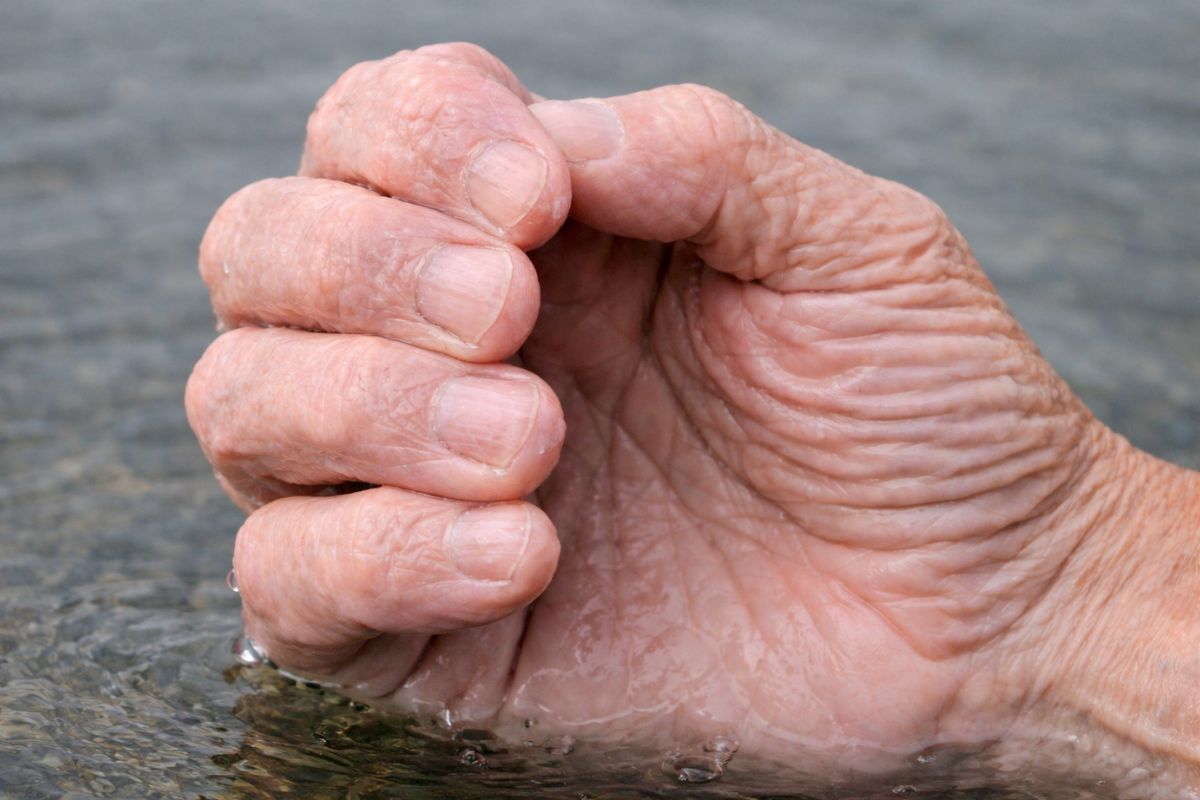

Science revealed that wrinkled fingers in water are a reaction controlled by the sympathetic nervous system through vasoconstriction, not by liquid absorption through the skin, and that the grooves function like tire treads that drain water to improve hand grip on wet surfaces.
When submerging the hands in water for a few minutes, the skin on the fingers changes appearance and the grooves that everyone knows appear. But science has shown that the phenomenon of wrinkled fingers goes far beyond a simple bathtub curiosity and reveals a complex neurological mechanism with possible medical, forensic, and even biometric technology applications. For a long time, it was believed that the skin absorbed liquid and swelled, but studies have shown that the amount of water absorbed is not enough to form the observed grooves, making this explanation inadequate.
Today science knows that the process is controlled by the sympathetic nervous system, through vasoconstriction. Water enters through the pores and ducts of the sweat glands, changes the concentration of salts, and activates nerve endings that lead to the contraction of blood vessels in the dermis. This reduces the local blood volume and causes the skin to “bunch up” in some areas, forming the typical wrinkles that appear on the fingers. It is not the skin swelling. It is the nervous system responding to the presence of water with an adaptation that science believes has an evolutionary function.
What science says about the true cause of wrinkled fingers in water
The difference between the popular explanation and the scientific explanation is fundamental. Science has proven that wrinkling does not occur by osmosis or passive absorption of water through the skin, but by an active reflex of the nervous system.
-
Three teenagers transform cut cardboard into Japanese origami-style packaging that promises to retire styrofoam and bubble wrap, win a $12,500 prize, and target giants like Amazon, FedEx, and Home Depot after a robot motor arrived broken.

-
The large jar blender has a rival: Oster Ultra Power bets on 1,000 W, six stainless steel blades, and two portable cups with leak-proof lids.

-
Tesla injected an additional $250 million into the German factory, doubled the battery cell target, and opened its own production line for startups.

-
No more TV stuck on the wall: Samsung The Freestyle+, the new projector with over 400 lumens projects on walls, floors, and ceilings, bringing cinema to any corner of the house.


The clearest proof is that people with nerve injuries in their hands do not exhibit wrinkling after immersion, even if the skin is intact and exposed to the same amount of water for the same time.
This finding reinforces that wrinkles are an indicator of local neurological function. If the problem were merely water absorption, the skin would wrinkle regardless of the state of the nerves.
Science uses this discovery as a clinical tool: doctors can submerge fingers in warm water for a few minutes to assess wrinkling and identify possible peripheral nervous system dysfunctions, something that previously required more invasive tests.
The rain tire theory that science used to explain wrinkled fingers
From an evolutionary perspective, the main hypothesis of science is that wrinkled fingers improve grip in wet environments.
The grooves would function as channels that drain water from the contact surface, similar to the tread design of a tire, which prevents hydroplaning by creating pathways for water to flow and maintain direct contact between the rubber and the asphalt.
Researchers at Newcastle University tested this theory to verify if grip actually increased in practice with wrinkled fingers. The experiment compared the ability to manipulate wet objects with dry fingers and with fingers after immersion in water, and the results confirmed that the grooves improve grip precision on wet surfaces.
For evolutionary science, this adaptation may have been essential for human ancestors who needed to collect food in rivers, fish with their hands, or move across wet terrain.
Wrinkled fingers as a second fingerprint according to science
One of the most intriguing discoveries is that the wrinkling pattern repeats in the same individual. By comparing photos of fingers before and after immersion, researchers observed that the wrinkles follow a relatively stable design, linked to the organization of blood vessels and tissues just below the skin.
This suggests that each person has a unique wrinkling pattern that could function as a kind of “second fingerprint,” activated only in humid conditions.
For forensic science and biometric technology, this discovery opens possibilities that are still being explored. If the wrinkling patterns are individual and reproducible, they could be used as a complementary identification method in contexts where traditional fingerprints are compromised by moisture or wear.
It is a research area that combines neurology, dermatology, and identification technology in a field that science is just beginning to map.
What the absence of wrinkled fingers reveals about health according to science
Under normal conditions, the mechanism occurs in the same way for almost everyone and is considered a physiological reflex.
But science has identified that when the skin does not wrinkle after a reasonable time of immersion, this may be a sign of changes in the nervous system or peripheral circulation. The absence of wrinkling is used in clinical practice as an indicator of possible autonomic dysfunctions that deserve investigation.
In conditions such as type 2 diabetes, heart failure, or specific neurological conditions, the wrinkling process may be slower or even absent. Medical science uses the finger immersion test as a simple and non-invasive tool to guide the need for additional tests.
A test that anyone can do at home, observing whether the fingers wrinkle normally after five to ten minutes of immersion in warm water, can raise alerts that justify a medical consultation.
Why this discovery of science changes the way we look at the human body
The phenomenon of wrinkled fingers is a perfect example of how science transforms something that seemed trivial into a window to understand complex mechanisms of the body.
A detail that most people ignore in the shower or pool reveals information about the functioning of the nervous system, the grip capability of the hands, and even the individual’s health status. Science has not only explained what happens but has found practical utility for a phenomenon that humanity has observed for millennia without understanding.
The next time you look at your wrinkled fingers after a bath, you will know that it is not your skin soaking wet.
It is your nervous system activating a precision mechanism that your ancestors used to survive in humid environments, and that modern science uses to assess your neurological health. A silent superpower hidden at your fingertips.
Did you know that wrinkled fingers in water are a reaction of the nervous system and not the skin absorbing liquid? Had you heard about the rain tire theory? Let us know in the comments. Scientific curiosities about the human body always spark good debates, especially when they change something we believed our whole lives.