






 Portuguese
  Spanish
  3 min of reading
  0 comments


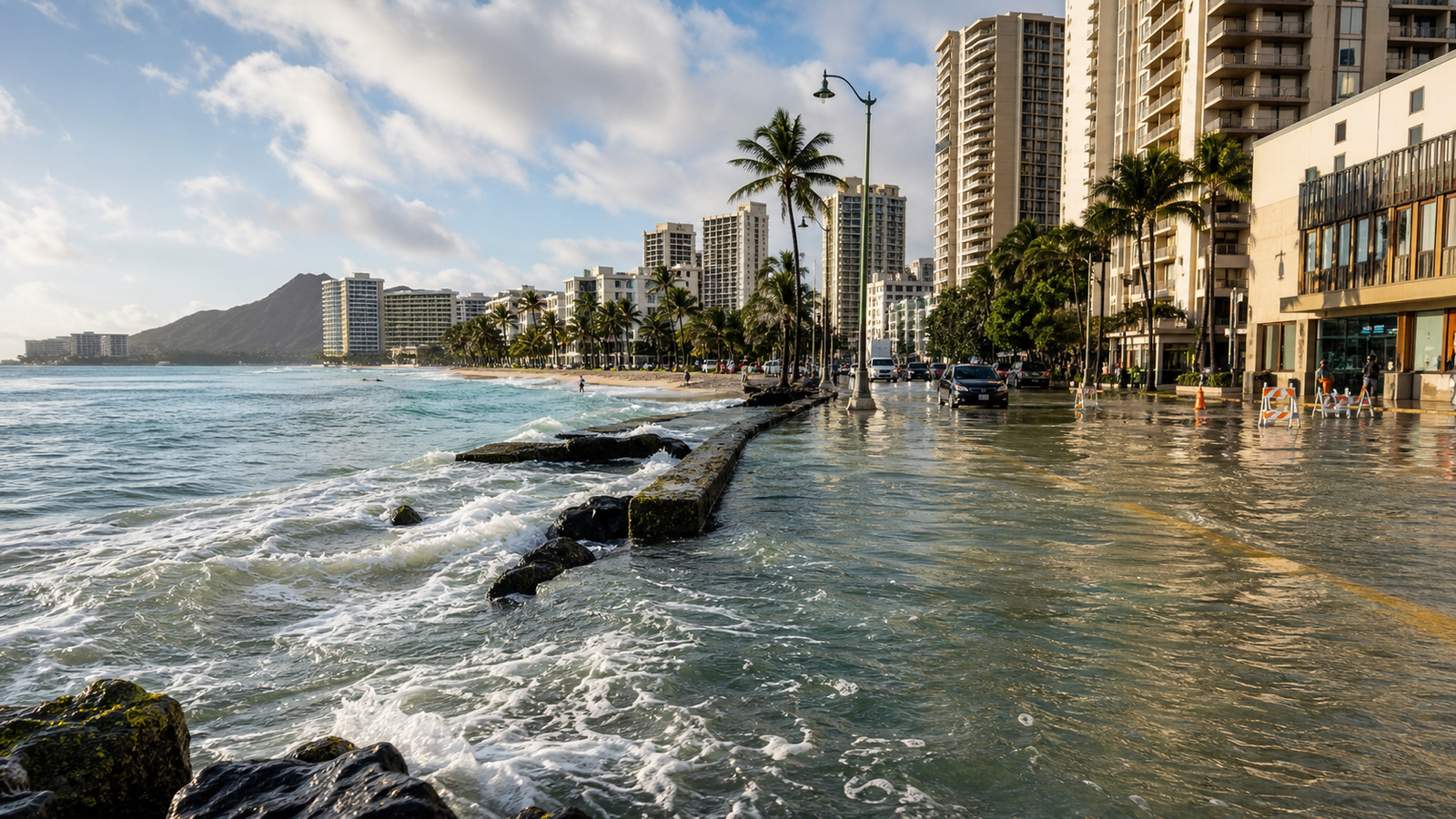
Scientists point out that low-lying areas of Oahu, Hawaii, are sinking up to 40 times faster than predicted, increasing flood risks in Honolulu, Waikiki, and Pearl Harbor in the coming decades
Certain areas of the island of Oahu, Hawaii, are sinking up to 40 times faster than predicted, increasing the risk of flooding in Honolulu, Waikiki, and Pearl Harbor in the coming decades.


Oahu is sinking at a much faster rate than predicted
The finding was presented by scientists who analyzed soil behavior amidst rising sea levels.
The study indicates that low-lying coastal areas may experience impacts sooner than imagined.
-
Helicopter Drops 180 Tons of Sand and Gravel on Swedish River to Revive Ecosystem Damaged by Decades of Exploitation

-
Brazilian Company Launches Retro Smartphone with 48 MP Camera, T9 Keyboard, and Privacy Features for Social Media-Free Use

-
Self-Taught Chinese Farmer Builds 5-Ton Submarine from Scrap, Launches It in Anhui River
-
Invisible Induction Technology Enables Wireless Power for Blenders, Coffee Makers, and Air Fryers, Reducing Countertop Cables





The warning involves homes, businesses, and urban structures located in vulnerable regions. In Honolulu, Waikiki, and Pearl Harbor, the combination of subsidence and sea-level rise could lead to estimated damages of billions of dollars.
The research was published in the journal Communications Earth & Environment. Geophysicist Kyle Murray, from the University of Hawaii at Manoa, stated that in areas of rapid subsidence, the effects of sea-level rise will arrive sooner than predicted.
Ground subsidence can accelerate coastal flooding
Sea-level rise linked to climate change already increases the risk of coastal flooding in low-lying neighborhoods around Honolulu. The new survey shows that ground subsidence can amplify this risk.
The assessment was highlighted by Dr. Kristina Dahl, vice president of science at Climate Central. She stated that subsidence can intensify the impacts associated with the ocean’s advance over lower coastal areas.
The central point of the research lies in the interaction between two factors. On one hand, sea levels continue to rise; on the other, parts of the territory lose altitude, making certain regions exposed to extreme flooding.
Satellite data analyzed for almost twenty years
To examine the phenomenon, researchers spent almost twenty years evaluating satellite data from the Hawaiian Islands.
The information was compared with measurements from the Global Satellite Navigation System to calculate subsidence rates.
The team mapped coastal topography with a high-resolution digital elevation model. Afterwards, they used geospatial analyses to identify subtle variations in terrain elevation.
This data cross-referencing allowed for the construction of a model on the combined effects of ground subsidence and sea-level rise.
The result indicated an exacerbation of flooding in certain areas of Oahu.
Rate reaches 25 millimeters per year in coastal areas
The Hawaiian islands slowly sink as they move away from the Big Island. This process, associated with the weight of the islands and the movement of tectonic plates, has shaped the archipelago over millions of years.

In Oahu, the overall annual subsidence rate was about 0.6 millimeters per year, approximately the thickness of ten sheets of copy paper. However, certain coastal regions recorded 25 millimeters per year.
This rate is 40 times faster, according to a statement from the University of Hawaii at Manoa. The rate also exceeds Hawaii’s average subsidence, calculated at 1.54 millimeters per year since 1905.
Low-lying areas may feel impacts in the coming decades
The situation is concerning because it involves well-known and populated regions, such as Honolulu, Waikiki, and Pearl Harbor. In these areas, the loss of ground elevation can accelerate problems that previously seemed more distant.
The study indicates that the impacts of sea-level rise do not depend solely on the advance of water. When the ground also sinks, urban areas face a more delicate scenario.
Scientists point out that the changes found were unprecedented. The speed recorded in parts of Oahu makes the Oahu sinks a warning for coastal risks, infrastructure, and occupation in low-lying areas of Hawaii.
With information from New York Post.




Be the first to react!