Portuguese
  Spanish


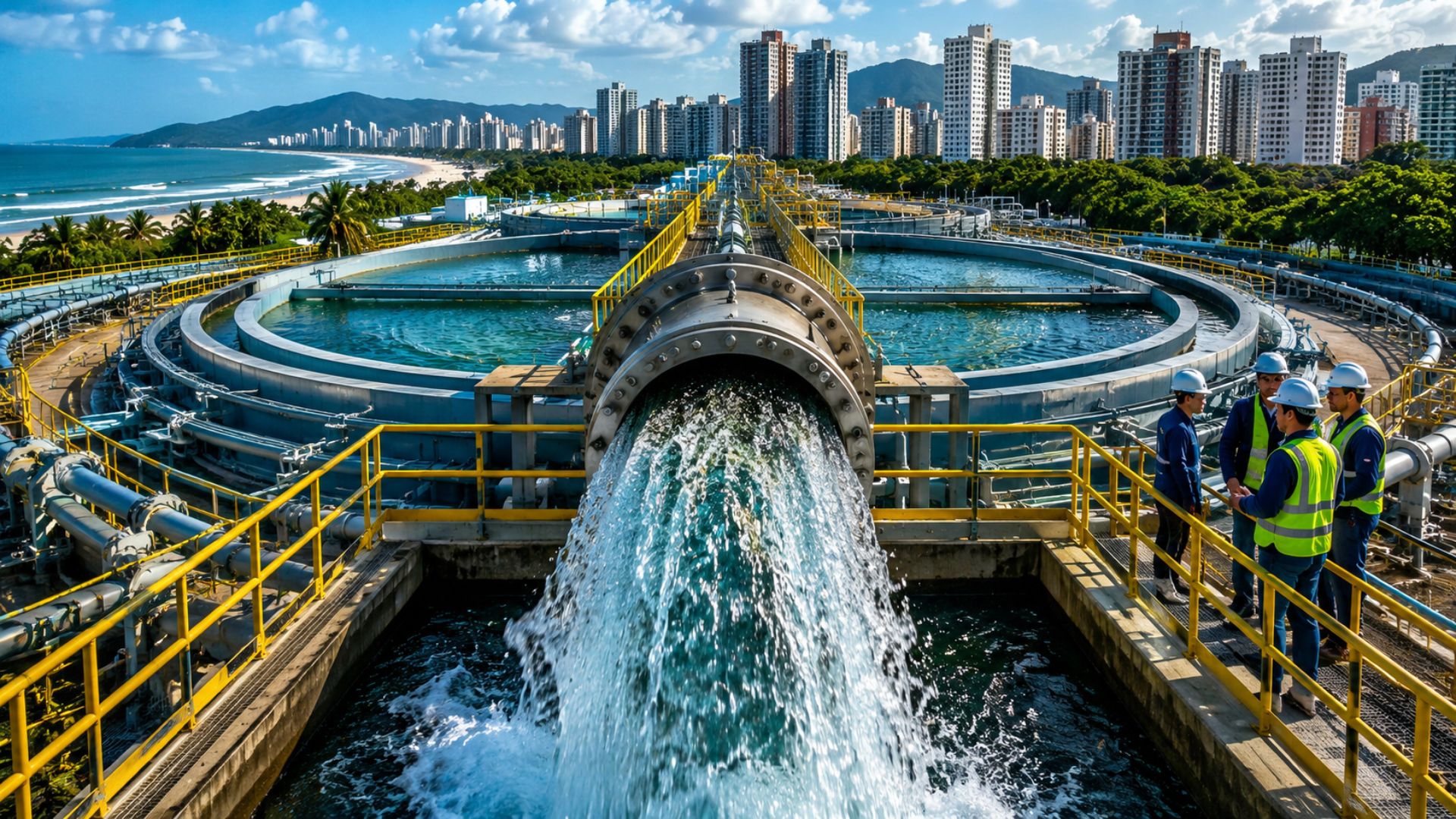

Record investment in sanitation places Praia Grande at the national top per inhabitant and advances Sabesp’s billion-dollar projects, with a new water treatment plant, expansion of the sewage network, and reinforcement in supply for residents and tourists of Baixada Santista.
Praia Grande, on the coast of São Paulo, leads the nation in investment in basic sanitation per inhabitant among the 100 most populous municipalities in the country, with R$ 572.87 per resident applied in 2024.
According to the 2026 Sanitation Ranking, published by Instituto Trata Brasil in partnership with GO Associados, the amount was about 322% above the average of the analyzed group, calculated at R$ 135.89.
In the same period, the city joined a new cycle of Sabesp projects, which foresees R$ 1 billion in investments by 2029 to expand water supply, sewage collection, and treatment.
-
While NATO secured more than $10 billion in missiles and space surveillance at a single forum, Brazil still spends 1.1% of its GDP on defense and is stalling its own anti-aircraft system.

-
Corn ethanol attracts R$ 23 billion in 21 new plants and prepares for a nearly 50% jump in Brazilian production by 2027, even with high interest rates.
-
A newly opened terminal in the middle of the Amazon has begun transporting soy and corn through Amapá, eyeing the queue of ships that is congesting the ports in the South.
-
Tesla injected an additional $250 million into the German factory, doubled the battery cell target, and opened its own production line for startups.


Among the main interventions, the new Melvi Water Treatment Plant was designed to add 1,270 liters per second to the supply of treated water in the municipality.
Praia Grande leads investment in basic sanitation
With data from the National System of Information on Basic Sanitation, referring to the base year 2024, the survey compares indicators of the 100 most populous municipalities in Brazil and exposes significant differences in the pace of investment.
In the 2026 edition, Praia Grande stands out in per capita investment, while a significant portion of large cities still applies values below those considered necessary to advance in the universalization of services.
According to the ranking, 51 municipalities invested less than R$ 100 per inhabitant, a level that does not reach half of the R$ 225 per resident estimated by the National Basic Sanitation Plan as a reference to universalize service.
Conversely, only 17 cities exceeded R$ 200 per inhabitant, and ten of them were above the level considered excellent by the study, which reinforces the gap between the evaluated municipalities.
Within this scope, Praia Grande differentiates itself from other large urban centers evaluated by achieving the highest per capita investment in the period analyzed by Instituto Trata Brasil.
Also appearing among the highest values per inhabitant are Aparecida de Goiânia, Cuiabá, Vila Velha, Nova Iguaçu, Canoas, Guarujá, Montes Claros, Joinville, and São Bernardo do Campo.
Sabesp Works Expand Water and Sewage
Aimed at expanding local infrastructure, the package announced for Praia Grande includes works to expand water supply, sewage network expansion, and modernization of operational structures used by Sabesp.
The company reported that the investments are part of actions for water supply and sewage treatment in the municipality, with execution planned until 2029 and a focus on increasing system capacity.
By directly increasing the production of treated water, the new Melvi Water Treatment Station (ETA) is considered one of the most impactful works for a city that combines permanent residents and a fluctuating population during the summer season.
With the delivery of more 1,270 liters per second, the structure seeks to reinforce local water security and reduce pressure on existing infrastructure during periods of higher consumption.
Besides the station, the interventions include improvements related to sewage treatment, an area considered crucial for reducing environmental impacts, improving sanitary conditions, and expanding urban service coverage.
In coastal cities, sewage collection and treatment are directly related to the protection of streams, canals, and beaches, as well as influencing public health indicators and urban quality.
Baixada Santista Appears Among the Highlights of the Ranking
The result of Praia Grande is part of a regional scenario of good indicators, as other municipalities in Baixada Santista also appear in relevant positions in the national sanitation ranking.
Santos ranked 4th overall, with 99.33% total water service, 98.46% sewage collection, and distribution losses of 5.35%, one of the lowest rates among the municipalities evaluated.
In practice, the presence of cities from Baixada Santista among the highlights reveals the concentration of investments and the regional importance of works focused on basic sanitation on the São Paulo coast.
With a high resident population, seasonal tourism, and consumption peaks during hot periods, the region requires more robust systems for water production, storage, and distribution.
Even though part of the São Paulo coast shows positive indicators, the 2026 Sanitation Ranking shows that the country maintains significant inequalities in access to basic services.
The study reports that more than 30 million Brazilians still lack access to drinking water and about 90 million, equivalent to 43.3% of the population, do not have sewage collection.
Why Per Capita Investment Matters
Basic sanitation includes water supply, sewage collection and treatment, waste management, and urban drainage, services that directly affect public health, the environment, and quality of life in cities.
When investment falls below what is necessary, the progress of universalization tends to be slower, especially in peripheral areas, urban expansion zones, and regions pressured by population growth.
In Praia Grande, the amount invested per inhabitant indicates a phase of acceleration in construction, although the indicators still show room to expand sewage coverage in the municipality.
According to the ranking, the city already records 99.24% total water service, while total sewage collection reaches 87.21%, a rate that can still advance towards levels closer to universalization.
In this context, the expansion of the Melvi Water Treatment Station and sewage structures addresses the need to expand system capacity and transform the announced investment into effective service for the population.
As the national goal of universalization depends on increased coverage and improved operational efficiency, the continuity of construction will be crucial to consolidate results in the coming years.
Available data indicates that Praia Grande took the national lead in per capita investment among large municipalities in 2024, while Sabesp has scheduled billion-dollar projects to expand local infrastructure until 2029.
From now on, the main indicator will be the speed at which the new resources will be converted into more collection, sewage treatment, and water supply security.