






 Portuguese
  Spanish
  4 min of reading
  0 comments


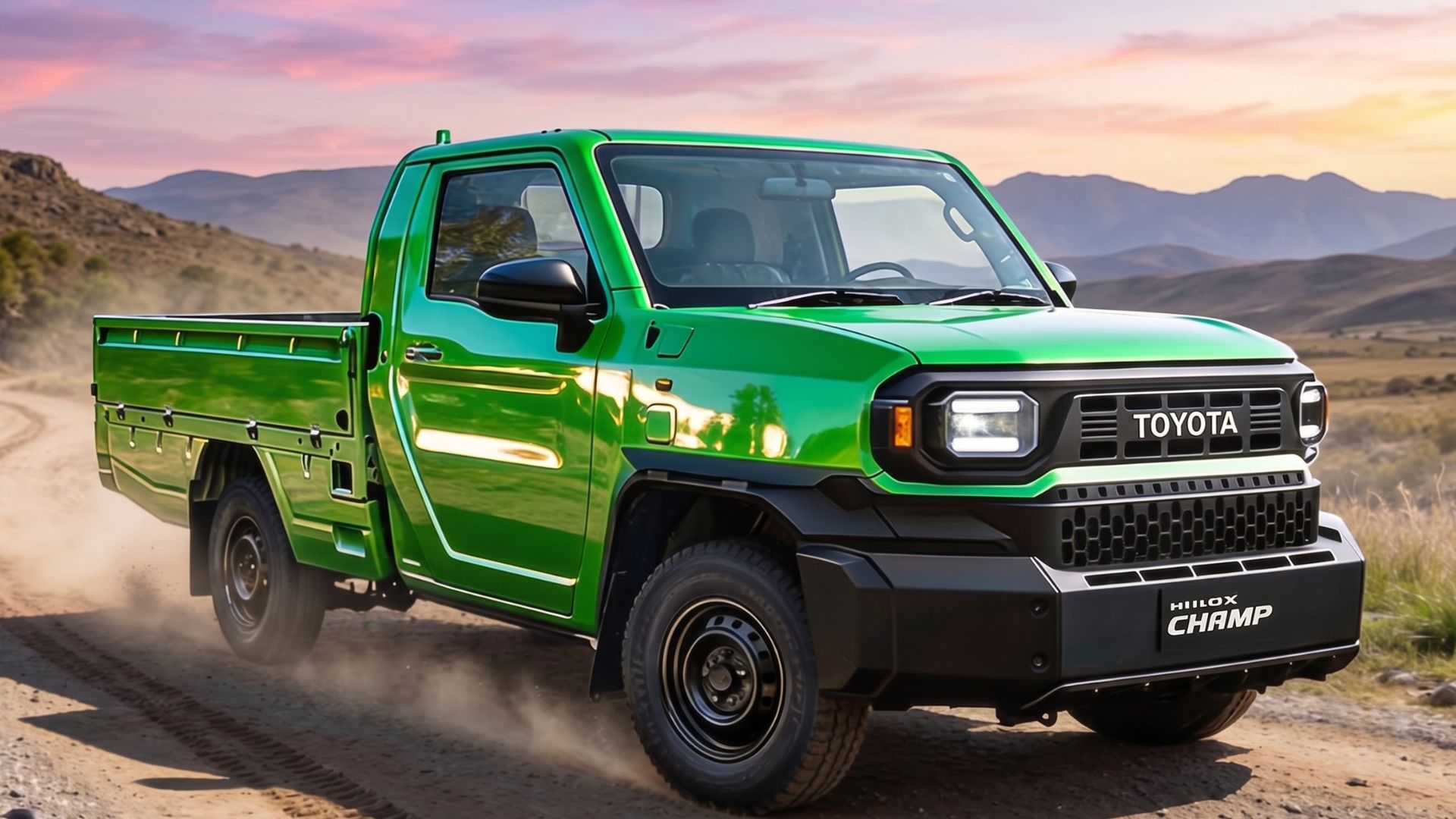
Toyota Hilux Champ costs around R$ 81,7 thousand in Thailand, bets on simplicity, modularity and can turn from ambulance to food truck.
Toyota has created a vehicle that seems to have come straight out of a 1990s automotive market, but was born to meet modern demands for logistics, transportation, and small businesses. The Hilux Champ was developed to be an extremely versatile work platform, simple to repair and adaptable to dozens of configurations. Initially sold in Thailand, the pickup draws attention for combining a ladder frame structure, turbo diesel engine, customization capability, and a price significantly lower than many mid-size pickups sold in various markets.
According to Toyota Thailand, the entry-level version with a 2.4 diesel engine starts at 519 thousand baht, about R$ 81,7 thousand in direct conversion. The conversion does not include taxes, freight, homologation, or import costs.
Toyota created a pickup designed to be transformed into practically any type of commercial vehicle
The Hilux Champ was born from the project known as IMV 0, presented by Toyota as a global platform aimed at emerging markets. The concept was simple: create a robust, cheap, and easily adaptable vehicle for different professional needs.
-
Chevrolet Onix leads the efficiency ranking among flex-fuel cars by Inmetro, achieves almost 18 km/l, and costs less than R$ 100,000.

-
Non-alcoholic beer is not always 0.0%: the drink can appear on the breathalyzer, result in a fine of R$ 2,934.70, suspend the driver’s license for 12 months, and even lead the vehicle to be impounded.

-
A burned Ferrari seemed destined for scrap, until a company removed the V8 engine, installed three electric motors, and transformed the old sports car into the 308 GTE with a 47 kWh battery.
-
Smaller than a Kwid and priced at around R$ 60,000, the Mitsubishi eK Cross EV features a 1,500 W outlet, 180 km range, and becomes a sort of power bank on wheels in Japan.

According to Toyota, the model was developed to receive different implementations directly on the chassis, allowing transformations into cargo body, mobile workshop, ambulance, food truck, refrigerated transport, minibus, or service vehicle.
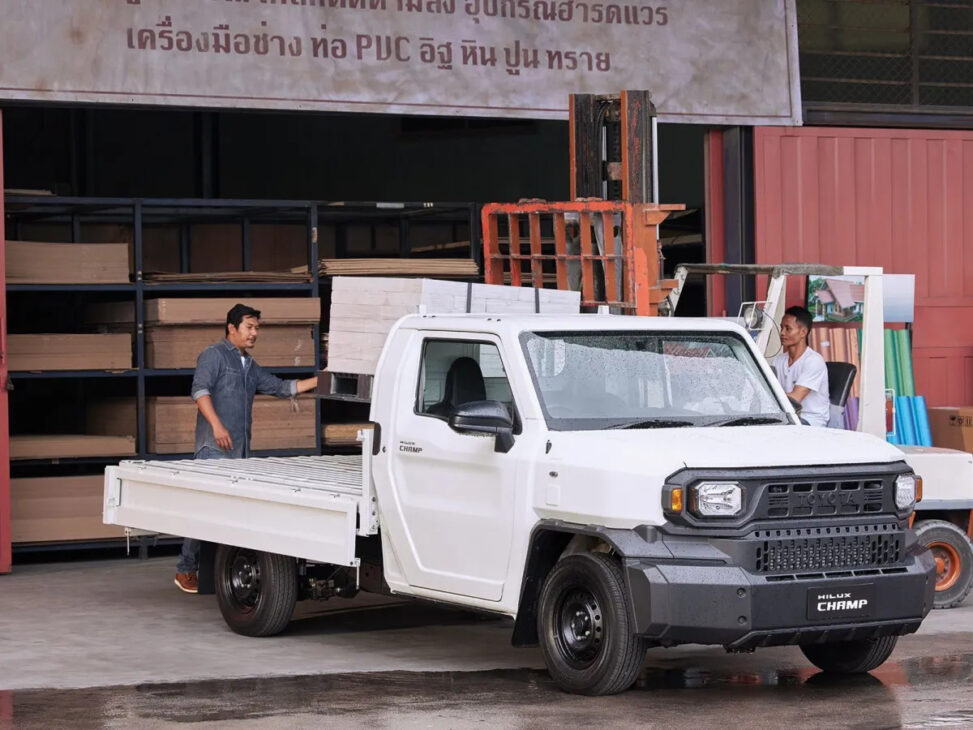
To facilitate this process, the rear structure has several attachment points that allow the installation of modules without major structural modifications. Toyota itself states that more than a hundred implement manufacturers can adapt the platform for different applications.
150-horsepower turbo diesel engine equips the most sought-after versions of the Hilux Champ
In the diesel versions, the Hilux Champ uses the well-known 2.4 turbo diesel 2GD-FTV engine of 2,393 cm³, widely used in other vehicles of Toyota’s IMV family.
According to information released by Toyota Thailand and official dealerships in the country, the engine delivers 150 horsepower at 3,400 rpm and up to 343 Nm of torque in manual versions, reaching up to 400 Nm in automatic versions.
The transmission can be a five-speed manual or a six-speed automatic, always with rear-wheel drive. Unlike the traditional Hilux, the Champ does not have 4×4 versions.
Dimensions reveal a pickup created to maximize cargo space
One of the differentiators of the Hilux Champ is the offer of different wheelbase lengths and bodies.
According to Toyota Thailand, the model is sold in versions with a total length between 4.52 meters and 5.30 meters, depending on the chosen configuration. The wheelbase can reach 3,085 mm, while the width remains at 1,785 mm.


The usable area of the body also varies. In the longer versions, the cargo compartment can reach 2,647 mm of internal length, allowing the transport of volumes incompatible with most compact pickups currently sold.
Simple interior makes it clear that the priority is work, not luxury
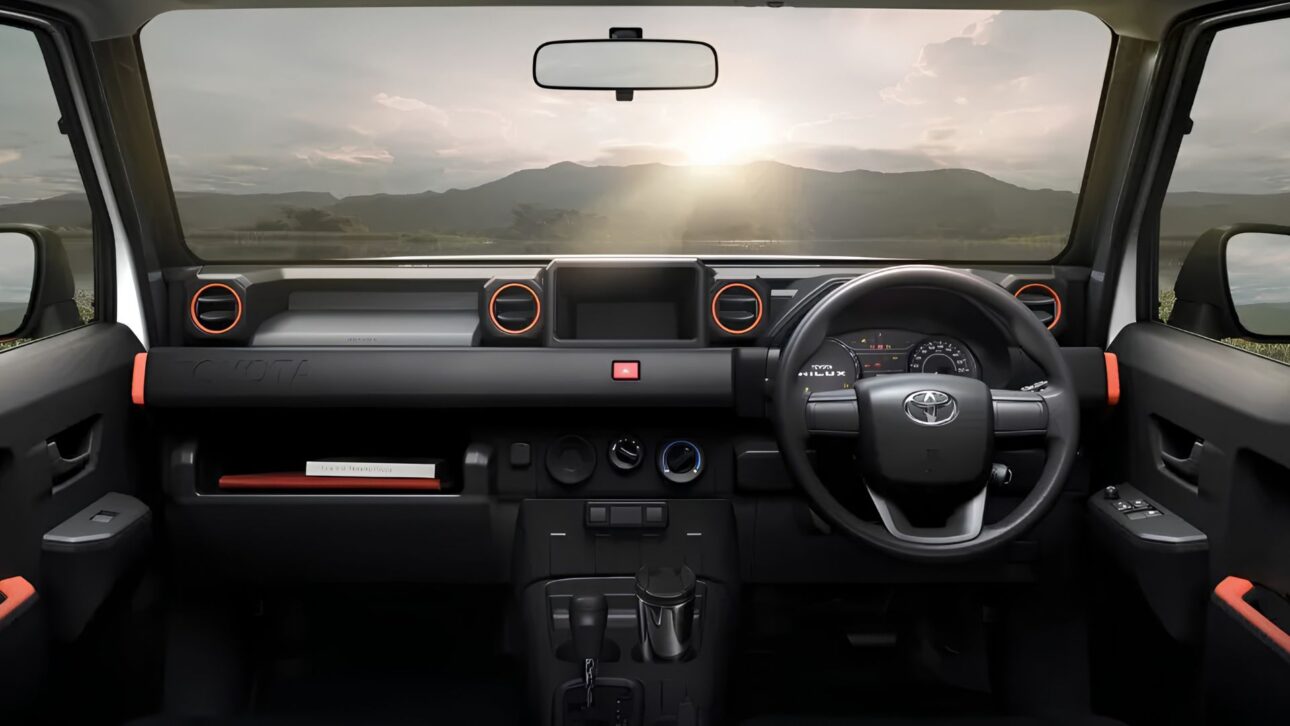
Upon entering the cabin, it is evident that Toyota prioritized operational cost and practicality. The basic versions have a cabin for only two occupants, simplified controls, and functional finishing. Depending on the configuration, items like electric windows, locks, and additional equipment appear only in the higher versions.
The strategy resembles classic utility vehicles that favored robustness and ease of maintenance over sophisticated equipment.
The most striking factor is the commercial positioning of the pickup. According to Toyota Thailand, the entry-level manual diesel version costs 519 thousand baht, while more equipped versions can exceed 615 thousand baht. In direct conversion, this represents approximately between R$ 81.7 thousand and R$ 96.9 thousand, not considering taxes and import costs.
For comparison purposes, this value is much lower than that practiced by a large part of the medium pickups currently sold in various markets, including the Brazilian one.
Why the Hilux Champ Sparks Interest in Markets Seeking Simpler and More Affordable Vehicles
In recent years, mid-size pickups have gained more technology, safety equipment, connectivity, and refinement, but they have also become significantly more expensive.
The Hilux Champ takes the opposite path. It bets on a formula based on mechanical simplicity, low acquisition cost, modularity, and ease of repair.
The success of the proposal may indicate that there is still room for utility vehicles focused on heavy work, especially in markets where small businesses, farmers, and service providers seek more affordable solutions than the traditional pickups currently offered.
Technical Specifications of Toyota Hilux Champ 2.4 Diesel MT C&C LWB
| Item | Specification |
|---|---|
| Engine | 2.4 turbodiesel 2GD-FTV |
| Displacement | 2,393 cm³ |
| Power | 150 hp |
| Torque | 343 Nm |
| Transmission | 5-speed manual |
| Drive | Rear (4×2) |
| Seats | 2 |
| Length | Up to 5,300 mm |
| Width | 1,785 mm |
| Height | 1,735 mm |
| Wheelbase | Up to 3,085 mm |
| Starting price in Thailand | 519,000 baht (about R$ 81,7 thousand) |
The Hilux Champ Shows That Not All Automotive Innovation Depends on Giant Screens or Electric Motors
While much of the industry rushes to launch increasingly sophisticated vehicles, Toyota has bet on a different idea: creating a modern work tool using simple concepts.
The result is a modular pickup capable of taking on dozens of different functions without giving up the robustness that has made the Hilux family known worldwide.
The question is whether there is room for something similar in markets where utility vehicles have become increasingly expensive and distant from those who really need them.










Be the first to react!