Portuguese
  Spanish


What looked like dark gravel on the ground of the Minas Gerais hinterland became the sixth occurrence of its kind ever recorded on the planet, a scientific enigma about a gigantic collision that melted the rock and then disappeared without leaving a crater
The meteorite glass found in northern Minas Gerais is not just any stone: they are fragments of rock that were melted and hurled into the sky by a violent impact, hardening in the air before falling back to Earth. Spread over hundreds of kilometers, they bear the signature of a catastrophe that no one witnessed.
The most intriguing part is what’s missing in the story. There was the impact, the glass remained, but the crater that should have been left on the ground simply isn’t there. It’s a geological crime with all the clues, except the scene.
A black gravel that was proof of an impact
The material went unnoticed for years. According to Space, the fragments are called geraisites, a name that honors the state of Minas Gerais, where they were found scattered across the terrain.
-
Philosophy Student Invents Self-Moving Wheelchair Controlled by Body Weight Using Pressure Sensors

-
Every Late September, Pilots Flock to Remote Northern Australia to Surf the Morning Glory Cloud Phenomenon

-
Switzerland Maps Light Patterns to Track Snowmelt and Forest Microclimates with 10-Meter Precision
-
Scientists Race to Harness Vast Underground Energy for Clean Electricity


At first glance, they didn’t seem like much. According to Space, they are dark objects, similar to common pebbles, the kind anyone would step on without imagining they were in front of a rare record of cosmic collision.
It was the trained eye that changed everything. What separated that gravel from any ordinary stone was not the appearance, but the origin: terrestrial rock melted by the absurd heat of an impact. Recognizing this transformed the hinterland ground into a scientific site.
Geraisites: the sixth field of its kind in the world
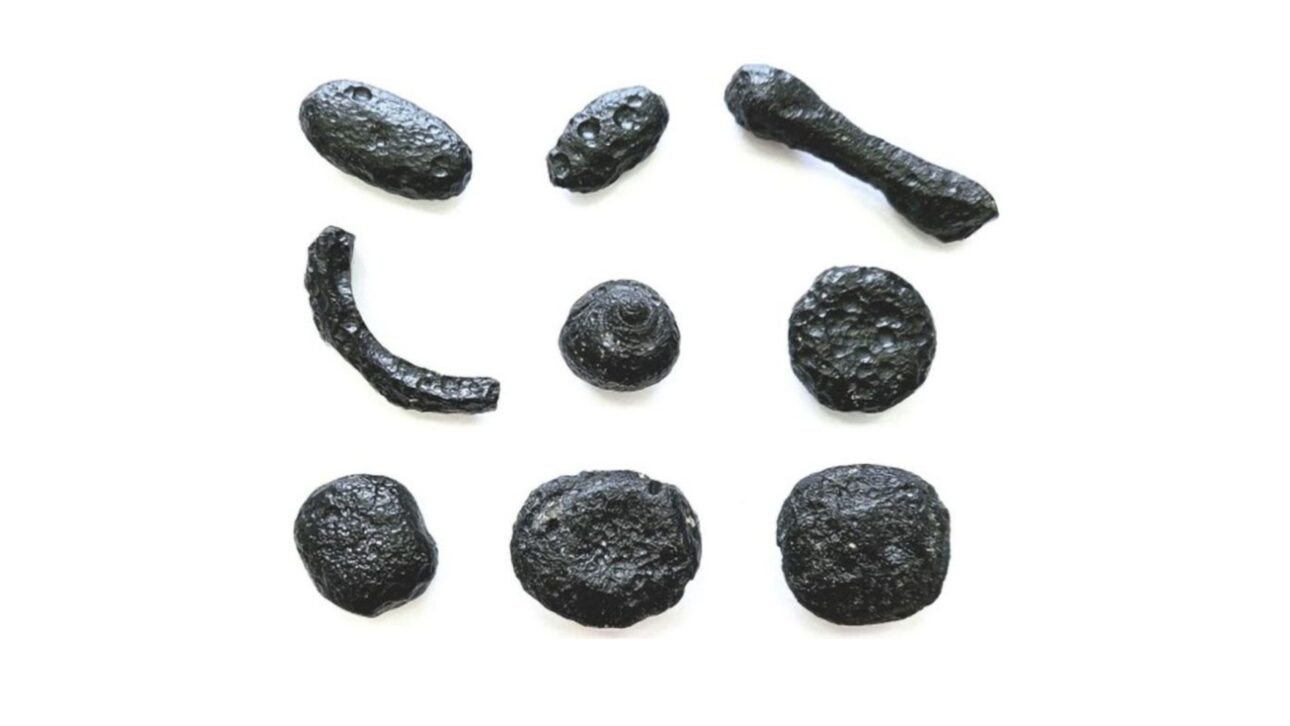
This type of material is extremely rare. According to Space, there are only a few known tektite fields worldwide, which makes each new occurrence an event for science.
Rarity has a number. According to SciTechDaily, until now only five of these fields were known in the world, in Australasia, Central Europe, the Ivory Coast, North America, and Belize, and the mining find has entered the list as the sixth.
Entering this club is a weighty matter. Having the only field of this type in the entire southern hemisphere in Brazil puts the country on the map of a geological phenomenon that most people have never heard of. The mining hinterland held a treasure of planetary geology.
One million fragments and 900 km of trail
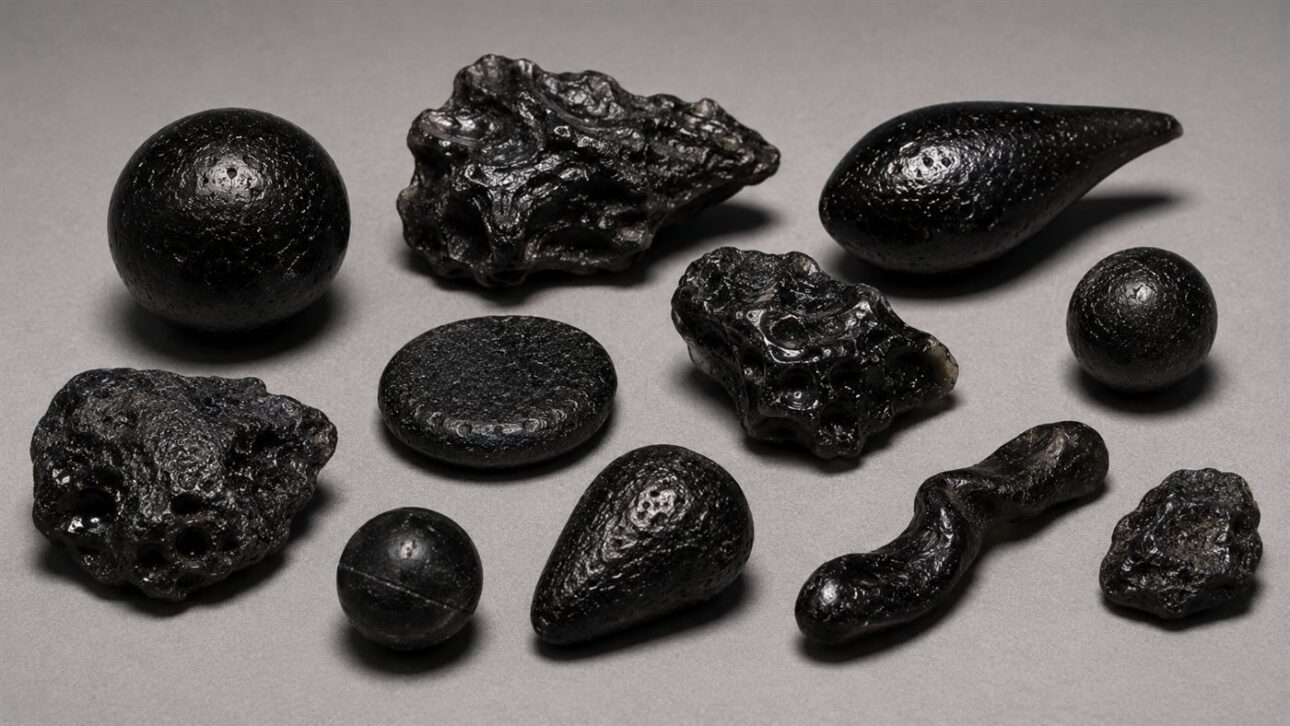
The quantity is impressive. According to SciTechDaily, researchers had already gathered more than 600 fragments by the time of the study’s publication, a jump from the approximately 500 collected by July 2025.
The covered area is even more astonishing. According to SciTechDaily, the material first appeared in a stretch of about 90 kilometers, in the municipalities of Taiobeiras, Curral de Dentro, and São João do Paraíso, in northern Minas Gerais, and the distribution reached more than 900 kilometers when adding specimens found in Bahia and Piauí.
This spread says a lot about the force of the event. Launching pieces of molten rock over hundreds of kilometers requires an explosion of energy hard to imagine, far beyond anything seen in human history. The trail is the measure of the violence.
Black on the outside, green on the inside
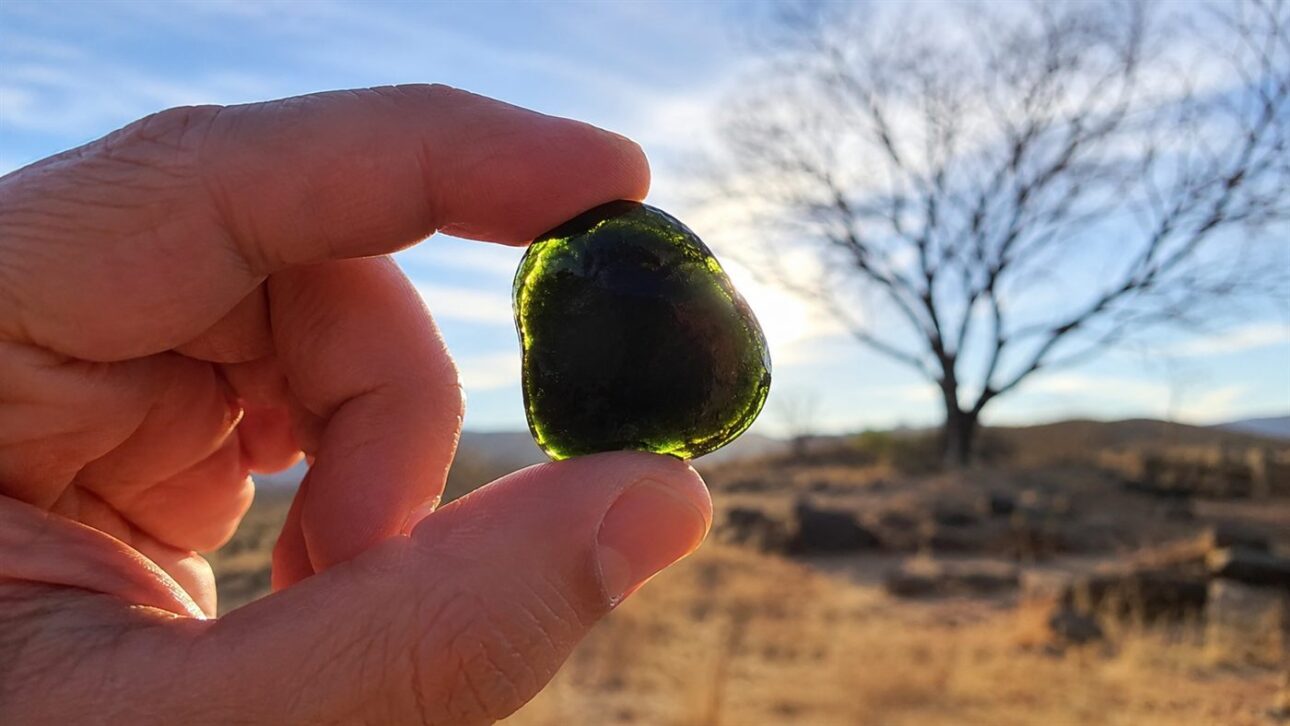
Up close, the material has a subtle beauty. According to SciTechDaily, the fragments are black and opaque at first glance, but when exposed to strong light, they become translucent and reveal a greenish-gray hue.
The shapes also tell the journey they made. According to SciTechDaily, there are spherical, ellipsoidal, drop-shaped, disc-shaped, dumbbell-shaped, and even twisted specimens, designs that are born from the flight of the molten rock through the air before cooling.
The size varies from tiny pieces to notable ones. According to SciTechDaily, weights range from less than 1 gram to 85.4 grams, with some fragments reaching 5 centimeters in the largest dimension. Each curve and each twist of the glass is the frozen record of seconds of flight at extremely high temperatures.
The chemistry that reveals the terrestrial origin
The proof that the meteorite glass originated from Earth itself is in its composition. According to SciTechDaily, the material has a silica content between 70.3% and 73.7% and sodium and potassium oxides between 5.86% and 8.01%, a signature compatible with melted continental rock.
The metals reinforce the picture. According to SciTechDaily, chromium levels between 10 and 48 parts per million and nickel levels between 9 and 63 parts per million were measured, data that help trace the source of the material.
But the decisive detail is the water. According to SciTechDaily, the water content was between 71 and 107 parts per million, much lower than volcanic glasses, which usually have from 700 ppm to 2%. Almost without water, this glass could only have formed in a flash of extreme heat, not in the slow interior of a volcano. The dryness is the fingerprint of the impact.
Three-billion-year-old rock melted in seconds
The age of the event was pinpointed precisely. According to SciTechDaily, the collision happened about 6.3 million years ago, at the end of the Miocene period, with measurements clustering around 6.78, 6.40, and 6.33 million years.
The melted material, however, is much older than the impact. According to SciTechDaily, the isotopic signature indicates that the molten rock came from the continental crust of the Archean period, aged between 3.0 and 3.3 billion years, in the São Francisco craton region.
This sets up an impressive scene. A piece of Brazil’s oldest basement, billions of years old, was melted in an instant and hurled into the sky by a single blow from space. The entire geological time collapsed in an instant of fire.
An international team and the journal Geology
The finding was not confined to a laboratory. According to Space, the study was conducted by researcher Álvaro Penteado Crósta, from the Institute of Geosciences at Unicamp, a reference in the country for extraterrestrial impacts.
The work had global reach. According to SciTechDaily, the research led by Crósta at IG-Unicamp brought together collaborators from Brazil, Europe, the Middle East, and Australia, in an effort to confirm the nature of the material.
And it earned the seal of formal science. According to SciTechDaily, the result was published in the journal Geology on December 2, 2025, officially recognizing the mining field as an internationally recognized discovery. It wasn’t a collector’s guess: it was peer-reviewed science, with numbers and signature.
The unresolved mystery: the vanished crater
The biggest enigma of the case is what doesn’t appear. According to Space, despite all the glass scattered across the terrain, the crater that should have been created by the impact has not yet been found.
Science has hypotheses for the disappearance. According to SciTechDaily, so far no associated crater has been identified, although the evidence points to an origin in the ancient basement of the region, suggesting that the hole may have been erased by erosion or covered over millions of years.
It’s the kind of mystery that keeps the search alive. There is evidence of the crime scattered over 900 kilometers, but the exact location of the strike remains hidden somewhere in the interior of Brazil. The hunt for the lost crater has only just begun.
Why the meteorite glass from Minas matters
The case of the geraisites shows that Brazil holds, in the open air, records of cosmic events of global scale that world science only knows in handfuls of places. A handful of meteorite glass on the ground of the hinterland has rewritten the planetary map of a very rare phenomenon.
The lesson is about what we tread on without seeing. If a black and dull pebble can be proof of an explosion from millions of years ago, how much more geological history is spread, silently, beneath our feet? The extraordinary was disguised as common.
And here’s the challenge for you: how many clues of ancient and grand catastrophes go unnoticed every day, just waiting for someone to look with the right curiosity?