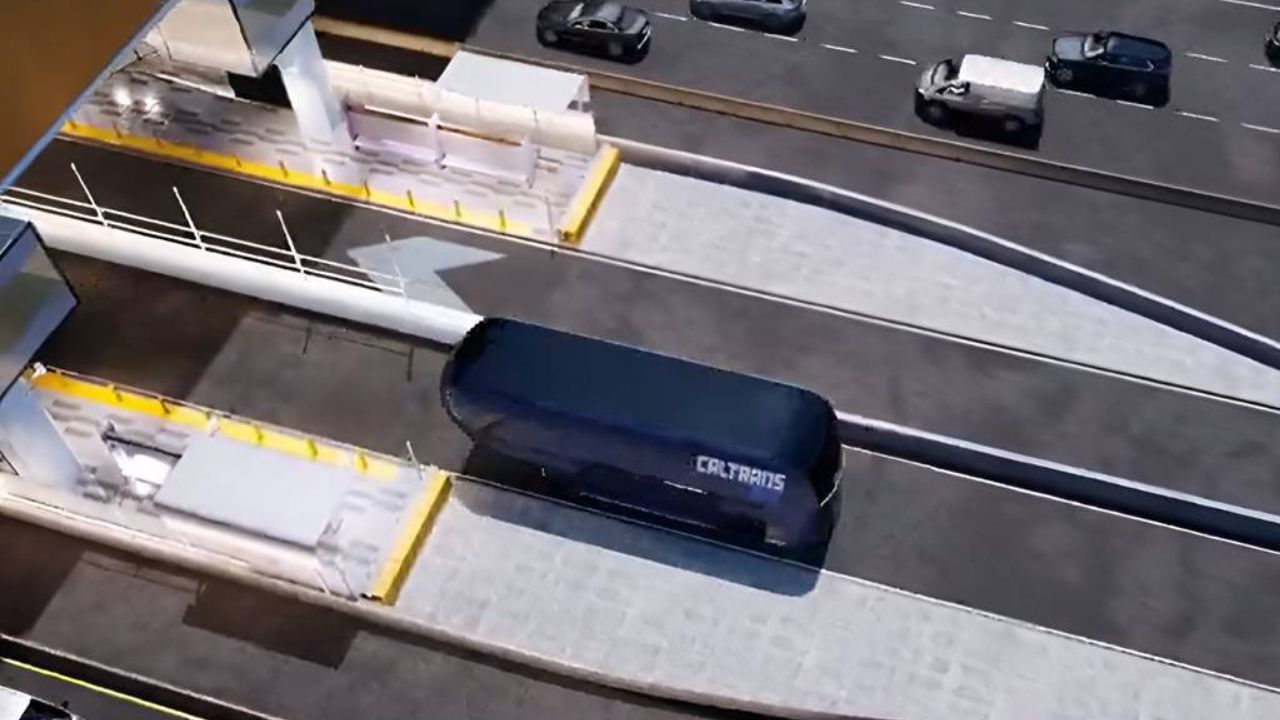

Inspired by the Autobahns, the bullet bus project in California focuses on high-tech lanes to offer fast travel with low state cost.
To make the bullet bus project feasible, the California Department of Transportation is seeking engineering references from world-renowned pavements, such as the German Autobahn and Texas toll roads.
The plan consists of creating an ultra-fast road transport network, operating between 130 km/h and 225 km/h on exclusive and segregated lanes, according to information from AutoPapo.
The goal is to offer a high-performance alternative to connect urban and tourist areas that would not be served by trains due to the prohibitive costs of tracks.
-
Rolls-Royce Turns Heads with 30-Inch Floating Wheels, 6.6-Liter V12 Engine, and 563 Horsepower

-
2019 Kia Sportage EX: A Spacious and Cost-Effective SUV with 2.0 Flex Engine and Panoramic Roof
-
Fiat Strada Becomes Top Seller in June, Surpassing Onix, Polo, Hilux, and T-Cross with 107 HP Engine and 732 km Range.

-
Suitcase-sized hydrogen engine spins at 25,000 rpm, nearly doubling the efficiency of conventional cars and replacing exhaust smoke with water vapor


Thus, the state plans to build parallel roads to current highways, ensuring that these vehicles never share space with common traffic.


The engineering challenges for the bullet bus
Currently, California’s road network has limitations that prevent high speeds, with curves and asphalt designed for maximums of 135 km/h.
To raise this standard and allow the bullet bus to travel safely, the infrastructure will need to undergo a deep technical overhaul.
According to Caltrans, rigorous maintenance and ground leveling are the keys to the proposal’s success.
The new exclusive lanes should feature specific construction characteristics:
- Elite paving: Perfectly flat asphalt to withstand friction at high speeds.
- Controlled geometry: Curves with calculated inclines to maintain vehicle stability.
- Passive safety: Implementation of wide escape areas along the route.
- Specialized vehicles: Buses with enhanced aerodynamics and engineering focused on maintaining cruising speed for long hours.
Express trips and the economic factor
Although the railway system is the main focus of billion-dollar investments in the state, the bullet bus emerges as a high cost-benefit bet.
The financial investment to implement asphalt is considerably less than what is required to install and maintain fixed tracks.
Moreover, buses offer a route flexibility that the rail system does not have.
In terms of time, feasibility studies are encouraging. If the system can maintain an average of 160 km/h (100 mph), travel time between major hubs would be drastically reduced:
- Los Angeles – San Francisco connection: Journey achievable in less than four hours.
- Use of strategic axes: Utilization of Interstate 5 and 80 routes, as well as U.S. Route 101.
- Logistical efficiency: Focus on maintaining constant movement without interruptions from passenger car traffic.
In this way, California hopes to circumvent the history of delays in rigid infrastructure works, betting on a technology that combines the performance of railways with the versatility of roads.
If paving challenges are overcome, the bullet bus could become the new standard of mobility for travelers on the American west coast.

Source: AutoPapo