






 Portuguese
  Spanish
  5 min of reading
  0 comments


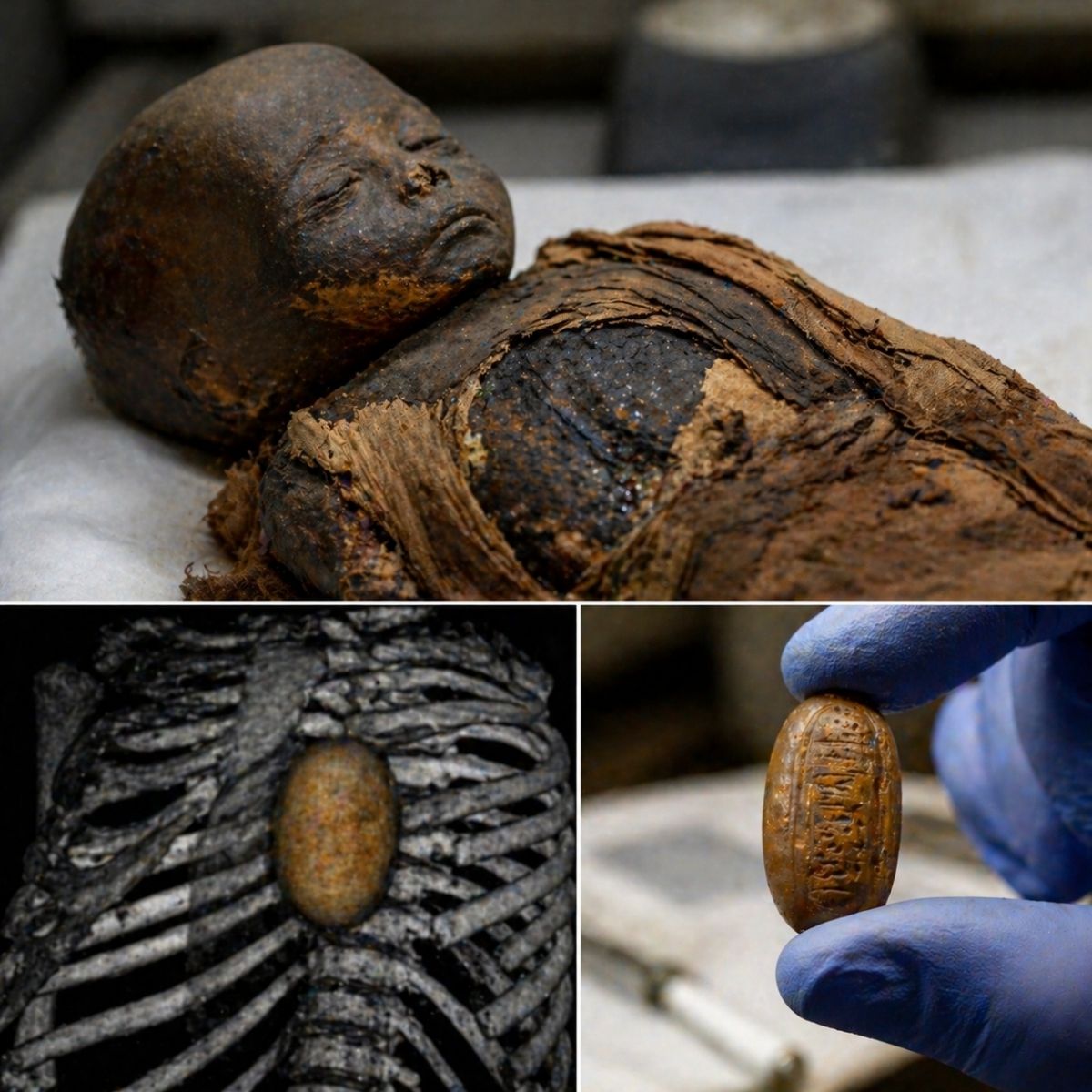
Researchers from Wrocław identified by X-ray an object in the chest of an eight-year-old child mummy from Ptolemaic Egypt, and believe it may be papyrus with the boy’s name from the region of Kom Ombo or Aswan, but the fragile cartonage prevents safe extraction.
Scientists conducted systematic radiological examinations for the first time on a child mummy from Egypt kept in Poland since 1914 and found an object that no one expected inside the boy’s chest. The mummy, which belongs to the collection of the Archdiocesan Museum of Wrocław and arrived in the city as part of the collection of Cardinal Adolf Bertram, revealed through computed tomography and X-rays the presence of an item inside the chest that Professor Agata Kubala from the Institute of Art History at the University of Wrocław believes could be a papyrus with the child’s name. The results were published in the journal Digital Applications in Archaeology and Cultural Heritage and open the possibility that, millennia after death, the boy may finally receive a name.
The research confirmed that the mummy belongs to a boy about eight years old, information obtained through the analysis of preserved soft tissues and the visible stage of dental development in the examinations. The body measures 123 centimeters in length, is wrapped in bandages and cartonage (material made of layers of linen or papyrus), and has a partially exposed face because a large part of the head wrappings was removed at some point in history. The examinations also confirmed that the brain was removed through the nasal cavity and that most of the internal organs were taken out, standard embalming procedures in ancient Egypt that indicate the child’s family had the resources to afford an elaborate funeral ritual.
What is the object found inside the chest of the mummy

The X-rays revealed the presence of an item inside the chest that clearly distinguishes itself from the bony structures and tissue remains. Professor Kubala stated that “it could be a papyrus containing, for example, the boy’s name,” a hypothesis based on the Egyptian practice of placing amulets, religious texts, or identifications inside mummies during the embalming process. If confirmed, the discovery would allow for the identification of a child who died over two thousand years ago and who has since only been known as “the child mummy of Wrocław.”
-
Survivor of 1966 SS Daniel J. Morrell Shipwreck in Lake Huron Recounts 38-Hour Ordeal in Extreme Cold

-
The Greatest Hoax in World Cup History? The Film That Denied Brazil’s 1958 Victory and Exposed How Fake Evidence Can Seem Convincing on TV
-
Fake South Korean Online Stores Offer Shopping Thrill Without Spending Money or Receiving Products
-
The War of Jenkins’ Ear: How a Severed Ear Sparked One of the 18th Century’s Most Unusual Conflicts


The problem is that extracting the object from the mummy without damaging it is a task that researchers have yet to accomplish. The cartonage surrounding the body is damaged and extremely fragile, and the team acknowledges that they have not developed a safe method to remove it without causing irreversible damage to the remains and the very object they wish to examine. The situation creates a dilemma that summarizes the ongoing challenge of archaeology: what is inside the mummy may contain the most valuable answer to the research, but the cost of obtaining it may be the destruction of the material they want to preserve.
Where the mummy came from and how it arrived in Poland
The analysis of the cartonage, which serves as a decorated and protective wrapping for the body, provided clues about the child’s geographical origin. The comparison of decorative patterns with cataloged specimens from other collections suggests that the boy came from the southern Upper Egypt, probably from the region of Kom Ombo, Aswan, or some neighboring necropolis, areas that during the Ptolemaic period maintained well-documented embalming traditions in archaeology. The mummy arrived in Wrocław in 1914 as part of Cardinal Adolf Bertram’s private collection and has remained in the Archdiocesan Museum since then without ever undergoing radiological examinations until this research.
The team is also working on the detailed interpretation of the decorative elements of the cartonage to refine the dating. The Ptolemaic period of Egypt, which extended from 305 BC to 30 BC, combined Egyptian funerary traditions with Greek influences, and the iconographic details present on the mummy’s wrapping may indicate not only when the boy lived but also the socioeconomic level of his family and the type of funeral ritual he received. The task is complex because the cartonage is deteriorated, but each legible fragment contributes to reconstructing the context in which the child lived and died.
What modern technology revealed about the mummy that human eyes could not see
Computed tomography and X-rays have transformed how the mummy is studied without needing to touch the body. The examinations performed by Dr. Maciej Mazgaj at the Regional Hospital in Lublin allowed for the visualization of internal structures that embalming preserved for millennia, including the condition of the teeth that determined age, the cavities left by organ removal, and the dark embalming substance reinforcing the bandages in the neck region. The mummy’s head and neck are darkened and covered with white salt crusts, traces of the dehydration process with natron that was fundamental for the body’s preservation.
The research team included names such as Marzena Ożarek-Szilke, Stanisław Szilke, and researcher Wojciech Ejsmond, and the work reinforces the value of non-invasive technologies for studying mummies. Instead of unwrapping the body and risking the loss of information contained in the layers of bandaging, imaging scans can penetrate each stratum without altering it, an approach that preserves the mummy intact while extracting data that previous generations of researchers would only obtain by destroying what they wanted to study. The object in the boy’s chest remains sealed precisely because the technology that identified it is more advanced than the technique available to safely remove it.
What could happen if scientists manage to open the mummy
If a safe extraction method is developed, the object found in the thorax could reveal information that would completely change what is known about this child. A papyrus with the boy’s name would give identity to a human being who until now existed only as a museum specimen, transforming “the child mummy from Wrocław” into a person with a name, origin, and history that could be cross-referenced with archaeological records from the Aswan or Kom Ombo region. In addition to the name, Egyptian funerary papyri often contained prayers, incantations, or passages from the Book of the Dead, texts that would provide context about the family’s religious beliefs and the treatment of child deaths in Ptolemaic Egypt.
While such a method does not exist, the mummy remains stored in the Polish museum with its secret sealed within its chest. Researchers maintain hope that advancements in conservation and micro-extraction techniques will, in the near future, allow access to the object without compromising the body that has protected it for millennia. Until then, the nameless boy from Wrocław will continue to be studied by technologies that see through his bandages, awaiting the day when science finally has enough care to open what embalming sealed.
And you, do you believe scientists will manage to discover the boy’s name? Should the object be removed even with the risk of damage to the mummy? Leave your opinion in the comments.





Be the first to react!