Portuguese
  Spanish


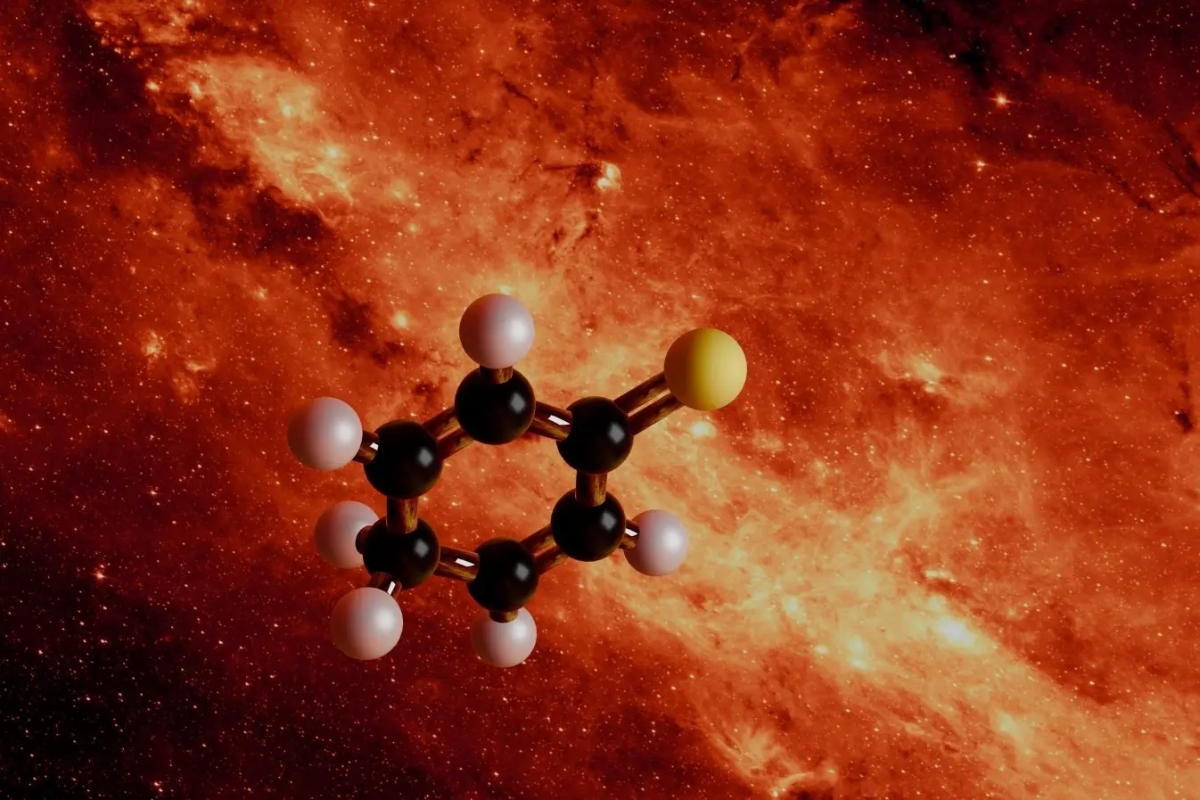


Finding near the center of the Milky Way reinforces the hypothesis that crucial compounds for biology may have formed in space and reached Earth long before the emergence of life
An international team identified in space the largest organic molecule with sulfur ever found among the stars. The structure has 13 atoms, was announced in January 2026, and has brought the discussion about the origin of life on Earth back to the forefront of astrobiology.
The compound appeared in the G+0.693 0.027 molecular cloud, about 27 thousand light years from Earth, near the center of the Milky Way. The impact is immediate because sulfur is an important component in molecules linked to life and expands the map of chemistry that exists in the cosmos.
Therefore, the finding has gained traction as a possible link between space chemistry and life, suggesting that crucial ingredients may have emerged long before the birth of the planet.
-
She heard for decades that space was not a place for women, became a pioneer in aviation, was part of the Mercury 13, and at 82, finally traveled with Jeff Bezos before dying at 87.

-
Scientists investigate microplastics in the airways of patients with sleep apnea and reveal a new focus for research on environmental pollution, human exposure, and possible impacts on breathing quality.
-
For the first time, scientists have seen the ocean floor open up in real-time—plates moving apart by two meters in a few days and 160 million cubic meters of lava emerging on the seafloor.
-
Iraq floats and sinks under an arm of the Euphrates 10 giant concrete boxes of 46,000 tons and 125 meters each to assemble a 2.4 km submerged tunnel and open a new land route between Asia and Europe.





G+0.693 0.027 cloud at 27 thousand light years became the stage for the discovery
The region where the molecule was detected has already attracted the attention of astronomers for concentrating a rich and unusual chemistry. Being close to the center of the Milky Way transforms this cloud into a natural laboratory to observe how complex compounds arise in the interstellar environment.
It was in this scenario that scientists located a signal compatible with a larger and more complex sulfur-containing organic molecule than anything that had been confirmed so far among the stars. The result elevated the significance of G+0.693 0.027 in the debate about the formation of compounds linked to life.
Structure with 13 atoms surpasses what had been seen with sulfur in space
The new molecule has the formula C6H6S and comprises 13 atoms in a stable structure that has drawn attention for its complexity. Until now, sulfur-containing compounds detected in interstellar space were smaller and left a significant gap between the chemistry of the cosmos and the chemistry found in bodies of the Solar System.
This leap in scale changes the interpretation of the topic. The presence of such an elaborate structure suggests that deep space can form more sophisticated molecules than previously thought, including those with characteristics similar to substances seen in comets, meteorites, and asteroids.
Confirmation on January 23, 2026 came from the crossing between laboratory and radio telescopes

According to Nature Astronomy, an international peer-reviewed scientific journal, the team confirmed the molecule by combining measurements made in the laboratory with signals captured by radio telescopes in Spain. This cross-referencing strengthened the result and eliminated the chance of a hasty identification.
The method also helps explain why the discovery attracted so much attention. First, the researchers obtained the signature of the molecule in a controlled environment. Then, they looked for the same pattern in deep sky observations and found the coincidence in the molecular cloud near the galactic center.
Sulfur enters amino acids and takes the discovery to the debate about life
Sulfur is the tenth most abundant element in the universe and is involved in essential amino acids for the functioning of life, such as those that help form proteins. When a large molecule containing this element appears among the stars, the discussion shifts from being merely astronomical to directly entering the field of the origin of life.
This does not mean that scientists have found life in space. What has emerged is a strong clue that the chemistry necessary to assemble biological ingredients may begin long before the formation of planets, in cold, dense clouds scattered throughout the galaxy.
Comets, meteorites, and asteroids gain new weight in this chemical route
The discovery reinforces the hypothesis that part of the compounds that fueled ancient Earth came from space in comets, meteorites, and asteroids. If complex sulfur-containing organic molecules already existed in the interstellar medium, the bridge between the cosmos and the planet’s chemistry becomes shorter.
That is why the finding has come to be treated as a possible missing link. The newly detected molecule does not alone solve the mystery of life, but it strengthens the idea that the chemical material that paved the way for it may have begun to organize long before Earth existed.
The discovery expands what science knows about cosmic chemistry and gives new momentum to the search for even larger compounds in space. Each advancement in this area brings researchers closer to understanding how elements scattered throughout the galaxy could turn into complex organic matter.
In the end, the weight of the announcement lies in what it represents. Finding the largest organic molecule with sulfur ever seen among the stars raises the bar for astrochemistry and repositions the discussion on how the ingredients of life may have arrived on Earth.
This article was produced based on information published by the journal Nature, one of the leading scientific publications in the world.