






 Portuguese
  Spanish
  3 min of reading
  0 comments


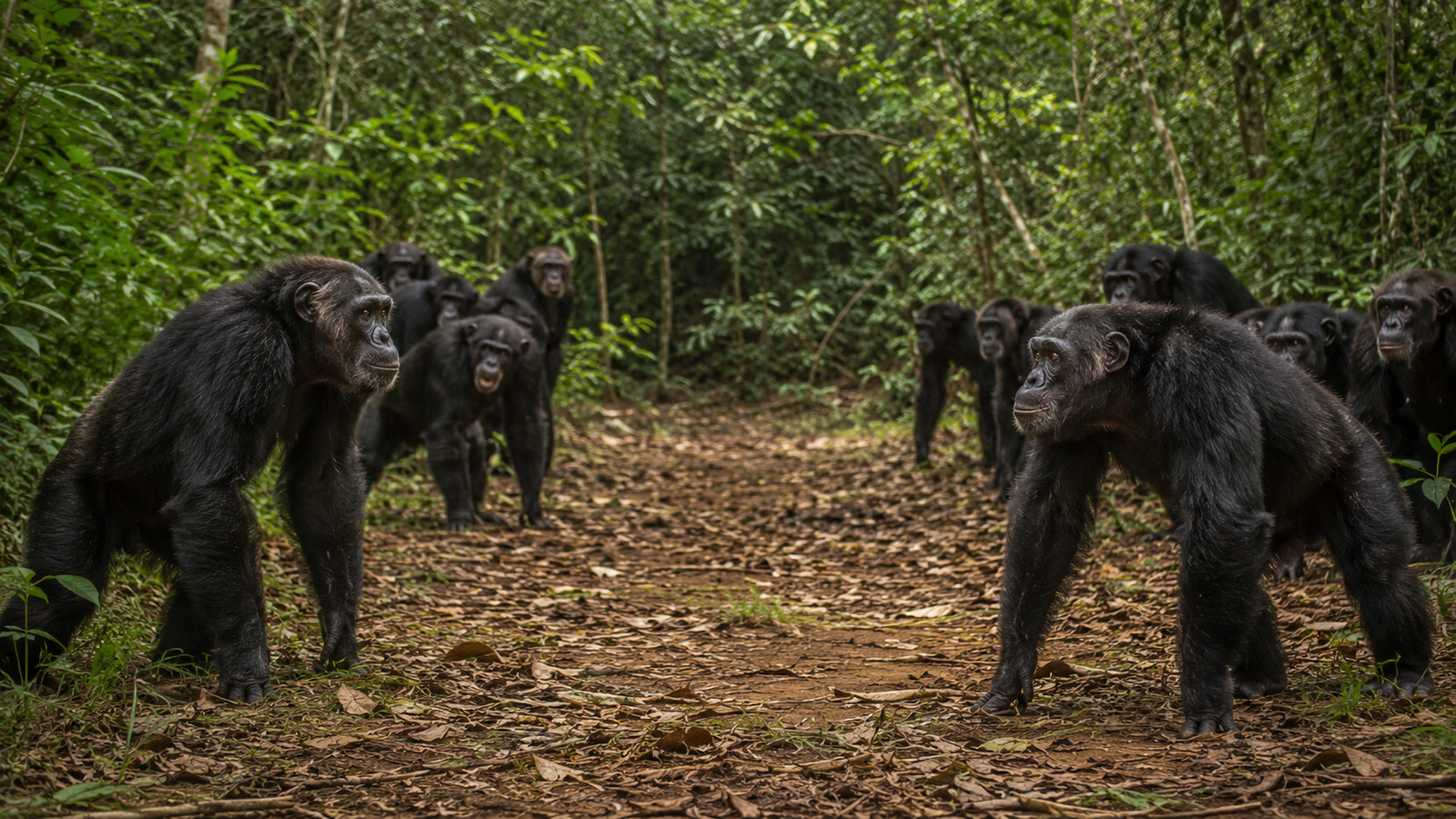
Research published in Science details how the largest habituated community of wild chimpanzees ever recorded split in Ngogo, Uganda, after years of social distancing, territorial patrols, and lethal attacks among former companions
The civil war among chimpanzees recorded in Ngogo, Uganda, began after the division of a community with more than 200 individuals and resulted in 24 attacks between 2018 and 2024. The conflict, described in research published in Science, left more than 20 chimpanzees dead, including infants.


Civil war among chimpanzees began after separation in Ngogo
The case occurred in Ngogo, a region in Uganda where scientists have been monitoring a large habituated community of wild chimpanzees for about three decades.
The group, with more than 200 individuals, underwent a process of social polarization starting in 2015.
-
Apple and Tesla on Alert After Cyberattack on Indian Supplier Exposes Over 200,000 Confidential Files, Industrial Projects, Employee Data, and Potential Trade Secrets on the Dark Web

-
In the Atacama Desert, a Tropical Oasis with Pool and Palm Trees Hosts Astronomers Studying the Universe

-
São Paulo Unveils 500 Electric Buses with $1.3 Billion Investment, Aiming to Cut 20 Million Liters of Diesel Annually and Showcase Clean Mobility

-
Robot Works 900 Hours to Build World’s Tallest 3D-Printed Concrete Tower, 30 Meters High, in Swiss Village of 12 Residents




The division did not happen immediately. Initially, some chimpanzees began occupying the central region of the territory, while another group settled in the western area of Ngogo. Even so, the animals still maintained interactions.
For some time, former members of the same community continued to interact, including engaging in sexual relations and joint hunting activities.
The change gradually solidified until scientists confirmed in 2018 that the two groups were completely separated.
Separation turned into lethal conflict among former companions
With the permanent split, the relationship between the groups changed dramatically. Between 2018 and 2024, researchers recorded 24 attacks, with more than 20 chimpanzee deaths. The victims included adult males and, later, even infants from the opposing group.
The research indicates that the chimpanzees began patrolling the new territorial boundaries. These movements reinforced intergroup violence and turned former companions into rivals involved in lethal attacks.
The study describes the episode as a rare phenomenon of permanent division among wild chimpanzees.
In 50 years, this is only the second documented case of group separation in the species. The first was reported by Jane Goodall in Gombe, Tanzania.
Study used GPS, field observation, and genetics
The Ngogo community has been monitored by scientists for three decades, which has allowed for the reconstruction of behavioral transformation over time. The analysis combined GPS data, field observations, and genetic information.
These records helped identify how the social organization of the chimpanzees changed before the definitive separation.
The study indicates that the split occurred after a period of social and spatial “partitioning,” during which the subgroups progressively distanced themselves.
The division became irreversible when social ties weakened. Individuals who acted as “bridges” between the subgroups died due to diseases, reducing connections that still maintained some integration among the chimpanzees.
Females also help explain the group’s dynamics
Although males attract more attention for leading patrols and participating in intergroup violence, the study highlights that females play a fundamental role in the social structure of chimpanzees.
They influence the group’s dynamics through decisions related to space usage, food selection, reproductive strategies, and complex social relationships. Therefore, violence between groups cannot be understood by considering only the males.
The research also contrasts this behavior with that of bonobos. Despite being equally close to humans, bonobos form more tolerant associations between groups and do not engage in lethal conflicts after divisions.
This article was prepared based on information from the provided material and the research published in the journal Science, with data, numbers, and statements preserved as per the consulted material.
Data and information from CNN and BBC were used in this article, along with other consulted sources.


Be the first to react!