Portuguese
  Spanish


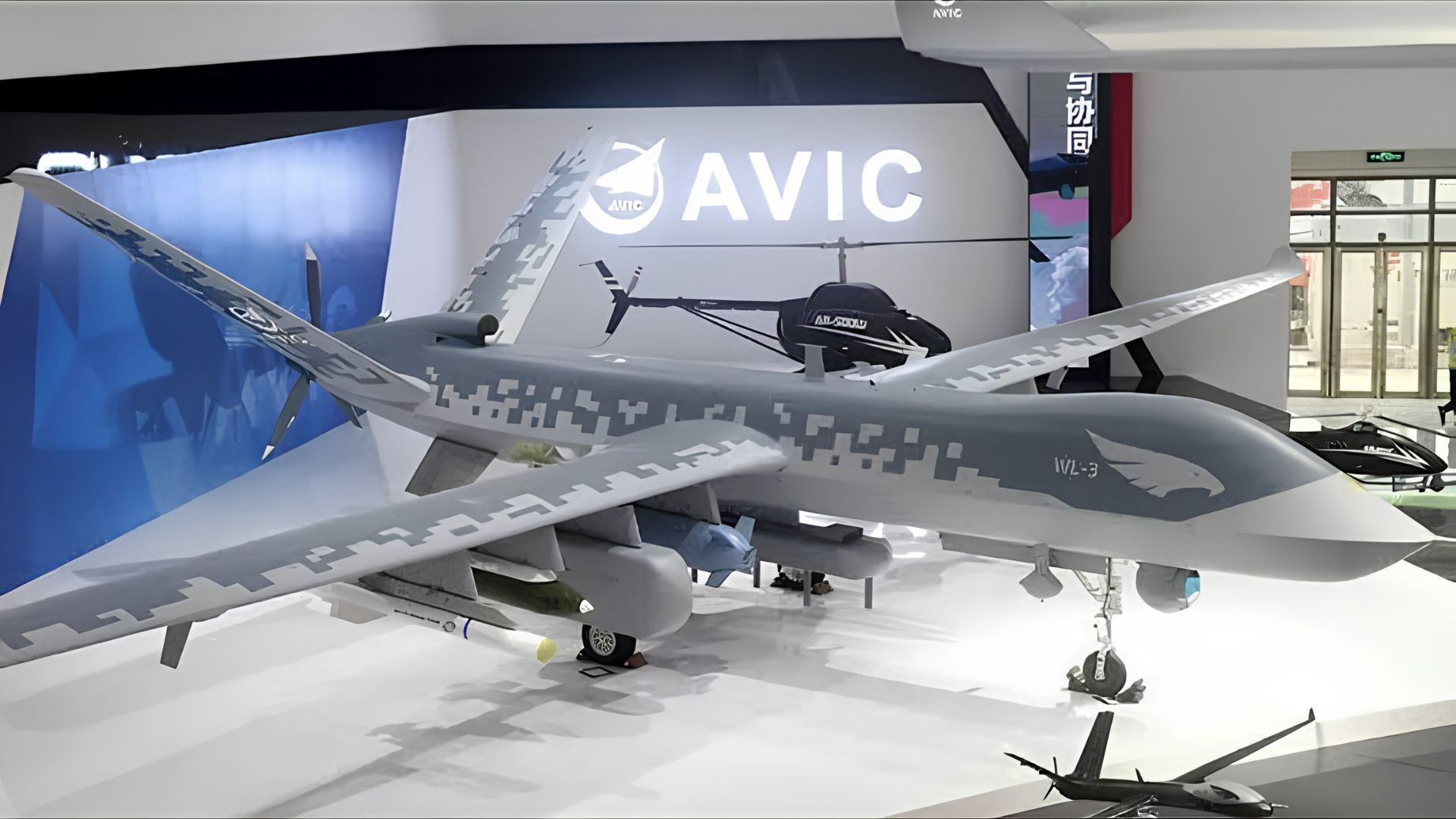


China presents Wing Loong 3, military drone with a range of 10,000 km, autonomy of up to 40 hours, and anti-submarine capability.
China is rapidly expanding its military capabilities with large drones, and one of the projects that has attracted the most attention in recent years is the Wing Loong 3, an unmanned aerial vehicle developed by the Chinese state-owned Chengdu Aircraft Industry Group for surveillance missions, maritime attack, and anti-submarine warfare.
The drone impresses mainly due to its scale. According to data presented during the Airshow China and reproduced by defense-specialized publications, the Wing Loong 3 features:
- wingspan of approximately 24 meters;
- maximum takeoff weight of about 6.2 tons;
- autonomy exceeding 40 hours;
- and operational range estimated at up to 10,000 kilometers.
The wingspan makes the model comparable in size to some light executive jets, while the autonomy allows the aircraft to remain in the air for almost two full days without landing.
-
Abandoned Building in Brazil to Become Biotechnology Unit with $10 Million Investment, Bridging Science, Industry, and Public Health

-
Netherlands Builds Giant 240-Meter Inflatable Barrier That Rises to Protect Cities from Storm Surges

-
Brazilian Submarine Robot “FlatFish” Operates Independently at 3,000 Meters Depth to Inspect Seafloor Pipelines Without Support Vessels
-
Eufy Unveils Omni S2: Advanced Robot Vacuum with 30,000 Pa Suction, Self-Cleaning Mop, AI Obstacle Avoidance, 12-in-1 Station, and Built-In Fragrance Dispenser



The drone was presented as a platform for submarine hunting
The most unusual aspect of the project is precisely its maritime function. According to information released by the Chinese industry and reproduced by defense-specialized media, the Wing Loong 3 was designed to carry out anti-submarine missions using sensors deployed in the ocean called sonobuoys.


These sonobuoys are equipment used to detect noises emitted by submarines underwater. Traditionally, this type of operation requires:
- large manned aircraft;
- specialized operators;
- complex acoustic systems;
- and complete military teams analyzing data in real-time.
The Wing Loong 3 attempts to automate part of this process using artificial intelligence, onboard sensors, and long-duration patrol capability.
China claims that the drone can execute complex oceanic patrol missions
The presentations of the Wing Loong 3 indicate that the drone was designed to operate in large maritime areas for extended periods.
According to materials released during the Airshow China, the aircraft can operate in:
- maritime surveillance;
- reconnaissance;
- surface attack;
- search and rescue;
- electronic warfare;
- and anti-submarine missions.
The promotional images showed the drone carrying:
- sonobuoys;
- maritime sensors;
- armaments;
- and reconnaissance equipment.

Part of the international analyses on the project highlights that the Chinese objective seems to be to reduce dependence on extremely expensive manned aircraft in long-duration oceanic patrols.
The range places the drone among the largest military models in the category
Another point that drew attention was the disclosed range. According to presentations related to the program, the Wing Loong 3 would have the autonomy to cover about 10,000 kilometers, a distance sufficient to cover vast maritime areas without the need for refueling.
This would allow prolonged missions in disputed regions of the Indo-Pacific, an area that concentrates:
- strategic trade routes;
- increasing submarine presence;
- territorial disputes;
- and increased naval activity from China, the United States, and Asian allies.
The autonomy of over 40 hours also allows the drone to remain in surveillance orbit much longer than various conventional manned aircraft.
The Wing Loong 3 is part of China’s expansion in military drones
The project is part of a larger family of Chinese military drones Wing Loong, created to compete internationally with American and Israeli models.
Previous versions had already been exported to several countries in the Middle East, Africa, and Asia. The Wing Loong 3 appears as a much larger and heavier evolution of the previous line.
In addition to maritime capability, the drone was also presented as a multifunction platform with potential for:
- ground attack;
- limited air combat;
- strategic reconnaissance;
- and intelligence operations.
Experts still treat some of the capabilities with caution
Although the technical numbers released by China are impressive, some of the announced operational capabilities still lack broad independent validation.
A large part of the available information came from presentations by the Chinese industry itself and military analyses based on officially released materials.

Even so, experts point out that the program clearly shows the strategic direction followed by China: increasingly replacing traditional military operations with long-range unmanned systems.
The drone shows how naval warfare is entering a new phase
For decades, hunting submarines required huge manned aircraft, highly trained crews, and extremely expensive operations. Now, giant long-range drones are beginning to take over some of these functions.
And perhaps that’s exactly what makes the Wing Loong 3 so symbolic: it shows how artificial intelligence, automated sensors, and unmanned aircraft are beginning to transform even one of the most complex military missions on the planet into something that can be executed by a single drone operating thousands of kilometers from the base.