Portuguese
  Spanish


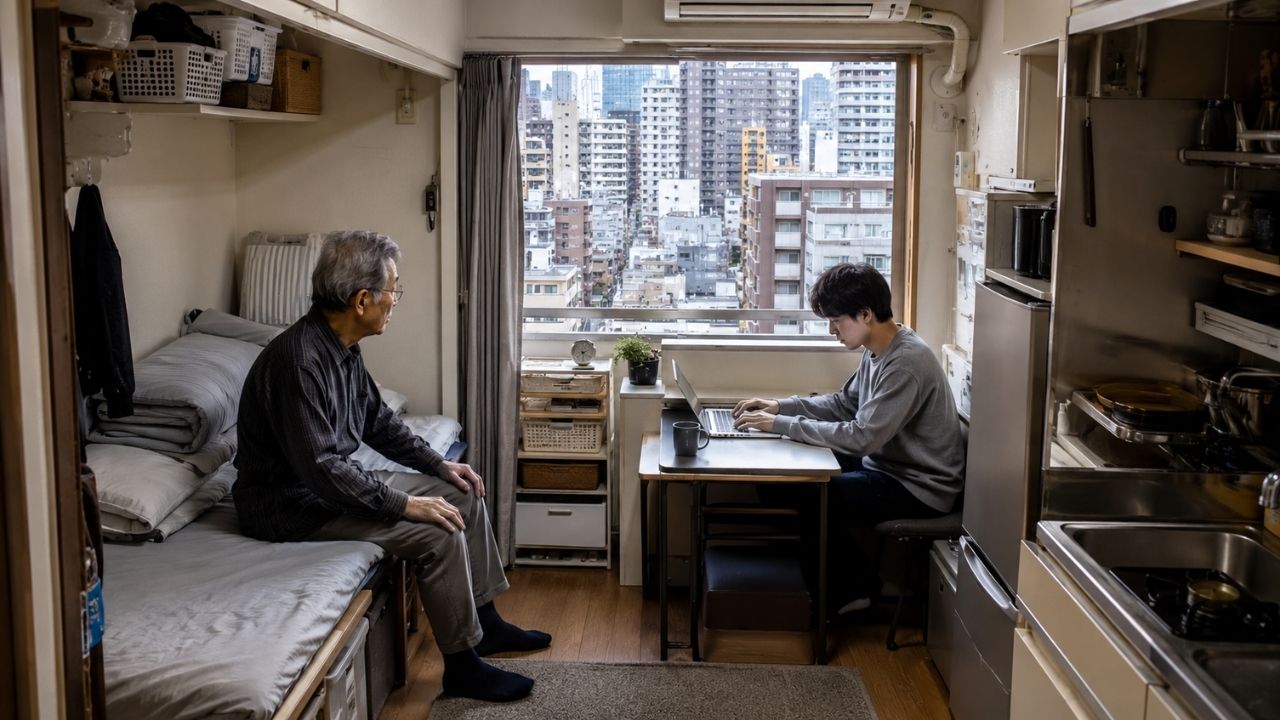

In Japan, an official survey indicates that the average size of homes has fallen to the lowest level in three decades, with smaller apartments, higher construction costs, and expensive land pushing young people, the elderly, and families into reduced spaces, while the real estate market tries to preserve current competitive prices and profit margins.
Japan has reached the smallest average home size in 30 years, according to an official survey conducted periodically by the Japanese government. By the end of 2024, homes averaged 90 m², below the peak of 93 m² recorded in 2003.
The reduction affects single-family homes, condominiums, multi-family properties, and rental units. This movement occurs amid rising construction costs, the appreciation of land in contested areas, and the real estate market’s attempt to maintain more competitive prices, with a direct impact on young people, families, and the elderly.
Homes in Japan have reached the smallest average size in three decades

The most symbolic data of the change is the drop to 90 m² of average area in Japanese homes. The difference compared to the peak of 2003 may seem small in absolute numbers, but it reveals a prolonged trend of reducing domestic space.
-
Major Appliance Manufacturer Closes Factory in Argentina, Shifts Production to Brazil, and Restructures in Latin America with Mexico Closure, Investing Up to $165 Million

-
China to Revive $3.6 Billion Mega-Dam Project in Myanmar, Stalled Since 2011, Promising 6 GW Capacity and Completion in Eight Years

-
Foreign Company Wins Auction for Brazil’s First Immersed Tunnel, a $1.3 Billion Project with $14 Million Contract Under Federal Investigation

-
China’s Century Megaproject Wows the World: Massive Water Transfer Network Moves Water from Wet South to Arid North, with Ambitious Plans in the Tibetan Plateau Involving Giant Tunnels at Altitudes up to 4,000 Meters



This change has become more evident in the last five years. The country is not just building smaller apartments for aesthetic choice, but due to economic pressure, in a market where building, buying land, and selling larger properties has become more difficult.
Multi-family apartments show the squeeze more clearly
In multi-family units, the scenario is even tighter. The average reached about 50 m², five square meters below the size considered adequate by the government for two adults in urban areas.
This number helps explain why the discussion goes beyond the real estate market. When the minimum space to live comfortably begins to shrink, housing ceases to be just a property issue and starts affecting routine, privacy, mental health, and family planning.
Construction costs rose and pushed properties down
One of the reasons cited for the reduction in housing is the increase in construction costs. According to the cited report, these costs have risen by about 30% since 2015 in Japan, putting pressure on developers and builders.
To maintain more affordable prices and preserve margins, companies have started to reduce the size of properties. In practice, the buyer may continue to pay competitive prices but receives less space for the same financial effort.
Expensive land worsens the equation in sought-after residential areas
In addition to more expensive construction, land in popular residential areas has also become more valuable. This reduces the room for maneuver for larger projects, especially in urban regions where the demand for location remains high.
With expensive land, large and custom properties lose space to smaller units. The result is a market where size becomes the adjustment variable: when the cost rises, the size decreases to keep the final price within a feasible range.
Young people face greater barriers to starting a family
The reduction in living space weighs especially on young people. In a country already facing declining birth rates and an aging population, the difficulty in accessing larger properties may discourage couples from starting a family.
Having children requires space, stability, and predictable income. When small apartments become the most viable option, many young people start to delay family plans or recalculate what they can sustain at home.
Stagnant salaries hinder access to larger homes
Experts cited in the discussion point out that isolated housing policies may not be enough to solve the problem. During Japan’s period of high economic growth, salary increases helped more people buy larger homes.
Today, this scenario is different. If salaries do not keep up with the cost of properties, the reduction in size becomes a direct consequence. The problem ceases to be merely architectural and starts to involve income, employment, cost of living, and purchasing power.
Elderly also face obstacles in renting
The housing problem in Japan does not only affect young people. A growing number of elderly people have difficulty renting properties, even when they have the financial means to pay. The barrier appears in landlords’ requirements, such as younger emergency contacts.
Data from the 2020 census indicate that the country had 6.7 million single-person households with residents aged 65 or older, equivalent to 12% of the total. The cited projection is that this number will reach 8 million by 2030.
Vacant houses do not automatically solve the crisis


Japan also deals with millions of vacant housing units, but that does not mean the problem is solved. Many of these houses, known as akiya, are old, inherited, and show deterioration or damage.
According to a survey by the Ministry of Infrastructure cited in the report, a significant portion of owners show resistance to renting to the elderly. The fear of solitary death, cleaning costs, and communication obligations to future tenants weigh on the decision to rent.
Smaller real estate market affects quality of life
The reduction in housing size creates effects that appear in daily life. Very compact apartments can hinder remote work, family interaction, storage, privacy, and adaptation for the elderly.
In some cases, the smaller house can be efficient and functional. But when the reduction happens mainly to offset costs, the risk is transferring economic pressure to the resident, who ends up living in a less comfortable space.
Japan shows a crisis that also appears in other countries
The case of Japan draws attention because it combines an aging population, low birth rate, smaller properties, expensive land, and high construction costs. But the logic is not exclusive to the country.
In many urbanized economies, the solution found by the market to keep prices competitive has been to reduce square footage. The question is to what extent this still meets the real lives of people or just keeps the real estate system functioning.
Smaller homes expose a silent change in daily life
Japan shows that the housing crisis does not always appear only in high prices or lack of properties. Sometimes, it reveals itself in the silent shrinking of the home, the loss of comfort, and the difficulty of planning for the future.
Now the question remains: are smaller apartments an inevitable adaptation to expensive cities or a sign of loss of quality of life? Would you accept living in a smaller property to pay less, or do you think the space inside the home should be treated as an essential part of well-being? Share your opinion.