Portuguese
  Spanish


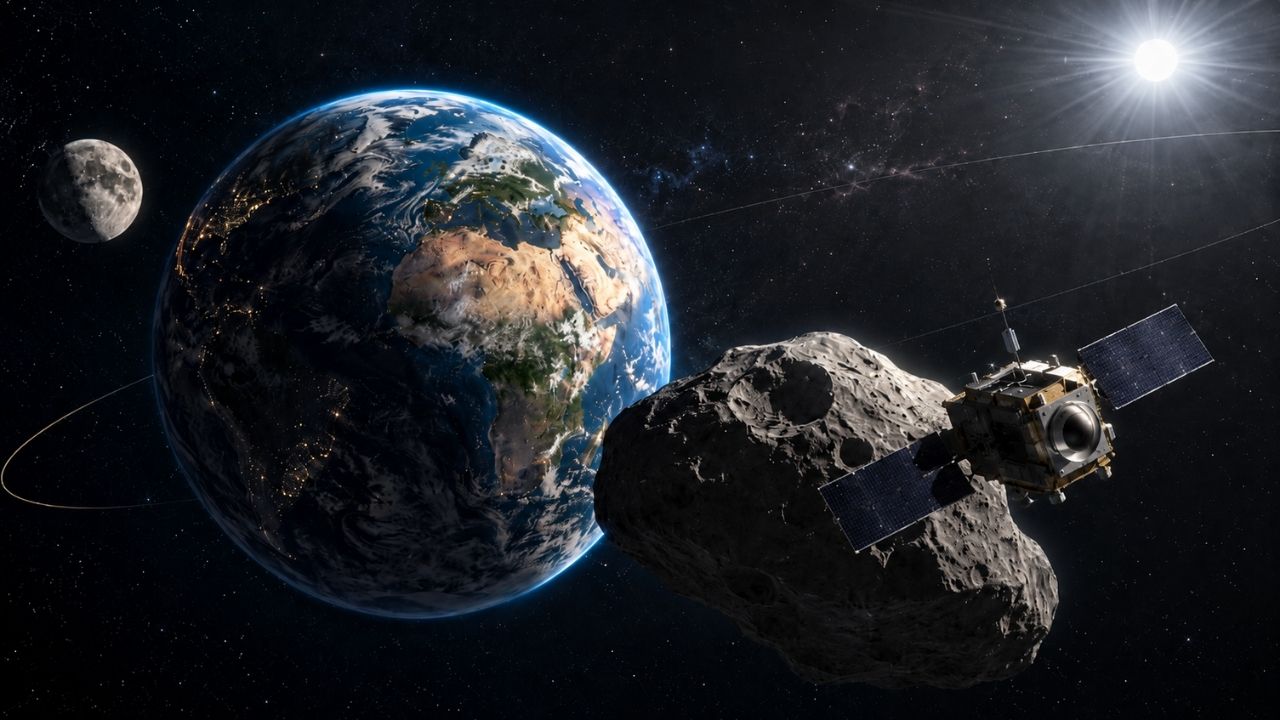

The asteroid Kamo’oalewa, Earth’s quasi-satellite, intrigues astronomers because it follows the planet’s orbit around the Sun and may have a lunar origin or come from the asteroid belt, a hypothesis that the Chinese mission Tianwen-2 will attempt to clarify with samples expected to return in 2027 to Earth in the coming months, according to research.
The asteroid Kamo’oalewa, officially identified as (469219), has returned to the spotlight because it accompanies Earth in an orbit around the Sun and its origin is not yet fully confirmed. Researchers are debating whether it could be a fragment of the Moon or an object coming from the asteroid belt between Mars and Jupiter.
According to Xataka, the answer may start to arrive in 2027, when the Chinese mission Tianwen-2 is expected to bring samples of the asteroid for laboratory analysis. The probe was launched in May 2025, is expected to reach Kamo’oalewa’s vicinity in 2026, and should return the sample capsule to Earth in November 2027.
Asteroid is not a second Moon, but accompanies Earth

Kamo’oalewa is classified as a quasi-satellite of Earth. This means that, seen from here, it appears to accompany the planet, but it does not orbit Earth like the Moon. In practice, the asteroid revolves around the Sun in a trajectory similar to ours.
-
AI Video Generator Automatically Creates Subtitles and Animated Captions

-
São Paulo Unveils Latin America’s Largest Underground Reservoir, Holding 900 Million Liters, in the Greater São Paulo Area

-
Chinese Teen Wins Gold in Germany for Invention Turning Air Moisture into Underground Irrigation in Drought-Stricken Areas

-
Desertification Threatens Brazil’s Caatinga: 85% of Semi-Arid Region Affected, 30 Million at Risk, and Efforts Underway to Restore 10 Million Hectares by 2045




This difference is important to avoid confusion. Kamo’oalewa is not gravitationally bound to Earth like a common natural satellite, but its orbit creates the impression of a constant companion on the planet’s path around the Sun.
Kamo’oalewa maintains a rare orbital dance for a long time
Scientific interest has grown because Kamo’oalewa exhibits an unusual orbital dynamic. Studies indicate that it alternates between quasi-satellite states and horseshoe orbit over long scales, with behavior that can repeat for hundreds of thousands or even millions of years.
This relative stability makes the asteroid a valuable target. Earth’s co-orbital objects are not common, and many remain in these states for shorter periods. Kamo’oalewa, therefore, has become a kind of natural laboratory to understand small bodies near our planet.
Lunar origin gained strength because of silicates
One of the most striking hypotheses is that Kamo’oalewa was born from the Moon. This possibility arose because spectral analyses pointed to similarities between its surface and lunar silicates exposed to the space environment.
If this origin is confirmed, the asteroid may have been torn from the lunar surface after an ancient impact. Some studies have associated the hypothesis with the Giordano Bruno crater, although this link still depends on more solid confirmation through samples.
Asteroid belt also appears as a likely explanation
A recent study cited by the scientific press suggests that the origin in the asteroid belt may be statistically more likely for similar co-orbital objects. Researchers simulated particles launched from the Moon and compared this path with objects coming from the population of near-Earth asteroids.
The result reinforces the doubt. The lunar appearance of the asteroid suggests an origin on the Moon, but the orbital dynamics may favor an origin in the asteroid belt. It is precisely this conflict between composition and trajectory that makes Kamo’oalewa so intriguing.
Simulations show how difficult it is to be born from the Moon and end up in this orbit
To test the lunar hypothesis, scientists simulated particles ejected from the Moon’s surface at different speeds and directions. The goal was to understand how many could escape the Earth-Moon system and end up in co-orbital orbits similar to Kamo’oalewa’s.
The number was small compared to the total simulated. This does not eliminate the lunar origin, but shows that the path is rare and requires very specific conditions. A fragment needs to leave the Moon with enough energy, escape the correct gravitational region, and still end up in a stable orbit close to Earth’s.
Tianwen-2 may solve part of the mystery in 2027

The Tianwen-2 mission was sent precisely to collect material from Kamo’oalewa. The expectation is to obtain at least 100 grams of samples, which will be returned to Earth for analyses capable of revealing the composition, age, and possible origin of the asteroid.
These samples may solve the part that telescopes and simulations still cannot complete. If the material is clearly lunar, the hypothesis of an impact on the Moon gains strength. If it is compatible with common asteroids, scientists will have to explain why its spectral signature seems so similar to that of the Moon.
China expands its ambition in space with sample return mission
Tianwen-2 also marks a new stage in the Chinese space program. After collecting from Kamo’oalewa, the mission is expected to proceed to study the object 311P/PanSTARRS, associated with the main belt region and considered a target of interest due to its unusual characteristics.
This strategy expands the scientific reach of the mission. China is not just visiting a near-Earth asteroid; it is attempting to link samples, orbital dynamics, and the evolution of small bodies in a long-term campaign in the Solar System.
Discovery may change understanding of lunar impacts
If Kamo’oalewa is confirmed as a lunar fragment, models on impacts on the Moon will need to be revisited. This is because launching an object of this size into a co-orbital Earth orbit requires a rare set of physical and dynamic conditions.
On the other hand, if the origin in the asteroid belt is confirmed, the puzzle does not disappear. The question will become: why does an asteroid coming from this region show signs so similar to lunar material? In both scenarios, the answer should open new questions.
Asteroid shows that Earth has almost invisible neighbors
The Moon dominates attention when talking about Earth’s companions, but Kamo’oalewa shows that our planet shares its orbital neighborhood with much smaller and much less known objects. They do not appear in the sky like the Moon, but they help reveal the dynamic history of the Solar System.
Now the question remains: if the asteroid Kamo’oalewa is indeed a piece of the Moon, does this change the way we view lunar impacts and near-Earth space risks? Or would it be even more curious to discover that an object from the asteroid belt managed to disguise itself as a lunar fragment? Share your opinion.