






 Portuguese
  Spanish


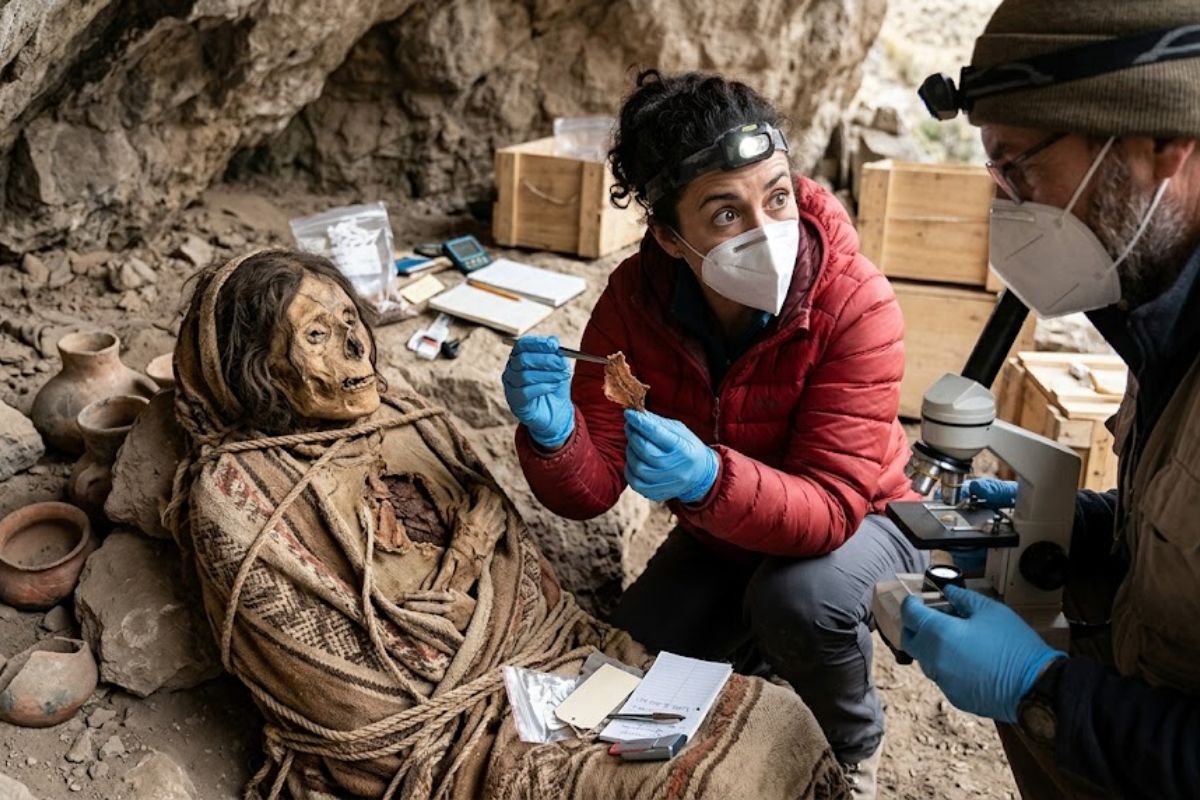
Researchers from the Eurac Institute found the bacteria Streptococcus pyogenes in a 700-year-old mummy removed from a funeral tower in the Andes of Bolivia, and the discovery published in Nature Communications in April 2026 represents the first archaeological record of this pathogen in the Americas, challenging the idea that diseases like scarlet fever only arrived on the continent with Europeans.
An international team of researchers investigating the preserved human genome in mummified bodies in the Andes of Bolivia made a discovery that no one expected. By analyzing the DNA extracted from a mummy of a young person who died approximately 700 years ago, scientists identified genetic material from Streptococcus pyogenes, the microorganism that causes scarlet fever and other severe infections. The finding, published on April 13, 2026, in the journal Nature Communications, marks the first time this bacteria has appeared in archaeological remains anywhere in the world. Frank Maixner, who heads the mummy studies area at the Eurac Research Institute, stated that the team was not specifically looking for this pathogen but adopted an open approach that examined both human genetic material and the DNA of microorganisms present in the remains.
The relevance of the finding goes beyond microbiology. Until this discovery, scientific knowledge assumed that Streptococcus pyogenes had only arrived in America with European colonization, which made bacterial respiratory diseases a post-Columbian phenomenon on the continent. The proven presence of the bacteria in a mummy from the so-called Late Intermediate Period, dated centuries before the arrival of Europeans, forces the scientific community to reconsider this timeline and investigate how the pathogen circulated in pre-Columbian America.
Where the mummy was found and why the Andes preserve bodies so well

The researchers worked with bodies deposited in chullpas, funeral structures in the shape of towers built in the Andean Plateau of Bolivia. In the Andean culture of this period, mummification was not exclusive to rulers or elite members: people of different social positions were buried this way. This widespread practice left an extensive collection of human remains preserved by the dry and cold climate of the altitude, offering modern scientists a rare window to examine the biology of entire populations.
-
In Somaliland’s Desert, Greenhouse Uses Sun and Seawater to Grow Lettuce, Cucumbers, and Tomatoes Without Rain: 1-Hectare Project Cools Crops, Desalinates Water, and Converts Brine into Commercial Salt

-
Trump Unveils $400 Million Boeing 747 Donated by Qatar as Temporary Air Force One Amid Boeing Delays, Sparking Debate on National Security, Costs, and Foreign Influence
-
Chinese Company Unveils Robotic Toilet That Comes to You, Featuring Lidar Sensors, Voice Command, Bidet, Hot Air Drying, UV Light, and Self-Cleaning Waste Disposal
-
Rotterdam Develops Floodable Square to Absorb Nearly 2 Million Liters of Rainwater, Doubling as Sports, Theater, and Leisure Space When Dry to Combat Urban Flooding




The mummy that contained Streptococcus pyogenes belonged to a young person who lived between the years 1000 and 1450 AD, a phase known as the Late Intermediate Period, the interval that separates the decline of the Tiwanaku civilization from the consolidation of the Inca Empire. This era was characterized by high population density and intense migratory movements in the Andean region, conditions that favor the transmission of pathogens between communities. The demographic context suggests that if the bacterium was present in this individual, it is likely that other people of the same time were also exposed to the microorganism.
What the mummy reveals about the health of the Andean youth

The analysis of the bones provided important complementary information. The skeletal indicators show that the young man was below the typical nutritional standard of his time, which may have compromised his defense system and made him more vulnerable to infections. This immunological fragility, detailed in the article from Nature Communications, helps explain why the bacterium was able to establish itself in the body with enough severity to leave detectable traces 700 years later.
The researchers have not yet determined whether Streptococcus pyogenes was the direct cause of death of the young person preserved in the mummy. However, the fact that bacterial DNA survived for seven centuries in sufficient quantity to be identified suggests that the infection was active at the time of death or shortly before it. The combination of malnutrition, population density, and close contact between communities created a conducive environment for bacterial diseases to spread easily.
Why the discovery in the mummy changes what was known about scarlet fever in the Americas
Streptococcus pyogenes is now one of the most widespread pathogens on the planet. It causes everything from common throat infections to potentially fatal conditions, and the scarlet fever caused by this bacterium was one of the leading causes of childhood mortality before the advent of antibiotics in the 1940s. Despite its current global distribution, there had been no record of its presence in America prior to European contact, which made scarlet fever a supposedly imported disease.
The Andean mummy significantly alters this panorama. Scientists raise the hypothesis that contamination may have occurred through contact with native animals of the Andes, a transmission route that does not involve travelers from other continents. If confirmed in future studies, this route would indicate that the bacteria already existed in the Americas independently, and not as a European biological legacy. The implication is profound: the history of scarlet fever and other infections by Streptococcus pyogenes in the Andes would need to be rewritten in light of what Nature Communications has just published.
What is still left to discover about the mummy and the bacteria
The team at the Eurac Institute acknowledges that the discovery raises more questions than it provides definitive answers. To build robust conclusions, it will be necessary to examine other mummies from the same period and region of the Andes in search of new cases of Streptococcus pyogenes. A single record, no matter how unprecedented, is not enough to redraw the epidemiological map of an entire continent, and the authors of the article in Nature Communications themselves warn that more research is indispensable.
The question of how the bacteria reached the young Andean also remains open. If the contagion came from local animals, it would be necessary to identify which species acted as natural reservoirs of the microorganism at that altitude and during that climatic period. If it came from other human populations through migratory routes, the geographical reach of the bacteria in pre-Columbian America may be much greater than previously thought. Each mummy analyzed from now on carries the potential to add pieces to this puzzle that science has only just begun to assemble.
And you, did you imagine that a 700-year-old mummy could change what we know about the history of diseases in the Americas? Do you think the bacteria already existed on the continent or came in a way we still do not know? Leave your opinion in the comments.




Be the first to react!