






 Portuguese
  Spanish


First stage of works on BR-116 between Piraí and Paracambi was released on June 25, 2026, and is already beginning to change the routine of about 390 thousand vehicles that pass monthly through the most critical section of the Presidente Dutra Highway
According to a report published by the portal Último Segundo/IG, signed by journalist Thayna Gemin and released on June 26, 2026, the decades-long wait has come to an end for those who face the Serra das Araras daily on the Via Dutra (BR-116). On the afternoon of Thursday, June 25, the first phase of the work was officially delivered, bringing the promise of faster, safer trips with fewer traffic jams between Rio de Janeiro and São Paulo.
The release of the first four kilometers of the new uphill lane, towards São Paulo, marks a concrete advance of the largest road infrastructure project currently underway in Brazil. The section covered is between the municipalities of Piraí and Paracambi, in the South Fluminense region, and has already begun to receive vehicle traffic immediately after delivery.
Less time on the road: what changes for the driver
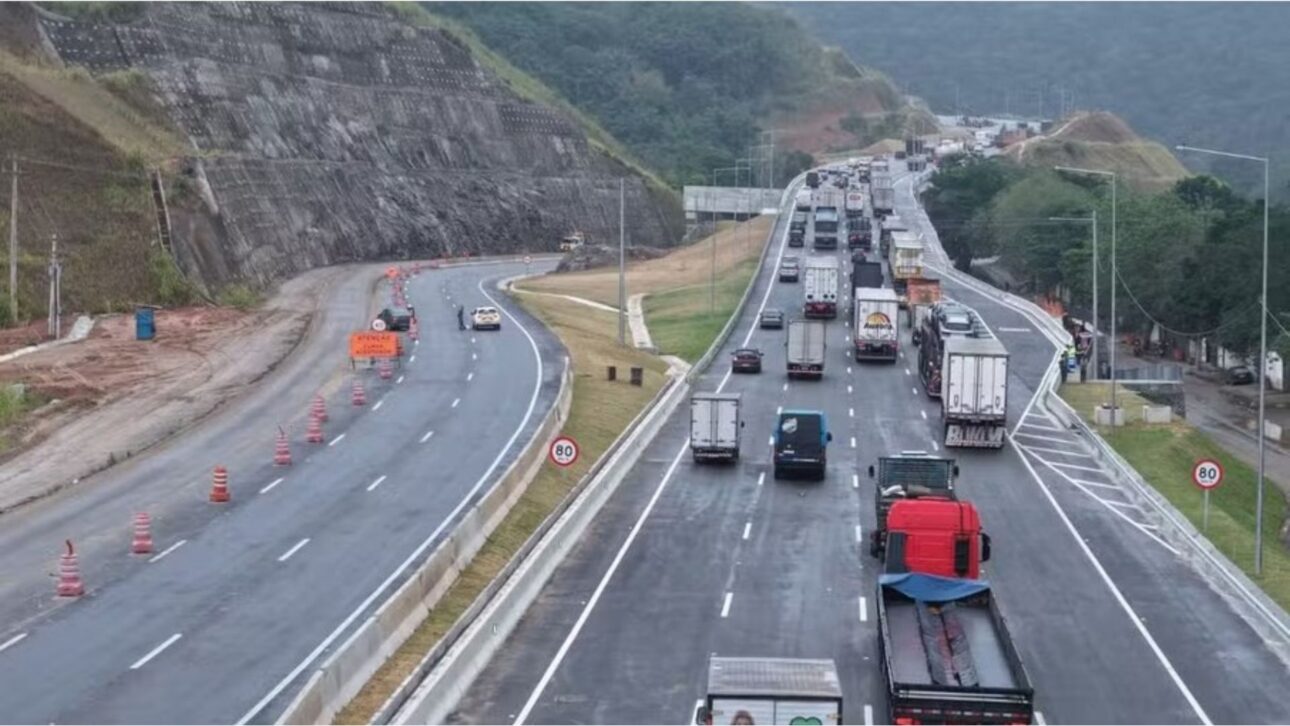
The main change felt by those who use the Dutra will be in travel time. With the new configuration of the mountain, the expectation of the concessionaire RioSP — a company of Motiva responsible for the work — is to reduce travel time by up to 25% towards São Paulo. In the direction of Rio de Janeiro, when the entire project is completed, the reduction could reach 50%, thanks to the new layout and the significant expansion of road capacity.
-
Major Infrastructure Project in Northeast Brazil Advances with New Overpass Construction to Ease Traffic for Over 13,000 Daily Drivers

-
Frustrated by local government inaction, Brazilian villagers crowdfund $800 to build wooden bridge for coffee transport across stream

-
Turkey Constructs World’s Deepest Undersea Rail Tunnel Connecting Europe and Asia, Uncovering Largest Collection of Medieval Ships in Byzantine Port
-
Revolutionary Building Material, SIP Panels, Set to Transform Construction by 2026 with 70% Heat Reduction and Faster Builds


In addition, the operational speed, which currently revolves around 40 km/h in various parts of the mountain, will reach up to 80 km/h in the new segments — a significant leap that, in practice, means fewer stops, fewer sudden brakes, and a much smoother drive along one of the most demanding sections of the entire Brazilian road system.
In this first stage, drivers will have four kilometers of new climbing lanes, in addition to the simultaneous opening of eight new fully lit viaducts. The structure also includes continuous shoulders, enhanced signage, and operational improvements that promise to make traffic flow more smoothly, particularly reducing the risk of accidents involving heavy vehicles — a category that accounts for about 36% of the monthly flow in the region.
A historical bottleneck that drives half of the national GDP
To understand the significance of this delivery, it is necessary to go back in time and look at what the Serra das Araras represents for Brazil. Every month, about 390,000 vehicles pass through the stretch, approximately 36% of which are trucks and cargo vehicles. Together, these vehicles transport a significant portion of the national economic production — making the Dutra, in this stretch, one of the most strategic logistical corridors in the country.
Responsible for connecting the metropolitan regions of Rio de Janeiro and São Paulo, the highway is essential for the transportation of goods between the two largest urban centers in Brazil. However, for decades, the mountain stretch has established itself as one of the biggest road bottlenecks in the country. The winding path, sharp curves, steep inclines, and frequent traffic jams have made the route a constant challenge for both regular drivers and truckers who depend on the road for their livelihood.
In this sense, the modernization of the stretch represents not only a time gain but a structural transformation in a critical link of the Brazilian economy. The Serra das Araras, which has existed since 1928 with its tight curves and speed limitations, is definitely on its way out.
Project with 70% progress and expected completion in 2027
Started in April 2024, the construction of the New Serra das Araras has already reached about 70% physical progress and received estimated investments of R$ 1.5 billion. When fully completed, the new structure will have four lanes and shoulders in each direction — totaling eight lanes —, in addition to 24 new viaducts, two escape ramps for trucks, lighting throughout the entire stretch, pedestrian walkways, slope containment, and modern electronic monitoring systems with automatic incident detection cameras.
The concessionaire’s forecast is to complete the entire project by 2027, approximately two years ahead of the initially planned contractual schedule. Additionally, the project has already generated around 7,000 direct and indirect jobs along the highway, with more than 2,000 workers directly involved in the Serra das Araras, most of them from the municipalities of Piraí and Paracambi.
More than reducing travel time, the central objective of the modernization of the Serra das Araras is to save lives. The expectation is to significantly reduce the accidents recorded in the region, especially those involving trucks on steep downhill stretches. With permanent shoulders, a more modern layout, escape areas, and intelligent monitoring, the new mountain range should offer much safer conditions for drivers, truckers, and passengers who use the Via Dutra daily.
On the other hand, the impact goes beyond road safety. According to the concessionaire, the project represents an important vector of economic development for the region, strengthening national logistics and increasing the efficiency of freight transport between São Paulo and Rio de Janeiro. In a country where economic competitiveness directly depends on the quality of its highways, the Nova Serra das Araras emerges as one of the most significant investments in recent years for the road infrastructure sector.
In light of such structural advancement, the reflection remains: if a single 16-kilometer project is capable of reducing travel time by up to 50% in one of the country’s most critical sections, how much is Brazil still losing in productivity, safety, and quality of life due to a lack of consistent investment in other federal highways?


