Portuguese
  Spanish


The 3I/ATLAS, the third confirmed object coming from outside the Solar System, revealed methanol in an unusual proportion in ALMA observations. The discovery shows that the alcohol escapes from the nucleus and icy grains in the coma, creating a rare chemical signature of a distant, cold, and still little understood environment.
The 3I/ATLAS revealed an unusual chemical composition when observed by astronomers with ALMA, in Chile, during its passage through the Solar System. The interstellar comet, the third confirmed object coming from outside our cosmic neighborhood, presented a high amount of methanol, a type of organic alcohol.
According to The Daily Galaxy, in June 2026, the discovery gained prominence because it helps scientists investigate materials formed in another stellar system. The observations occurred while the comet was being heated by the Sun, releasing gases and dust around the nucleus, in a process that allowed mapping part of its chemical signature in space.
The third interstellar visitor arrived with a striking chemical difference
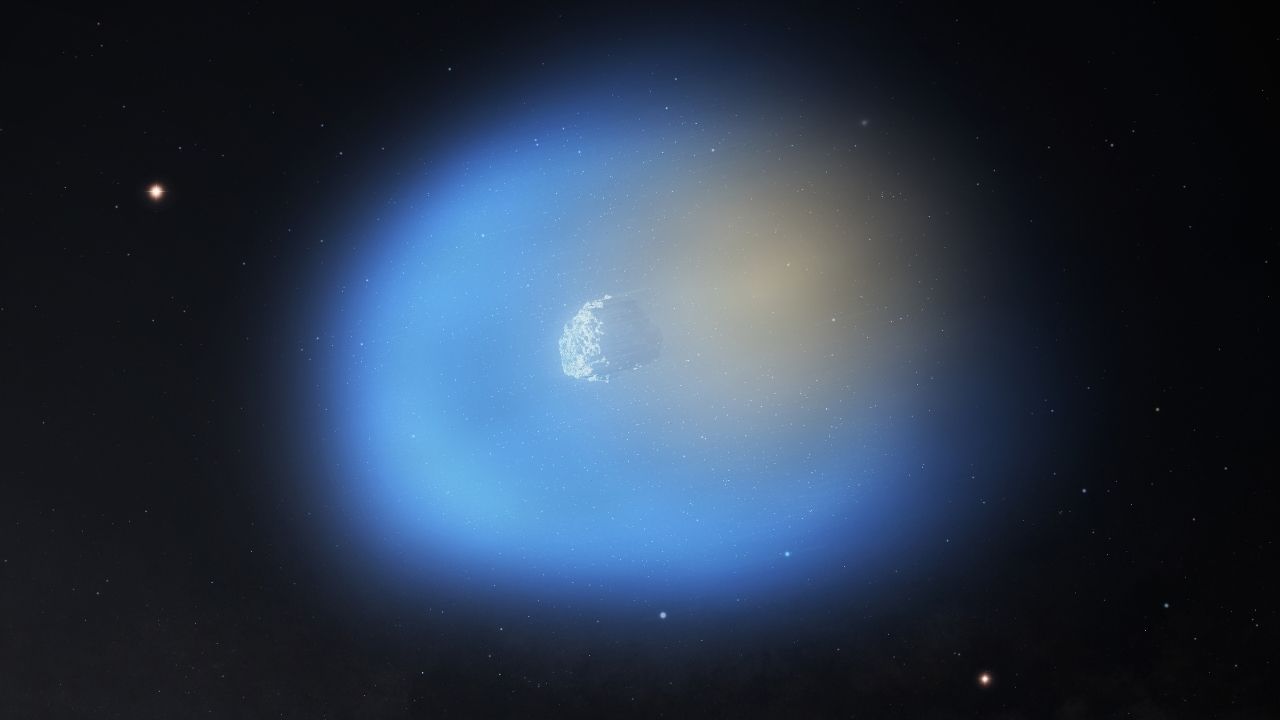
The story of 3I/ATLAS draws attention because interstellar objects are extremely rare among the bodies already observed passing through the Solar System. Before it, only 1I/‘Oumuamua and 2I/Borisov had been confirmed as visitors coming from outside, each with its own behavior and composition.
-
13-Year-Old Californian Girl Wins $25,000 Prize for Creating Low-Cost Water Filter from Discarded Animal Bones

-
Entrepreneur Secures $15 Million to Transform Steel Mill Waste into Concrete Material, Builds Demo Plant in the U.S. with a Goal of 10,000 Tons Annually

-
World’s Most Powerful X-Ray Laser, 3.4 km Long and Emitting 27,000 Flashes Per Second, Unveils Atoms in Motion in Germany
-
Former SpaceX Rocket Engineer Develops Fast-Growing Grass Panels to Replace Wood in Construction, Secures $47.5 Million Funding



The new comet, however, added a different piece to this short list. While Borisov seemed more familiar to the patterns of Solar System comets, the 3I/ATLAS presented a methanol-rich signature, suggesting that its formation occurred under chemical conditions different from those we know here.
ALMA detected methanol in an unusual proportion in the comet
Observations from the Atacama Large Millimeter/submillimeter Array, known as ALMA, identified signs of methanol and hydrogen cyanide in the coma of 3I/ATLAS. These molecules leave specific marks in submillimeter wavelengths, allowing researchers to compare their relative abundance.
The most surprising data was the high proportion of methanol compared to hydrogen cyanide. This contrast placed the comet among the methanol-richest objects ever analyzed, even when compared to many comets formed around the Sun.
Space alcohol doesn’t mean what it seems on Earth
When scientists talk about alcohol in 3I/ATLAS, it’s not about a drink or something similar to the everyday use of the word. The compound identified is methanol, a simple organic molecule, common in studies of cometary chemistry and relevant for understanding cold planetary formation environments.
This type of molecule can form on dust grains in very cold regions of space, when chemical reactions transform simple materials into more complex compounds. Therefore, methanol serves as a clue about the physical and chemical conditions of the place where the comet was born.
Methanol escaped from the nucleus and the icy grains of the coma
One of the most important points of the discovery is that the methanol from 3I/ATLAS does not seem to come only from the solid nucleus. The data indicates that part of this material also comes from icy grains suspended in the coma, the cloud of gas and dust that surrounds the comet when it is heated.
This process is called prolonged degassing. In it, icy particles present around the nucleus release molecules as they receive solar heat. In practice, the coma ceases to be just a passive envelope and starts to function as an additional source of gas, expanding the observed chemical trail.
Hydrogen cyanide had different behavior
While methanol appeared associated with both the nucleus and the icy grains, hydrogen cyanide followed a more direct behavior. Observations suggest that it escaped mainly from the nucleus of 3I/ATLAS, a pattern closer to what is usually observed in comets of the Solar System.
This difference between the two molecules is important because it shows that not all compounds were released in the same way. The comet seems to carry layers of chemical information, with substances responding in different ways to solar heating during its passage through the inner region of the Solar System.
James Webb had already pointed out another anomaly
Before the emphasis on methanol, observations associated with the James Webb Space Telescope had already indicated that 3I/ATLAS had an unusual coma in another aspect. The object showed significant signs of carbon dioxide, reinforcing the idea that its composition does not perfectly follow familiar patterns.
With ALMA data, the picture became even more interesting. Two different instruments began to indicate that this interstellar visitor carries an unusual chemistry, not just due to an isolated molecule, but due to a set of characteristics that defy simple comparisons with local comets.
What this chemical signature can reveal about another stellar system
The composition of 3I/ATLAS can function as an indirect sample of an environment we may never be able to visit directly. Since the comet was born outside the Solar System, its ices preserve clues about temperature, radiation, dust, and chemistry of the disk where it formed.
Even so, scientists still cannot pinpoint precisely which stellar system produced the object. What the analysis allows us to say is more cautious: the excess methanol suggests a different chemical history, possibly linked to cold regions or unusual formation conditions compared to many comets in our system.
Few objects make each discovery more valuable
The study of 3I/ATLAS is particularly significant because the sample of confirmed interstellar objects is still very small. With only three known cases, each new piece of data changes how astronomers interpret the diversity of bodies formed around other stars.
‘Oumuamua left doubts for not displaying a typical coma, Borisov came closer to the expected behavior for a comet, and 3I/ATLAS now broadens the scenario with a methanol-rich chemistry. The sequence shows that interstellar visitors can be much more varied than imagined.
A small comet opened a window to distant worlds
The 3I/ATLAS is not just another comet passing through the sky. It has become a chemical capsule from another stellar system, carrying molecules that help reconstruct part of a story formed far from the Sun and preserved in ice for an unknown time.
The discovery also shows how modern astronomy can extract information from fleeting objects, which pass by only once and then continue through interstellar space. Do you think comets like 3I/ATLAS can reveal the chemistry of distant worlds better than telescopes observing already formed planets? Leave your opinion in the comments.