






 Portuguese
  Spanish


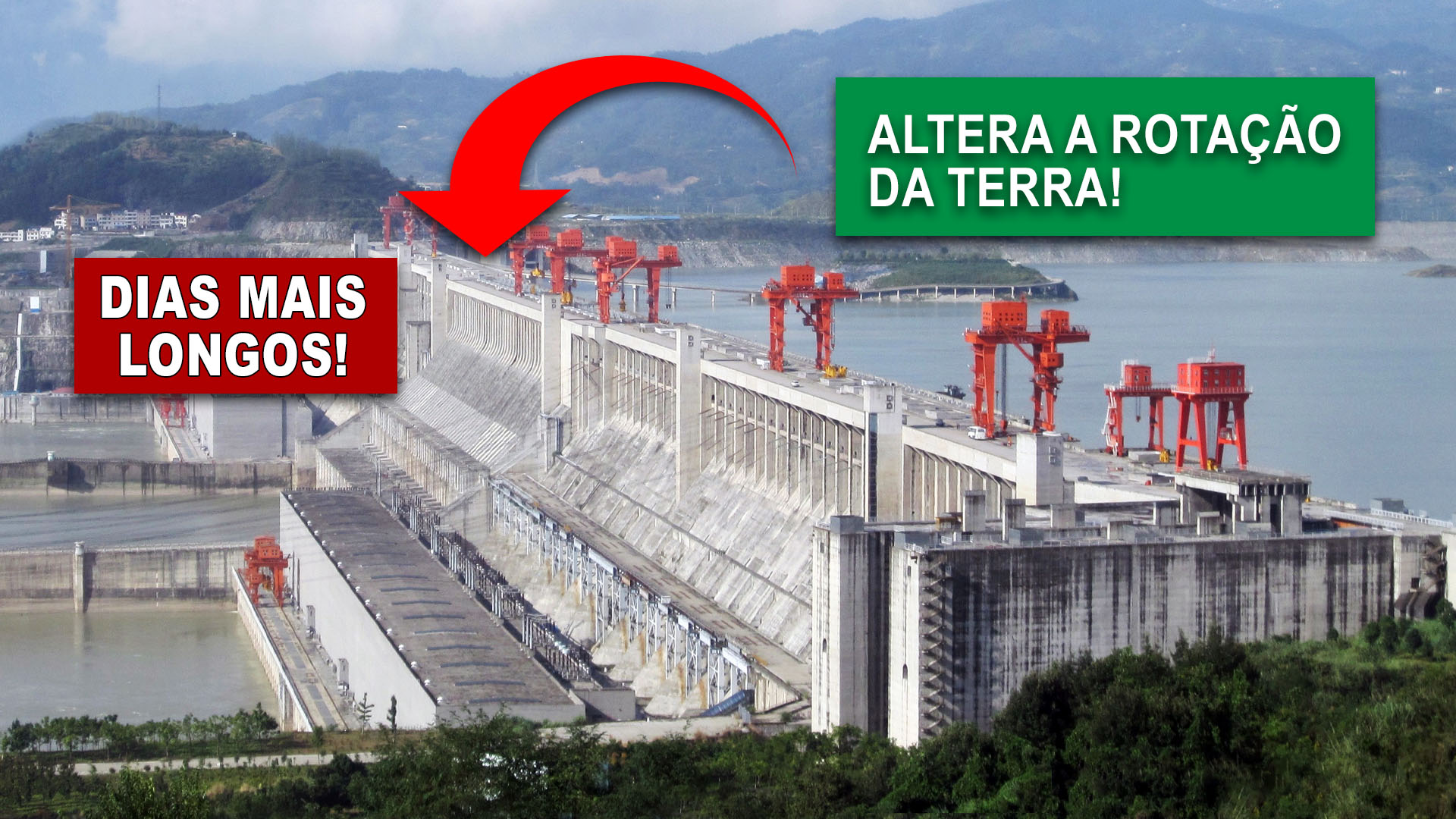

Three Gorges Dam on the Yangtze Can Lengthen the Day by 0.06 Microseconds When the Reservoir is Full, an Effect Calculated by NASA Scientists That Has a Minimal but Measurable Impact.
The Three Gorges Dam in China has returned to the center of scientific debate. According to calculations from NASA, the full filling of the reservoir displaces enough mass to increase the duration of the day by 0.06 microseconds.
The phenomenon arises from a basic rule of physics: by redistributing mass, the moment of inertia of the Earth is changed, and therefore, its rotation. The same reasoning explains natural variations caused by earthquakes and the melting of ice.
What Exactly Did NASA Estimate About Earth’s Rotation
In 2005, geophysicist Benjamin Fong Chao (NASA/JPL) compared the effect of large mass redistributions. In the case of the Three Gorges, about 10 trillion gallons (≈ 40 km³) of water slightly raise the planet’s moment of inertia.
-
11-Year-Old Takes Truck, Crashes Into Pilgrimage in Thailand, Killing Eight Buddhist Monks

-
Archaeologists Uncover Ancient Ruins and Artifacts in Shiloh, Potentially Shedding Light on the Biblical Ark of the Covenant
-
Havaianas Covers Brazilian Landmark with 4,500 Flip-Flops to Create Visual Spectacle of National Flag
-
Ancient Wind Tower Cools Desert Homes Using Physics, Water, and Smart Architecture Without Electricity



The theoretical result: +0.06 μs in the duration of the day when the reservoir is at its peak, and a pole shift of about 2 cm. It is an imperceptible value in everyday life, yet detectable by modern geodetic systems.
For comparison, the 2004 Indian earthquake shortened the day by 2.68 μs by rearranging mass in tectonic plates.
The Chinese Megaproject in Numbers: Energy, Volume, and Records


The hydroelectric plant totals 22,500 MW of installed capacity, the largest in the world, with 32 turbines of 700 MW and two auxiliary generators. The dam’s structure is 185 m high and over 2.3 km long; the reservoir totals about 39–40 km³.
In 2020, after monsoon rains, Three Gorges recorded 111.795 TWh, a new world record for annual hydropower generation, surpassing the 103 TWh mark of Itaipu (2016).
These figures help to illustrate why the project enters discussions about global geophysical impacts, even though they are minuscule on a practical scale.
Why Dams, Ice, and Wells Affect the Planet’s Rotation
When large masses move away from the axis of rotation, the planet rotates a little slower; when they move closer, it rotates a little faster. It is the same logic as a skater who opens or closes their arms to adjust speed.
The construction of dams stores water at specific altitudes, altering the global distribution of mass. Separately, the melting of ice caps displaces water toward the equator and tends to slow down rotation over decades.
Another measurable anthropic factor is groundwater extraction. Between 1993 and 2010, the pumping of ≈2,150 gigatons explains ~80 cm of the pole shift observed, according to a study in Geophysical Research Letters.
What Changes in Practice
The variation of 0.06 μs from the Three Gorges is tiny compared to other time drivers, such as tidal forces and moment exchanges between the core and mantle. Still, the sum of various effects can disturb milliseconds in the long term, relevant for GPS, telecommunications, and finance.
Therefore, timekeepers discuss adjustments like the “negative leap second” — removing a second from UTC if the Earth accelerates enough in the coming years. Recent reports indicate this scenario is being evaluated around 2028–2029, although there is uncertainty and technical resistance.
Meanwhile, studies remind us that thousands of dams since the 19th century have also contributed to moving the poles by trapping water on land, reinforcing that large constructions influence subtle geophysical processes.
We want to hear from you: Should colossal works that change microseconds be included in environmental licensing? Does the clean generation record compensate for any geophysical risk, no matter how small? Leave your comment.




Great article, thank you for sharing these insights! I’ve tested many methods for building backlinks, and what really worked for me was using AI-powered automation. With us, we can scale link building in a safe and efficient way. It’s amazing to see how much time this saves compared to manual outreach.