Portuguese
  Spanish


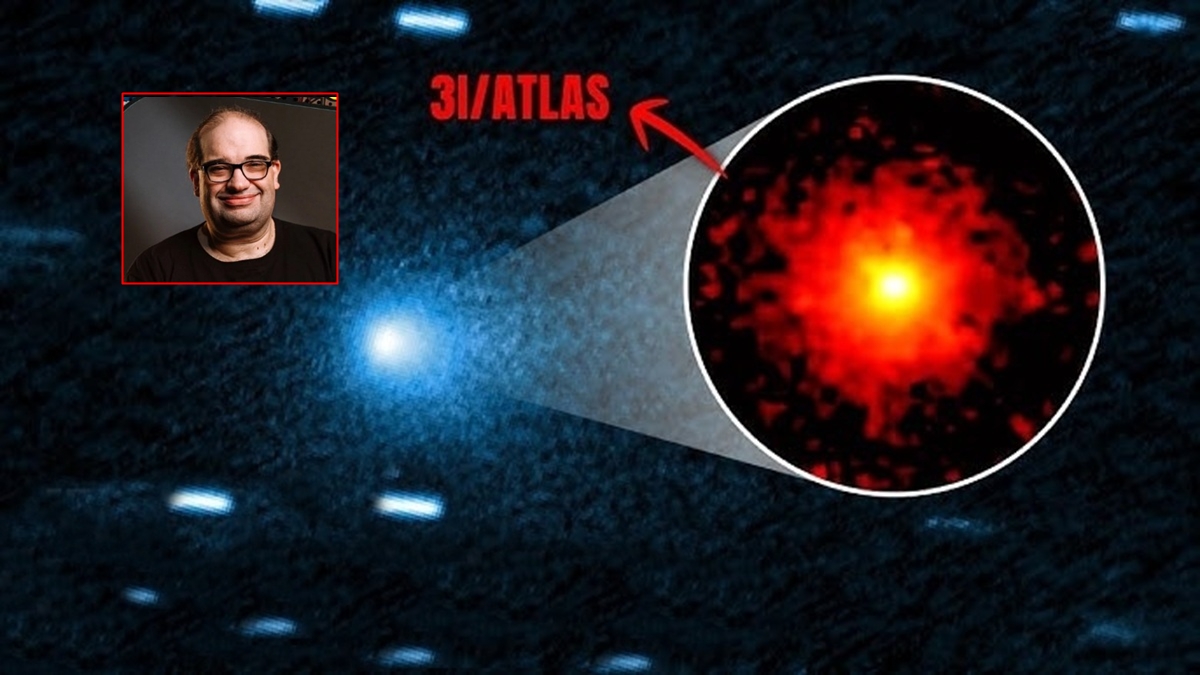


Space Always Fuels Mysteries and Speculations. With 3I/ATLAS It Was No Different. Many Came to Believe It Could Be a Camouflaged Spaceship. But Sergio Sacani Analyzed Data from the Gemini Telescope and Brought the Definitive Answer.
As soon as the object 3I/ATLAS was detected in the sky, theories began to emerge. For some, it could be a camouflaged spaceship created to deceive astronomers.
Others imagined it was a mysterious body from another stellar system on a mission unknown.
The brightness, extensive tail, and unusual trajectory fueled the bolder hypotheses. After all, interstellar visitors are extremely rare. When they appear, it is natural that they spark fascination and also suspicion.
-
Pennsylvania Mine Creates Ice in Summer Heat and Melts in Winter, Turning a Mountain Crevice into a Reverse Natural Refrigerator

-
China Accelerates Global Expansion of Robotics: From Smart Vacuums to Industrial and Humanoid Machines, Millions Exported to Over 150 Markets
-
Polar Air Mass to Hit Brazil: Temperatures to Plummet in Nine States, Near Freezing in the South with Frost Risk Until Monday
-
Chinese “dark factories” produce electric cars 24/7 with minimal human intervention, as Zeekr assembles 800 units daily, raising concerns in Brazil.





On social media, comments arose that someone could be “creating an artificial tail” to hide the object’s real identity.
Some even suggested that it was not natural, but rather advanced technology disguised as a comet to avoid attracting attention.
This atmosphere of mystery gained momentum because the first images showed a diffuse structure. There was a central point surrounded by a fog and a clear tail, always pointed away from the Sun.
For many, it was sufficient material to question: are we looking at something beyond conventional astronomy?
The Answer from Sergio Sacani
In light of the speculation, Sergio Sacani took it upon himself to bring order to the discussion. On the Space Today channel, he analyzed the images captured by the Gemini South telescope in Chile and was clear: 3I/ATLAS is a comet.
According to Sacani, there is no doubt. The presence of a coma, the cloud of dust and gas surrounding the nucleus, and the formation of the tail are unmistakable signs of cometary activity.
Moreover, the intensity of this activity increased as the object approached the Sun.
“If it has activity and the activity increased, it is a comet. No question about it. We can hammer it down,” he stated.
He even joked about the speculations, saying it would only be a spaceship if someone was inventing a tail to deceive astronomers. But he made it clear: the scientific evidence leaves no room for doubt.

What the Images from Gemini South Show
The observations were made on August 27, 2025, during the Shadow the Scientists educational program. Students from Hawaii and La Serena followed a two-hour session in real-time, interacting with astronomers while data was collected.
Using the GMOS instrument, the telescope captured colorful and deep images of 3I/ATLAS. In them, a broad coma and a tail extending 1/120 of a degree in the sky were visible. Both pointed away from the Sun, just like comets do.
Sacani highlighted that these structures were much more evident than in previous records. This demonstrated that the object had become more active as it moved through the inner Solar System.
The Importance of Spectra
More than generating beautiful images, the goal was to collect spectra. This technique analyzes the light emitted at different wavelengths, revealing the chemical composition of the celestial body.
Astronomer Karen Meech explained that the colors and the spectrum indicate the size of dust particles and the chemistry of the coma. She noted that the results showed a great similarity with native comets of the Solar System.
This discovery is important because it suggests that the processes of planetary system formation may be similar around other stars. Therefore, 3I/ATLAS is not just a fleeting curiosity, but a true interstellar messenger.
Voices from Science
Meech stated that “these images are both a scientific milestone and a source of awe.” For her, visitors like 3I/ATLAS remind us that the Solar System is part of a living and dynamic galaxy.
Researcher Bryce Bolin from Eureka Scientific reinforced that each interstellar comet brings clues about worlds beyond our own. “By studying its light and color, we can begin to understand the diversity of planetary systems in the galaxy,” he said.
Thus, each piece of collected data is a part of the puzzle of stellar formation. The scientific impact goes far beyond the visual spectacle.
Significant Dates in the Trajectory
3I/ATLAS will have three important encounters. On September 29, 2025, it will reach perihelion, the closest point to the Sun, at 210 million kilometers.
A few days later, on October 3, it will pass just 29 million kilometers from Mars. The MRO spacecraft, equipped with the HiRISE camera, is expected to capture detailed images.
Finally, in March 2026, it will approach Jupiter. At that moment, the Juno spacecraft may observe unprecedented details of the interstellar visitor. Each of these dates represents a new opportunity to expand knowledge.
A Rare Visitor
3I/ATLAS is only the third interstellar comet ever observed. These objects follow hyperbolic orbits, meaning they do not return. They are unique encounters that must be maximized.
Sergio Sacani reminded that we have been monitoring the comet since its entry into the Solar System. This will allow us to understand how it reacts at different distances from the Sun, something fundamental for astronomy.
Between Mystery and Science
Theories about spaceships may ignite curiosity, but science has shown another path. 3I/ATLAS is a comet in full activity, with typical tail and coma, revealing secrets about the formation of planetary systems.
It reinforces that the universe is dynamic and full of surprises. More than mystery, it brings knowledge and admiration. A rare visitor but scientifically invaluable.