






 Portuguese
  Spanish


Documented by underwater robots between 2010 and 2012 and analyzed in a study published in 2026, the Byzantine shipwreck Knidos F rests at 370 meters depth on the sea floor of Turkey. Its 545 almost intact amphorae help reconstruct trade routes that linked the Aegean to the Black Sea.
Imagine a ship that sank a thousand years ago and whose cargo remains almost intact, stacked in the dark at the bottom of the sea as if time had stopped. This is what rests at 370 meters depth off the coast of Turkey: 545 whole or nearly whole amphorae, most of the cargo of a Byzantine merchant ship named Knidos F. The story was told by the Greek Reporter.
The important detail is that the discovery itself is not recent, but its interpretation is. The Byzantine shipwreck was mapped by expeditions with underwater robots between 2010 and 2012, and only now, in a study published in 2026, have researchers pieced it together. The result is a map of the lost trade routes that linked the Aegean Sea to the Black Sea at the time when the Byzantine Empire dominated these seas.
545 amphorae stopped in the dark at 370 meters
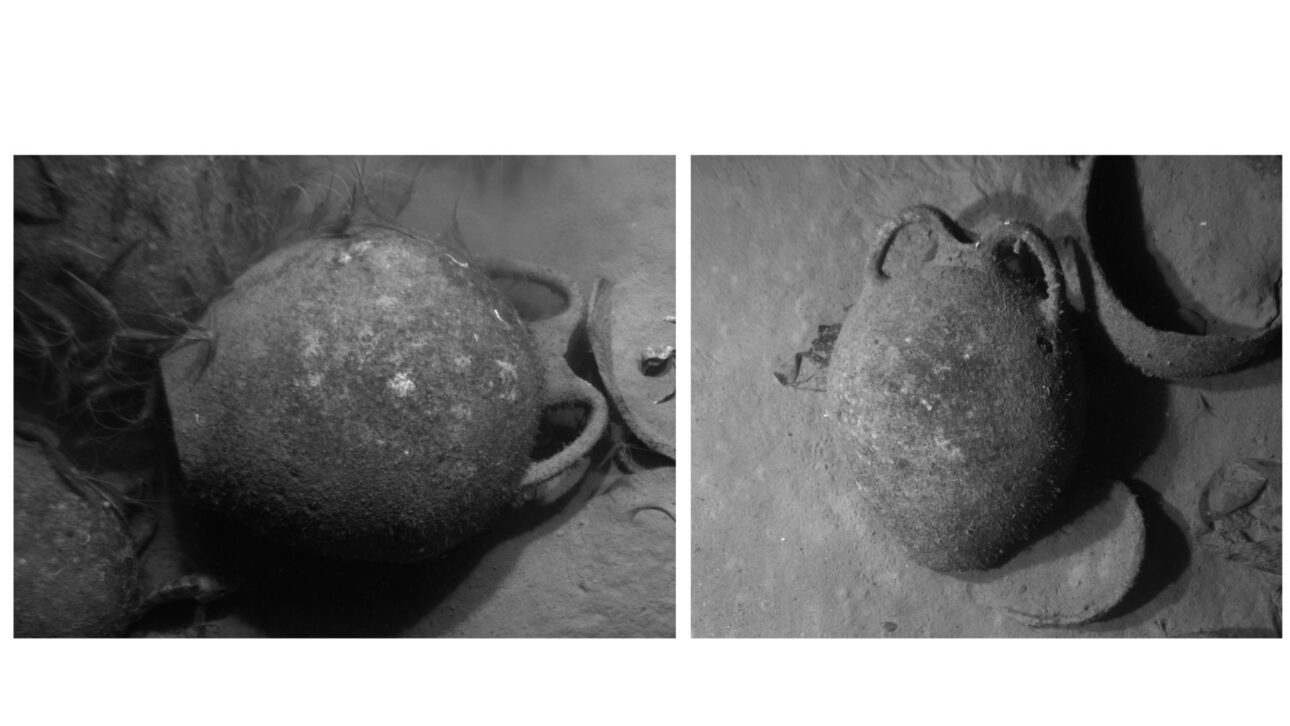
The scenario of the find is impressive. The Knidos F is located about 10 nautical miles northeast of Knidos, an ancient Greek and medieval port city, at the far west of the Datça peninsula in Turkey.
-
NASA to Send Astronauts Over 400 km Above Earth for 6.5-Hour Spacewalk to Repair Canadarm2 on the ISS

-
Microsoft Raises Xbox Prices Again Due to Rising Component Costs

-
Teen from Rajasthan Desert Village Builds Homemade Wind Turbine Generating 20 kWh Daily, Founds Startup Sunwind

-
Professor Builds Solar Power Plant from Electronic Waste, Restores School Days in Remote Brazilian Amazon Community


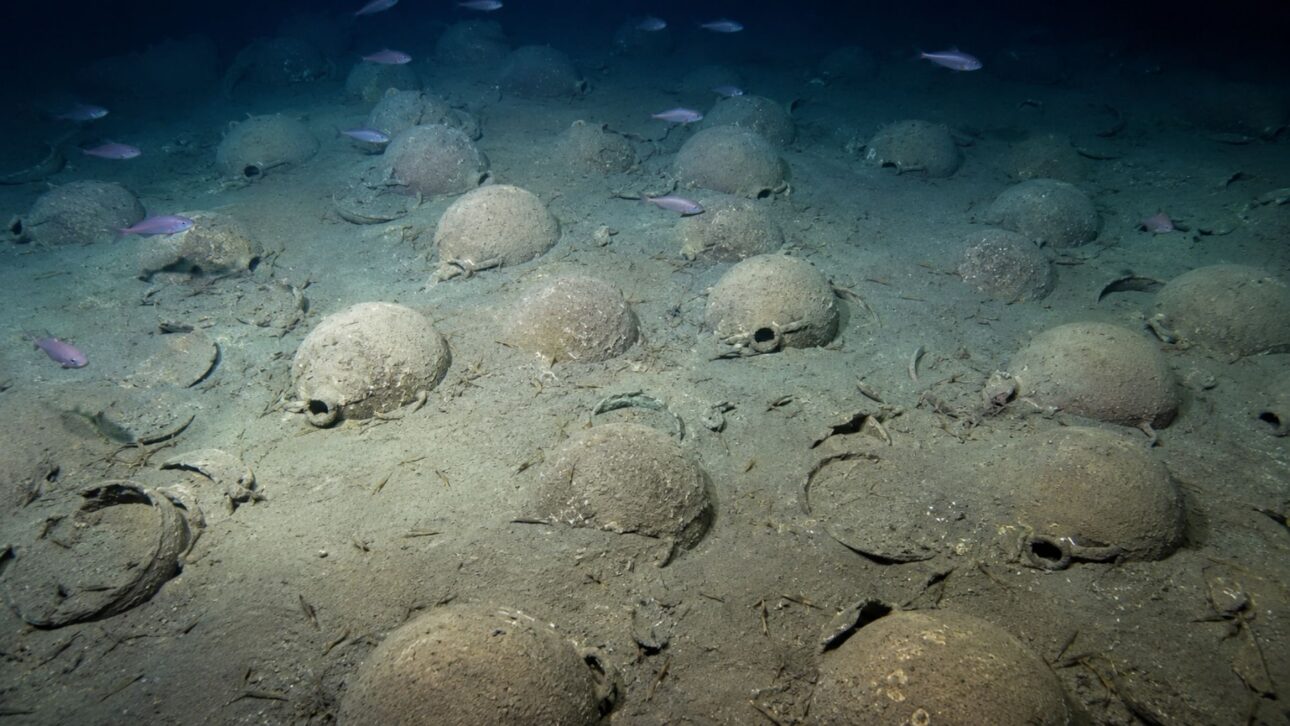
Down there, at 370 meters depth, the ship’s cargo spreads across the sea floor in a rectangle approximately 12 by 10 meters.
The numbers of the cargo give the scale. Researchers counted 545 intact or nearly intact amphorae, in addition to at least 80 broken ones.
For a shipwreck a thousand years old, this preservation is rare, and it is what transforms the site into a true time capsule stopped at the bottom of the sea of Turkey.
The depth explains much of this conservation miracle. So deep, far from waves, fishing nets, and divers, the cargo remained untouched for centuries. It was this isolation that allowed the amphorae from the Byzantine shipwreck to reach the present almost as they were on the day the ship sank.
The 2026 study that deciphered the shipwreck
The novelty lies in the analysis, not the discovery.
The Byzantine shipwreck and two others nearby were located and filmed in deep-water expeditions conducted between 2010 and 2012 by the Ocean Exploration Trust, in partnership with Turkish and American experts.
For this, they used the exploration vessel Nautilus, side-scan sonar, and the underwater robots Hercules and Argus.
The breakthrough came with the scientific publication. In 2026, a study in the journal Heritage, led by researcher Evren Türkmenoğlu, examined in detail the three shipwrecks, known as Knidos F, Knidos L, and Knidos N.
This work transformed images of the seabed taken more than a decade earlier into a complete interpretation of trade, cargo, and maritime routes.
Therefore, precision matters: what is from 2026 is the understanding, not the first visit to the site.
This distinction matters because science often works this way, with data collected at one time and deciphered years later when there is time, method, and comparison to extract the hidden story in each amphora.
The amphorae that tell the story
The star of the cargo has a technical name. The Knidos F primarily transported amphorae of the Günsenin I type, a characteristic model that helps date the Byzantine shipwreck between the 10th and 12th centuries.
Recognizing the type of amphora is like reading the label of a package: it reveals where it came from, what it carried, and in what era it circulated.
Amphorae were the standard container of the ancient world.
Made of ceramic, they were used to transport wine, olive oil, and other bulk products across the Mediterranean, stacked in the hold of ships.
In other words, they were the packaging that moved commerce, the ancient equivalent of the containers that today cross the oceans filling cargo ships.
The 2026 study went beyond cataloging the known.
According to the research, the analysis of the shipwrecks helped identify even a previously unknown type of amphora, expanding the catalog of containers that circulated in the region.
Each new piece is an additional clue about how that maritime trade network operated.
The Lost Trade Routes: from the Aegean to the Black Sea
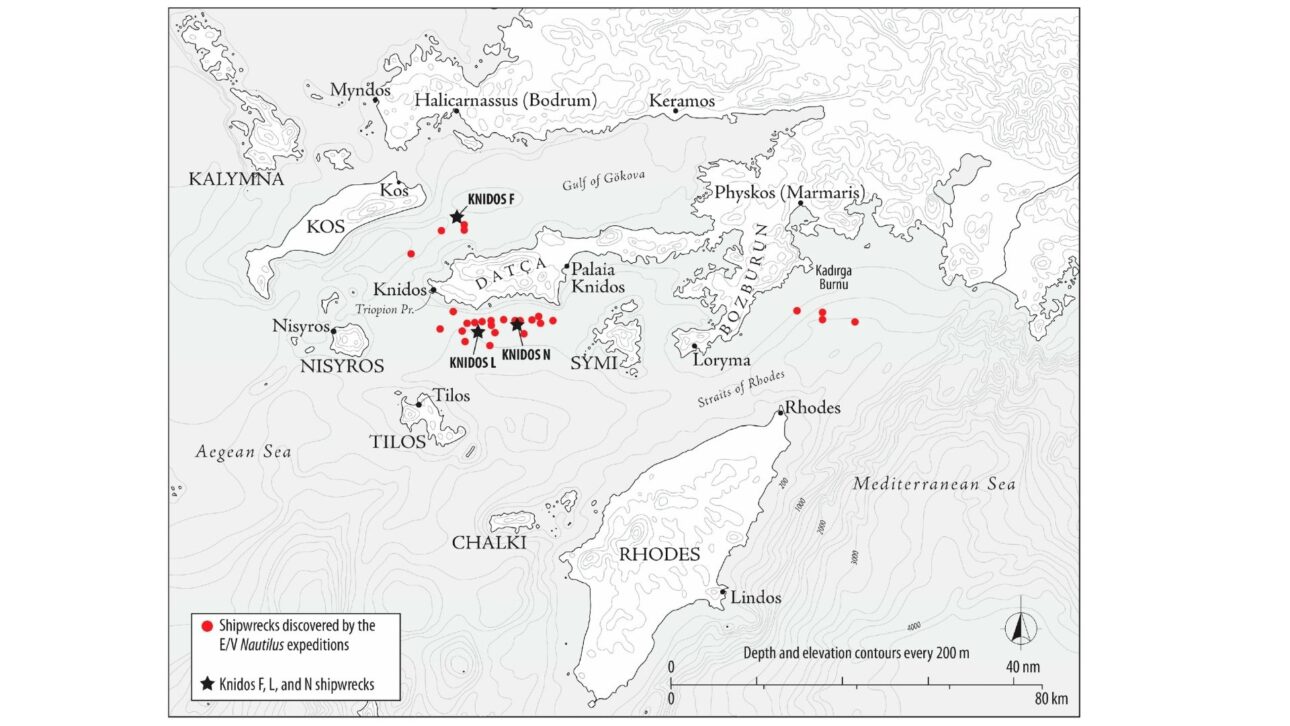
map image: Dan Davis
Here lies the heart of the discovery. Together, the shipwrecks of Knidos help reconstruct trade routes that connected the Aegean Sea, Anatolia, the Black Sea, and the eastern Mediterranean.
It’s like redrawing, on the map, the invisible roads that Byzantine ships traveled carrying goods between distant regions.
The period tells a story of rise and fall. The cargoes of the Knidos F and L shipwrecks, from the 10th to 12th centuries, reflect the resurgence of Byzantine maritime trade, a moment of economic breath.
Meanwhile, the later Knidos N, probably from the 13th century, shows a different scenario, a sign of how these trade routes rose and fell according to the politics and economy of the time.
This ebb and flow reveal the strategic value of the region. The so-called Carian maritime corridor, where the shipwrecks are located, was an artery of Byzantine cargo transport.
Studying these lost trade routes is to understand how the logistics that sustained an empire worked, long before modern ports and steel ships existed.
Technology that Searches the Seafloor
Finding a ship at 370 meters is not a task for the average diver. At 370 meters, the pressure and darkness make direct human work impossible, and thus exploration relies on machines.
It was the underwater robots, the ROVs Hercules and Argus, operated from the ship Nautilus, that traversed the seafloor of Turkey and recorded the Byzantine shipwreck with cameras and sensors.
This is the same family of technology used to explore the deep ocean in search of resources.
Side-scan sonar, remotely operated vehicles, and research ships are the tools that map the seabed, whether to find oil and gas or to locate a thousand-year-old shipwreck.
Underwater archaeology rides on the coattails of this advancement in deep-water engineering.
Without this arsenal, the Knidos F would remain invisible. The ability to see and document the seabed accurately is what allows discoveries like this to come out of the dark and reach public knowledge.
Each improvement in this technology opens the door to more stories dormant on the ocean floor.
Why such shipwrecks matter
A well-preserved shipwreck is worth more than treasure. For science, it is a frozen snapshot of an exact moment in the past: what was produced, what was sold, and where it traveled.
The 545 amphorae of the Knidos F are not just ceramics; they are data about an entire economy that has disappeared.
The seabed functions as a giant, silent archive. Deep, cold, and low-oxygen waters preserve wood, ceramics, and metal for times that dry land would never allow.
That’s why so many lost chapters of human history are stored not in libraries but on the ocean floor, waiting for the right technology to be read.
In the end, the Byzantine shipwreck of Knidos connects past and present in a curious way. The trade routes it reveals remind us that maritime transport has moved the world for millennia, from wine in amphorae to today’s containers.
Understanding how trade flowed a thousand years ago helps us see with different eyes the logistics that still depend on the sea today.
And you, what else does the seabed hide?
The Byzantine shipwreck Knidos F proves that the seabed holds entire chapters of history waiting for those who know how to search. There were 545 amphorae sitting at 370 meters for a thousand years, and only a recent study managed to transform this silent cargo into a map of trade routes between the Aegean and the Black Sea.
And you, do you think the seabed still hides discoveries capable of rewriting what we know about ancient trade? Share in the comments which submerged mystery you would most like to see robots reveal.


