Portuguese
  Spanish


Dungar Singh Sodha grew up in a village in the Rajasthan desert and learned engineering on his own, through videos and articles. With around Rs 50 thousand, he built a homemade wind turbine from aluminum sheets and old fan blades, and in 2023 founded the startup Sunwind, now in over 50 countries.
Some people learn to generate energy at a university, and some learn by watching videos on their phones. Dungar Singh Sodha is in the latter group. Self-taught, from a village in the Rajasthan desert, India, he transformed aluminum sheets and old fan blades into a homemade wind turbine that actually works. The story was reported by ETV Bharat.
What started as a homemade invention turned into a business. With an investment of around Rs 50 thousand, the Indian currency, equivalent to a few thousand reais, Dungar built the first prototype and, in 2023, founded Sunwind Innovative, a renewable energy startup. Today the company claims to sell portable turbines to more than 50 countries. All from a wind turbine born from scrap.
From aluminum sheets and old blades to a working turbine
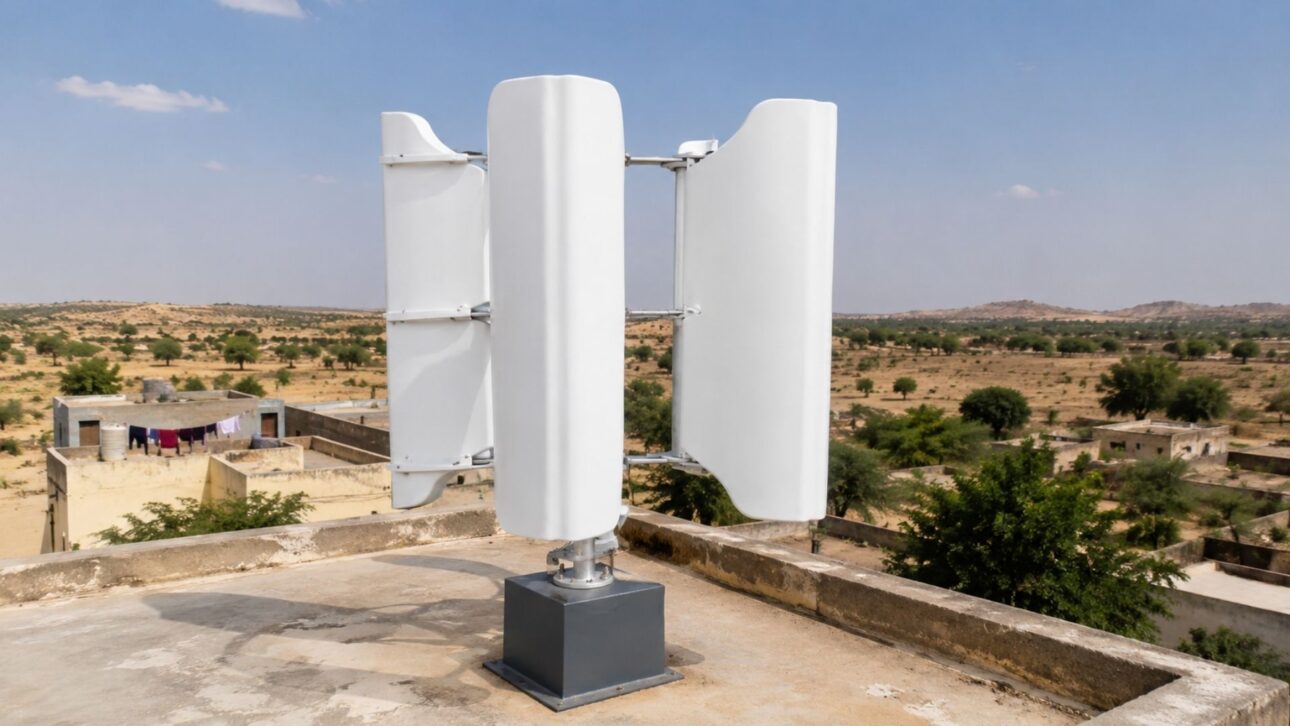
The starting point was scrap. To test the idea, Dungar and the team assembled a first wind turbine with what they had on hand: discarded aluminum sheets and fan blades.
-
Professor Builds Solar Power Plant from Electronic Waste, Restores School Days in Remote Brazilian Amazon Community

-
Massive 1.6 km-wide asteroid traveling at nearly 9 km per second to narrowly miss Earth this Saturday; here’s how, when, and where to watch the event.

-
Scientists Discover 10,000-Year-Old Stone Wall in the Baltic Sea, Used to Trap Reindeer Before Sea Levels Rose

-
Farmer’s DIY Cooling System Saves Harvests from Spoiling in 51 Countries by Tricking Standard Air Conditioners to Chill Rooms to 2°C


The process took about two months, done in a friend’s workspace, without a factory or assembly line.
The choice of material tells part of the ingenuity. Instead of buying expensive components, he repurposed what was discarded, proving the concept at a very low cost.
It was a homemade invention in the most literal sense, old parts gaining new function in the hands of someone who knew what they were doing, even without a diploma.
This crude prototype was what validated everything. Before thinking about selling, Dungar needed to know if the idea was feasible, and the aluminum turbine with old blades answered yes.
From there, the homemade invention ceased to be a backyard experiment and became the basis of a renewable energy product.
Up to 20 kWh per day: what the turbine delivers
The numbers explain the enthusiasm. According to ETV Bharat, the 1-kilowatt wind turbine generates 10 to 20 units of energy per day in favorable wind conditions, which is equivalent to up to 20 kWh daily.
In a month, this can reach about 300 units, enough energy to significantly reduce a household’s electricity bill.
The format also aids in adoption. The turbine is portable and can be installed on rooftops, balconies, or open spaces, without requiring a wind farm or large towers.
For homes, farms, and small businesses, it is a direct way to produce their own renewable energy and rely less on the grid.
The value proposition is clear: generate clean electricity at home, cheaply and simply.
In a windy region like the Rajasthan desert, such a wind turbine takes advantage of an abundant and free resource, the wind, turning it into tangible savings at the end of the month.
The self-taught from Sankhali
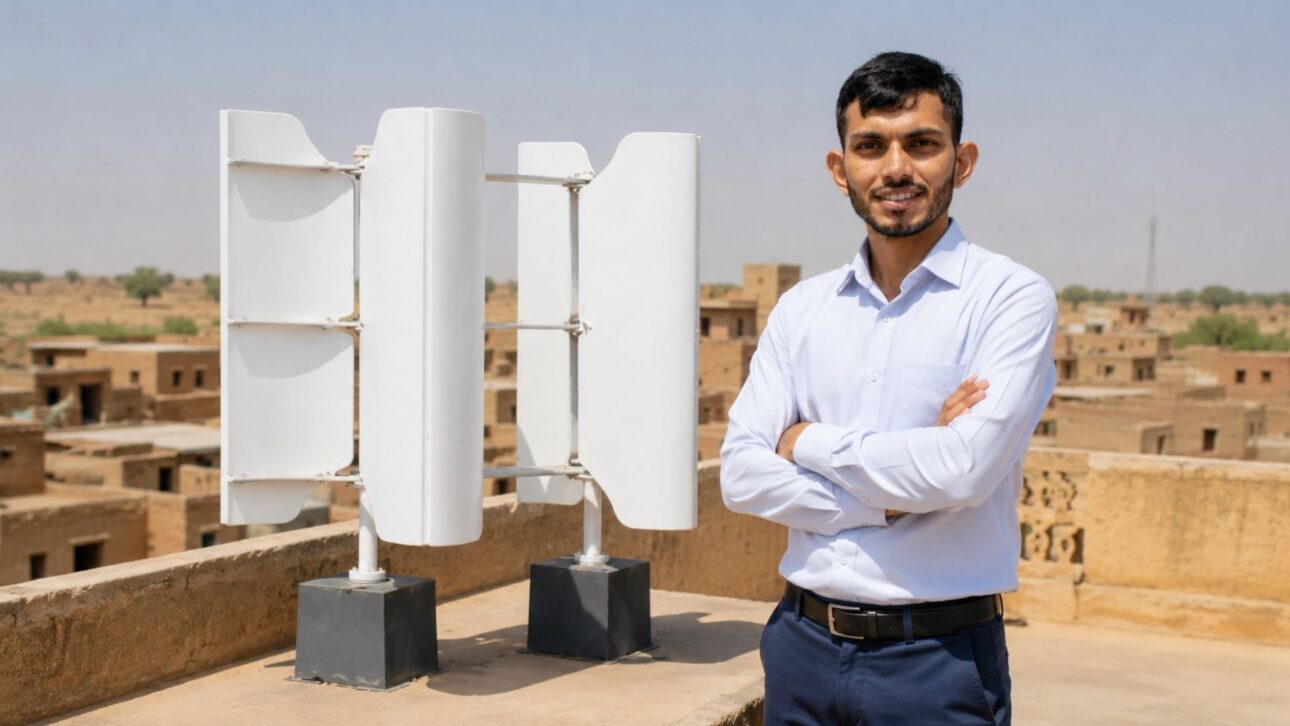
Behind the machine is a journey of self-study. Dungar Singh Sodha is from the village of Sankhali, in the Barmer district, Rajasthan.
Without formal technical training, he managed by studying tutorials on YouTube, academic articles, and technical materials from universities, crafting his own wind engineering curriculum through sheer determination.
The spark came from a childhood memory. Dungar recalls being interested in wind energy after seeing large windmills installed on his maternal family’s property during the floods of 2006. The image stayed with him, and years later it became the obsession that led him to build his own wind turbine.
This combination of curiosity and persistence is the heart of the story. It wasn’t luck or an isolated stroke of genius, it was study applied to a real problem.
Dungar’s homemade invention shows that technical knowledge today can be mined by anyone with the will and access to the internet, even starting from a village in the desert of India.
The Sunwind Startup and the 50 Countries
The idea scaled quickly. In 2023, Dungar founded Sunwind Innovative, described as India’s first company specializing in portable wind turbines.
The startup designs, manufactures, and installs small turbines for residential, commercial, and agricultural use, with models of different power and prices to fit various budgets.
The reach is impressive for such a young business. According to reports, Sunwind already delivers its turbines to over 50 countries, with clients in places like the United Kingdom, Qatar, United Arab Emirates, Uganda, and the Democratic Republic of the Congo, as well as ongoing installations in Greece. The homemade invention from Rajasthan has become an export product.
Institutional recognition has also arrived. The startup signed a memorandum of understanding with the government of Gujarat, valued at Rs 50 crore, during a major state investment meeting. For a renewable energy company born from aluminum sheets and fan blades, it’s quite a leap in just a few years.
Why This Matters for Clean Energy
Dungar’s case points to a larger trend. Renewable energy is moving beyond just large parks and plants to reach people’s rooftops.
Small and cheap turbines allow homes and farms to generate part of their own electricity, reducing bills and dependence on a grid that is not always reliable.
The homemade wind turbine has special appeal where energy is scarce or expensive. In rural and remote areas, producing your own bottled wind into electricity can be the difference between having light or not, pumping water, or running a small business.
It’s the decentralization of energy reaching those whom the traditional system often leaves last.
There’s also the message of reuse. Starting with scrap, as Dungar did, shows that innovating in clean energy doesn’t necessarily require high capital right away.
A good homemade invention, validated with recycled material, can be the first step of a solution that later gains industrial scale.
What Brazil Has to Do with This
For the Brazilian reader, the parallel is direct. Brazil is a wind power, especially in the Northeast, and still has regions where energy is expensive or unstable.
A small, cheap, and easy-to-install wind turbine fits this reality as much as it does the Indian desert.
There is no shortage here of backyard inventors capable of similar feats. Dungar’s story reinforces that technical talent and startup spirit can be born far from major centers, as long as there is access to information and a willingness to try. Low-cost renewable energy is fertile ground for those who want to undertake with purpose.
In the end, the lesson from Rajasthan is encouraging. Wind, scrap, internet, and persistence were enough to bring to life a wind turbine that today operates worldwide.
When ingenuity meets a free natural resource like wind, the result can go far beyond a backyard homemade invention.
And you, would you install one of these turbines at home?
The journey of Dungar Singh Sodha shows that it’s possible to transform aluminum sheets and old blades into a wind turbine that generates up to 20 kWh per day and becomes a renewable energy startup present in over 50 countries.
All starting with around Rs 50,000 and a lot of self-study.
And you, would you install a homemade wind turbine on your roof to lower your electricity bill? Share in the comments if you believe small-scale renewable energy can grow in Brazil and what would still make you think twice before adopting it.