






 Portuguese
  Spanish


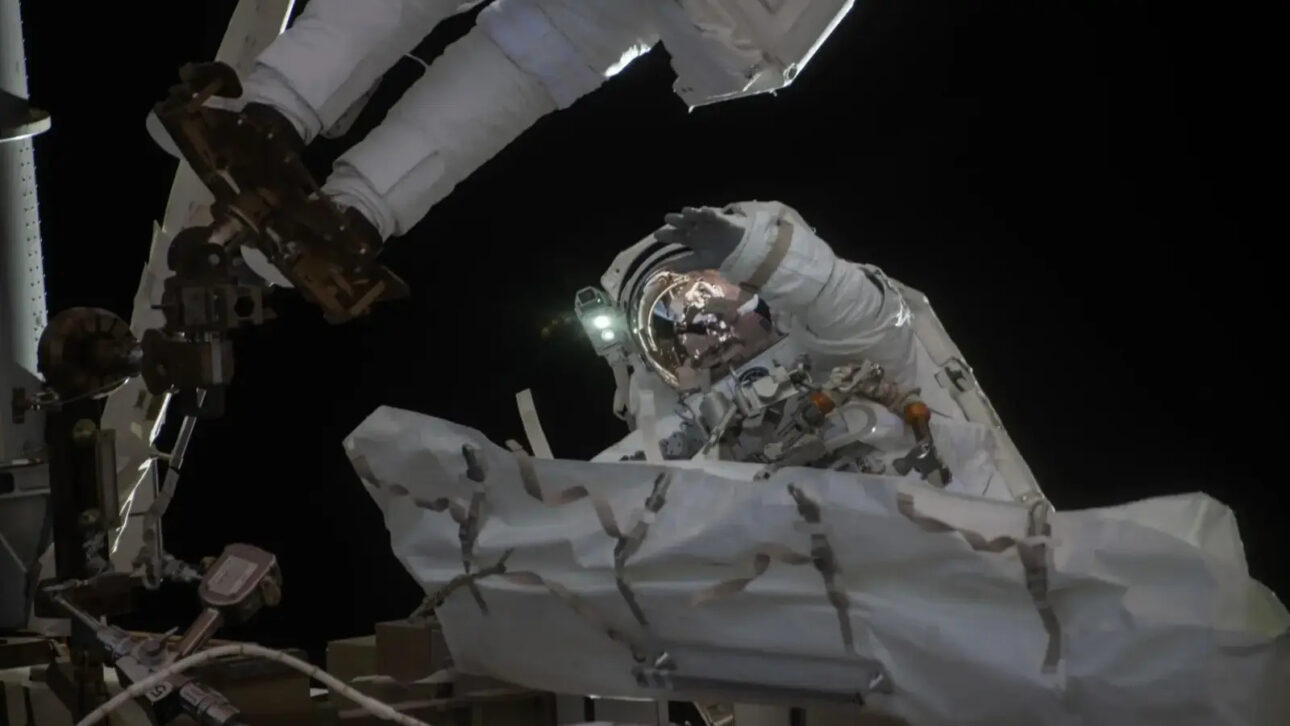
Chris Williams and Jessica Meir will spend about six and a half hours outside the International Space Station to replace a faulty joint of the Canadarm2, operation scheduled for June 30, 2026
NASA will conduct a spacewalk on June 30, 2026, lasting approximately six and a half hours to replace a faulty joint of the Canadarm2, an essential robotic arm of the International Space Station. The issue was identified on May 27, when the equipment recorded high current in the motor and did not move as expected.
Failure in Canadarm2 requires replacement of part in orbit
The Canadarm2 experienced the failure during routine operations on the International Space Station. One of the wrist joints of the robotic arm did not respond adequately to commands, while monitoring systems recorded high energy consumption in the motor.
After technical evaluation, NASA and the Canadian Space Agency concluded that replacing the joint in orbit would be the safest and most efficient alternative. A spare part necessary for the repair is already stored on the station.
-
Microsoft Raises Xbox Prices Again Due to Rising Component Costs

-
Teen from Rajasthan Desert Village Builds Homemade Wind Turbine Generating 20 kWh Daily, Founds Startup Sunwind

-
Professor Builds Solar Power Plant from Electronic Waste, Restores School Days in Remote Brazilian Amazon Community
-
Massive 1.6 km-wide asteroid traveling at nearly 9 km per second to narrowly miss Earth this Saturday; here’s how, when, and where to watch the event.


In operation for over 25 years, the robotic arm is used to move equipment, support the arrival and docking of spacecraft, and assist in scientific experiments.
Therefore, restoring its functionality is important for the continuity of the operational activities of the orbital laboratory.
Astronauts will have about six and a half hours to complete the repair
Astronauts Chris Williams and Jessica Meir will leave the station through the Quest airlock. Williams will participate in his second spacewalk, while Meir will conduct the fifth extravehicular activity of her career.
To facilitate identification during the operation, Williams will wear a spacesuit with red stripes. Meir will wear an unmarked suit.
The duo will follow a planned sequence to remove the faulty joint and install the spare unit.
The task requires precise coordination due to the movement limitations of the suits and the working conditions in microgravity.
The procedure involves careful handling of the arm structure, the use of specific tools, and the verification of each step.
Engineers on the ground will monitor the movements to protect the Canadarm2 and other station systems.


NASA and Canadian agency coordinate operation and contingency plans
The preparation involves teams from NASA and the Canadian Space Agency, responsible for reviewing tools, procedures, and alternatives for potential difficulties during the repair.
The replacement does not just consist of removing one part and installing another. The astronauts will need to adhere to safety protocols and may perform checks and adjustments during the spacewalk.
This coordination brings together the experience of the engineers responsible for monitoring the Canadarm2 and the practical actions of the crew members.
Extravehicular activities are among the most demanding tasks performed on the station, as they depend on physical endurance, precision, and constant attention.

Spacewalk will be broadcast live
The activity, identified as American spacewalk number 95, will be broadcast live starting at 7 AM Eastern Time. The coverage will be available on NASA+, Amazon Prime, Netflix, and the agency’s YouTube channel.
Before the operation, a press conference was scheduled for June 25. Bill Spetch, Fiona Antkowiak, and Jason Dyer are among the specialists expected to explain the planning, technical challenges, and context of the station’s maintenance.
NASA has also established guidelines and deadlines for journalists interested in attending the presentation in person or by phone. The meeting is expected to detail how robotic systems are monitored, maintained, and repaired in orbit.
This article was prepared based on information from NASA and the Canadian Space Agency, with data, numbers, and statements preserved as per the consulted material.


