






 Portuguese
  Spanish


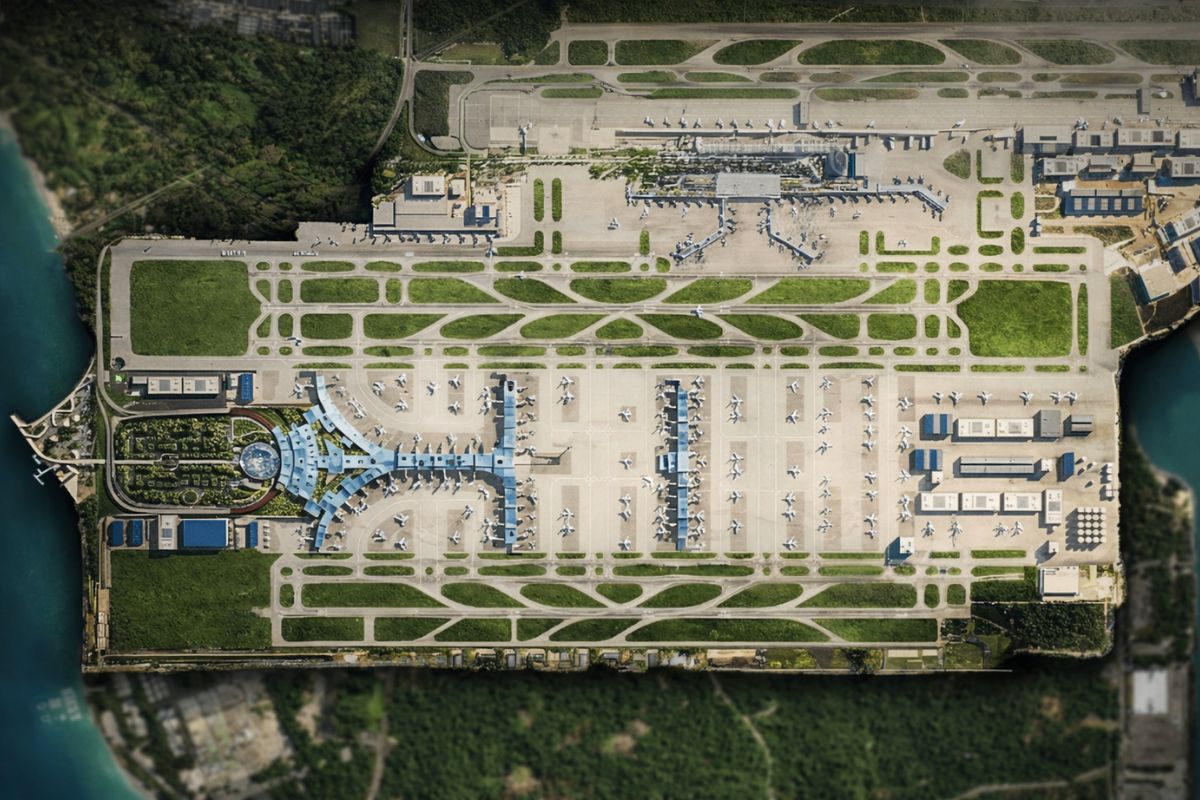


In A New Phase Of Expansion On Reclaimed Land, Changi Terminal 5 Transforms Singapore Airport Into A Mega Airport Terminal With A Capacity For 140 Million.
Singapore has already transformed a small piece of island into one of the world’s most admired airports. Now, it is making the boldest leap in its history. With an investment of about US$ 10 billion, the country is building the Changi Terminal 5 almost entirely on reclaimed land, in an expansion that alters the city map and redefines what a mega airport terminal is.
The idea is not just to grow. The new T5 is designed to operate in a world of pandemics, climate crisis, and fierce competition among global hubs, combining a gigantic building with flexible operations, roofs covered in solar panels, tunnels beneath an active runway, and direct integration with two metro lines. All this is built on yet another stretch of reclaimed land that expands the country’s area and pushes the airport further east.
Why Changi Needs A New Mega Terminal

Changi is already a global icon. The airport has been planned, since the 1980s, to grow in stages in Singapore, a tiny country that compensated for its lack of natural resources by becoming the air and sea gateway to Asia.
-
California Diverts 65% of Construction Waste from Landfills, Repurposing Millions of Tons into Road Base, New Asphalt, and Wood Chips

-
Japan Constructs World’s Deepest Sea Wall in the Pacific, Sinking Massive Concrete Structures for Three Decades

-
Pair Transforms Sunken Pontoon Bought for $4,000 on Facebook into 8,800-Pound Solar-Powered Tiny Home on Water
-
In Flood-Stricken South Sudan, Displaced Families Use Sand-Filled Plastic Bottles to Build Cooler, More Durable Homes



The existing terminals have multiplied, the runways have expanded, and over time came experiences like the Jewel, featuring the largest indoor waterfall in the world, gardens, a hotel, and a shopping complex that became a tourist attraction in its own right.
Even so, Changi is not among the largest airports in the world in absolute volume. With around 68 million passengers a year, it ranks 15th globally in total movement, although it is among the top when looking only at international flights.
Projections for the coming decades indicate growth of over 5 percent per year in travel within the Asia-Pacific region, which means doubling the volume in just over a decade.
To avoid losing ground in a scenario where Seoul, Hong Kong, Dubai, and other Asian hubs are also building ever-larger runways and terminals, Singapore decided to go beyond piecemeal adjustments.
Terminal 5 alone is expected to bring Changi’s annual capacity to around 140 million passengers, elevating the airport to the category of mega hubs with more than 100 million people per year.
How A Mega Terminal Rises From Reclaimed Land
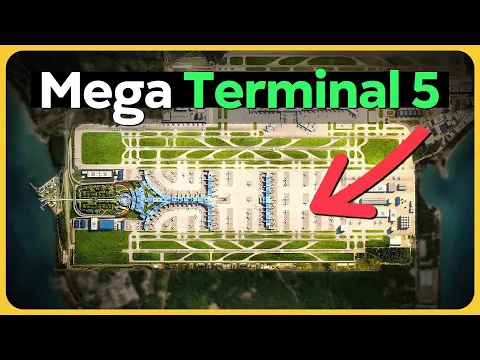

The history of Changi has always been linked to territorial expansion engineering. The current airport has largely been built on reclaimed land, and the project known as Changi East took this logic to the extreme.
Since 1998, Singapore has been dumping sand in shallow areas of the eastern part of the island, compacting the seabed and creating a new platform of 1,080 hectares.
To build the future T5, about 200 million cubic meters of sand were used over soft marine clay.
The stabilization required different compaction techniques: repeated drops of large weights on the ground, vibrating probes to eliminate pockets of air, and vibroflotation methods that use pressurized water to rearrange the sand particles.
Only after this reclaimed land behaves like a truly firm ground can runways, terminals, tunnels, and buildings actually rise.
First, the new area of Changi East received the Singapore Air Force, with a runway that needed to be extended to 4,000 meters to accommodate large commercial aircraft. Starting in 2030, this runway will be fully transitioned to civil use and integrated into the airport system.
In parallel, cargo, maintenance, and logistics areas are also being established on this same reclaimed land, preparing the surroundings of Terminal 5 to operate as a complete hub, not just as a departure building.
A Giant Terminal Broken Into “Neighborhoods”
Despite its size, T5 was designed to not feel like a warehouse for people. The design divides the complex into three interconnected sub-terminals, called 5A, 5B, and 5C, which helps visually reduce the scale and allows isolating parts of the operation when necessary.
Instead of a single impersonal hall, the architects conceived the space as a sequence of internal “neighborhoods,” each with its own identity.
Overlapping ceilings in curved shapes resembling leaves allow natural light to enter diffusely, creating plays of shadow and light that avoid an industrial warehouse feel.
Vertical gardens and green areas reinforce Singapore’s image as a “garden city” from the very first encounter of the traveler with the terminal.
The idea is that, even while in a building erected on reclaimed land, the passenger feels they are in an extension of Singapore itself, with more human spaces, resting areas, logical pathways, and architecture that blends technology with natural elements.
Operating In Pandemics: Isolatable Sub-Terminals And Minimal Contact
The Covid pandemic forced a profound revision of the design. The original plan was paused for two years while the airport dealt with sharp declines in traffic, temporary terminal closures, and uncertainty about the future of travel.
This experience led T5 to be designed, from the outset, as a terminal ready to face new sanitary crises.
The concept of sub-terminals gained even more importance: in the event of a new pandemic, parts of T5 can be physically and operationally isolated, allowing the rest of the structure to function with a lower risk of contagion.
The ventilation systems have been designed to operate in a boosted mode during critical situations, refreshing the air more frequently and allowing greater control over flows.
Additionally, the passenger experience is expected to be almost entirely contactless. Facial and iris-based biometrics promise to speed up immigration, boarding, and security checks, reducing queues and document handling.
In some cases, local citizens can already enter and exit practically without showing their passport, which is only checked once for foreign visitors upon arrival.
Tunnels, Trains, And Metro Beneath An Active Runway

Connecting a terminal of this size to the rest of the airport and the city is a challenge in itself. Therefore, the reclaimed land in Changi East is being crossed by large-diameter tunnels, opened by specialized excavation machines that operate beneath the existing second runway without interrupting the flow of aircraft.
These tunnels will house an internal tram system for passengers, baggage connections between sub-terminals, and lower layers dedicated to power cables, pipes, and other infrastructures.
The goal is to move people and luggage quickly between Terminal 5 and the older terminals, integrating everything into a single complex.
Beyond the airport, T5 will be served by two lines of Singapore’s Mass Rapid Transit system, with the extension of an existing line and the arrival of the new Cross Island Line, which will have one of its ends installed right in this reclaimed land area.
Building all of this amid daily landing and takeoff operations requires meticulous planning, strict work windows, and techniques that minimize any noticeable vibration on the surface.
The Environmental Cost Of Reclaimed Land And The Bet On Solar Energy
The advancement towards the sea has a cost. Singapore has already increased its land area by more than 25 percent in two centuries thanks to reclaimed land projects, which has meant, in practice, the disappearance of more than 90 percent of its mangrove forests and about a 60 percent decline in the region’s coral reefs.
The creation of areas like Changi East, with hundreds of millions of cubic meters of sand dumped onto sea bottoms, is part of this process.
As a partial response, Terminal 5 incorporates a large-scale sustainability agenda. The “leaves” of the roof not only filter natural light but also significantly expand the area available for solar panels, which are expected to form one of the largest rooftop solar energy installations in Singapore, with enough capacity to power the equivalent of 20,000 homes under optimal conditions.
Furthermore, T5 will be a point of expansion for rainwater harvesting systems, water reuse, and new waste management projects already being tested at Changi, all designed to bring the airport closer to net zero carbon goals in the long term.
Still, the debate remains: to what extent do these gains compensate for the inevitable impact of continuing to create reclaimed land in a country that has already lost most of its mangroves and reefs?
A US$ 10 Billion Investment To Secure The Crown Of Airports
From a financial and strategic standpoint, Terminal 5 and the entire development of Changi East represent at least US$ 10 billion in combined investments, considering the creation of the new area, the terminal, the aviation industrial zone, runway reinforcement, and transport connections.
At the same time, other regional hubs are not standing still. Seoul is adding runways and expanding terminals to surpass the 100 million passenger mark, Hong Kong is building a third runway and new expansions, and Dubai is working on an airport project capable of reaching around 260 million passengers per year in the future.
In this scenario, the bet on a mega terminal built on reclaimed land is how Singapore has found to ensure that Changi remains the country’s showcase and one of the main air connectivity points in the world.
The timeline foresees construction until the mid-2030s, in a long-term project that needs to be executed without compromising the current operation of the airport.
And you, looking at all this, do you think this combination of a mega terminal built on reclaimed land, a roof with solar panels, tunnels beneath the runway, and a capacity for 140 million passengers will be enough to keep Changi as the most desired airport in the world for the coming decades?






I wanna ask where did SG get the sand to dump into the sea for reclaimed land?
From Malaysia