






 Portuguese
  Spanish


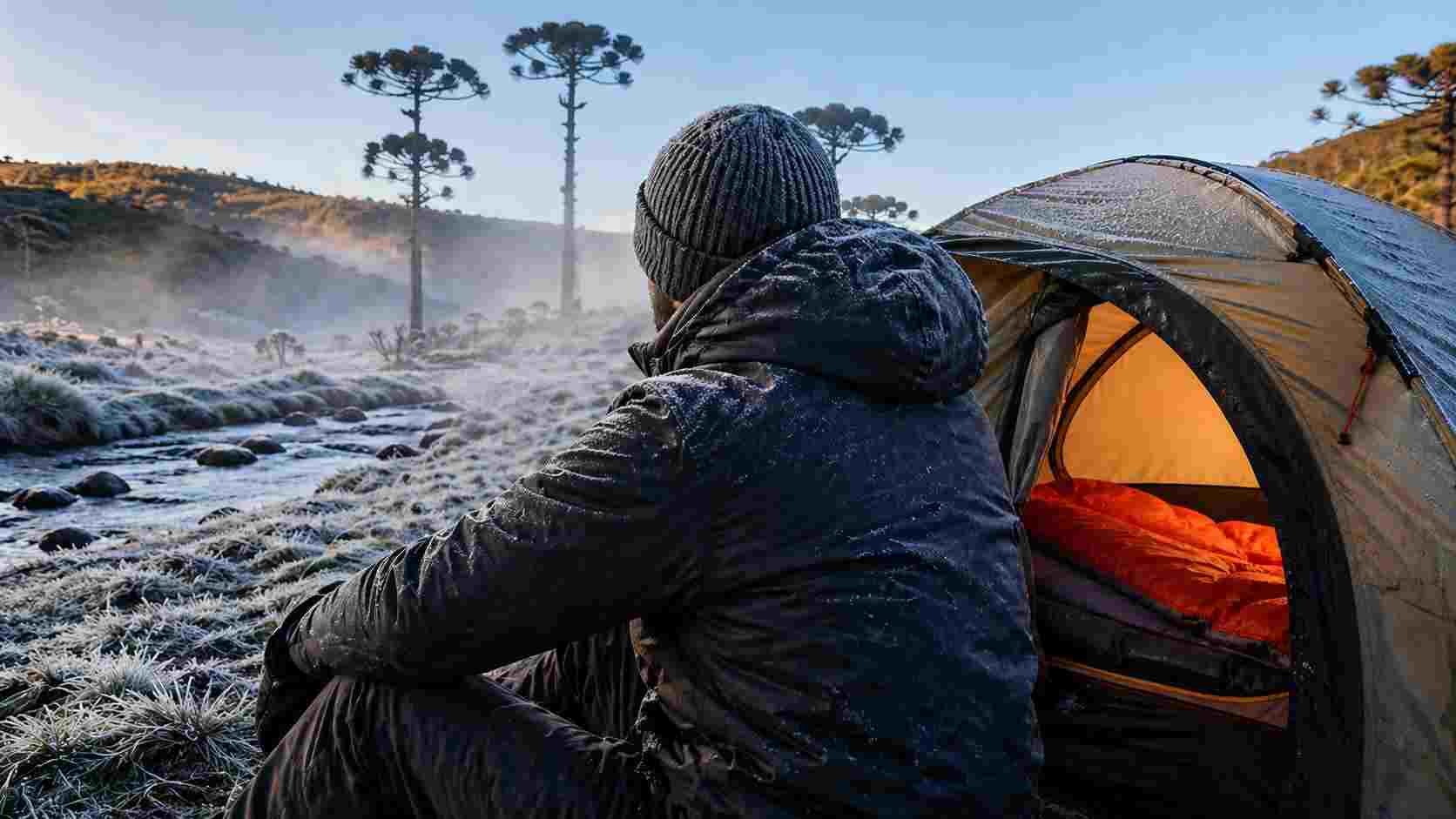

Report from the Área Secreta channel shows camping in Urupema, Santa Catarina, during the arrival of a cold front, with rain, hail, negative wind chill, and tests of equipment used to face a night in Brazil’s coldest city.
Urupema, Santa Catarina, identified in the report as Brazil’s coldest city, was the chosen setting by the Área Secreta channel for a camping trip under a cold front, rain, wind, hail, and negative wind chill, in an experience aimed at testing equipment made for extreme cold.
The proposal was simple yet demanding: leave the road after more than 11 hours of travel, find an isolated spot in nature, set up a tent before the rain arrived, and spend the night in a real condition of intense cold. The choice of Urupema came precisely from the city’s reputation, used in the video as the ideal location to put camping items prepared for sub-zero temperatures to the test.
The camp was set up in a grassy area, next to a crystal-clear stream and surrounded by araucaria forest. The place, described as beautiful and isolated, was provided after the presenter sought suitable spots in the city and received support from the owners of the Chalé Refúgio das Águas guesthouse.
-
Workers renovating a playground in northern England uncover 176 World War II bombs buried underground; training artifacts still contained explosives.

-
Brazilian Architect Transforms Waste into Sustainable Homes with Solar Power and Rainwater Systems for 40 Years

-
Security Guard Becomes Doctor at Louisiana Hospital Where He Once Worked, Studied Chemistry Between Shifts

-
Woman Rescued from Luxury Complex in Brazil Worked Without Pay for 55 Years, May Be Entitled to Over $300,000




Cold front changed the weather even during setup
The arrival of the cold front was expected for late afternoon, with forecasts of very cold weather, rain, and even a small possibility of snow. Therefore, setting up the tent became a race against time, as the presenter needed to get everything ready before the rain started.
The new tent was pitched on the lawn and received a protective structure against the cold coming from the ground. The preparation included a tarp, thermal layer, sleeping pad, and a special low-temperature sleeping bag, in an attempt to create sufficient insulation to face the night.
The sleeping bag used in the test was rated to withstand temperatures down to -3.5 ºC. The item was presented as one of the main resources for getting through the night in Urupema, especially since humidity, rain, and wind could make the sensation of cold even stronger.
Another item tested was a thermal mat placed beneath the sleeping pad and sleeping bag. The piece had an aluminized coating and was used to reduce the transfer of cold from the ground to the body, a central concern in any camping trip in very low temperatures.
Equipment tested in practice
In addition to the tent and sleeping bag, the experience in Brazil’s coldest city included hand warmers, waterproof socks, an extreme cold mask, an emergency thermal blanket, and military rations suitable for cold climates. The idea was to evaluate each item in a real situation, without relying solely on manufacturers’ descriptions.
The hand warmers were activated in the afternoon. The product promised up to 10 hours of heat and began to warm up shortly after being opened and shaken. Later, the item became important for keeping hands and feet warm, mainly due to the absence of suitable gloves.
The waterproof socks also underwent a direct test in the stream next to the camp. The presenter placed his feet in the icy water and then checked if the sock worn underneath had gotten wet. The result was positive: the water did not penetrate the material, even after contact with the stream and the soaked ground.
The extreme cold mask was used during the night when the temperature dropped even further. The accessory helped protect the head and ears, areas that started to bother as the cold advanced. Later, the item was removed because the humidity began to cause discomfort.
Rain, hail, and negative wind chill
The rain started during the exploration of the surroundings and became a constant presence in the experience. The tent resisted the humidity well, and the interior remained dry, despite the soaked exterior. This point was considered essential so that the camp would not turn into a bigger problem during the night.
During the afternoon, the presenter left the camp to explore nearby spots. At a waterfall in the region, he heard that the place can completely freeze under ideal cold conditions. The altitude mentioned was over 1,500 meters, and the ascent through the mountains brought the experience closer to even colder areas.
At Monte da Antena, the situation became more extreme. Strong wind, intense cold, and the falling of small ice pellets marked the passage of the cold front. The sensation described was like being on another planet, with enough cold to make filming difficult and leave hands freezing.
At night, the outside temperature reached about 2 ºC, with a wind chill of -2 ºC at one of the recorded moments. Later, the wind chill dropped to -3 ºC, while the rain intensified again and the cold inside the tent became harder to bear.
Military ration frustrated the night at the campsite
The meal, which should have been an important part of the cold-weather experience, ended up being one of the most frustrating moments. The military cold-weather ration kit included Mexican-style chicken and rice, cornbread, tropical drink powder, cranberries, chewing gum, mini Tabasco, and a chocolate nut brownie.
The problem arose when the presenter realized there was no practical way to heat the main meal in the package. As it was raining outside and no fire was prepared, a hot meal became unfeasible at the campsite. The dehydrated rice needed boiling water to be consumed.
Unable to prepare the main dish, he ate the available cold items, such as cornbread, dried fruit, and the chocolate brownie. Despite finding some foods tasty, the kit’s evaluation was negative for that situation, as a hot meal would have made a big difference on a freezing night.
Later, back home, the chicken and rice was prepared with hot water and approved for its taste. Still, in the context of the night in Urupema, the main food did not fulfill its expected role, because it depended on a heating structure that was not available at the most necessary moment.
Dawn brought little sleep and constant cold
The early morning was marked by discomfort, persistent rain, and difficulty sleeping. Even with the sleeping bag working well, the cold in his hands and the absence of gloves weighed heavily. Hand warmers were used inside his shirt, in his hands, and even by his feet to reduce the discomfort.
The presenter even avoided leaving the tent during the night, because the inside of the sleeping bag was warm and the outside remained cold and wet. The rain oscillated between stronger and weaker moments but did not stop long enough to make the night more peaceful.
The emergency thermal blanket was only tested in the morning, inside the tent. The item surprised with its ability to retain heat and could have been used inside the sleeping bag during the night. The late discovery made the presenter realize that the night could have been more comfortable if the blanket had been used earlier.
At dawn, the cold was still strong, and the campsite had to be dismantled in drizzle. The tent, tarp, and equipment were placed wet in the car, a difficult farewell after a night with little sleep and much humidity.
Experience reinforced the impact of cold in Urupema
The visit to Brazil’s coldest city showed that, even without a major snowstorm, the combination of rain, wind, altitude, humidity, and negative wind chill can transform a simple camping trip into a severe test of endurance and preparation.
Among the items evaluated, the sleeping bag, thermal mat, waterproof socks, mask, emergency blanket, and hand warmers performed well. The tent also withstood the rain and kept the interior protected, a decisive factor for the experience to remain possible throughout the night.
The biggest mistake was not bringing appropriate gloves and relying on a ration that required boiling water in an environment without preparation facilities. In practice, the experience in Urupema showed that adequate equipment makes a difference, but complete planning is indispensable when the destination is Brazil’s coldest city.


