






 Portuguese
  Spanish
  3 min of reading
  0 comments


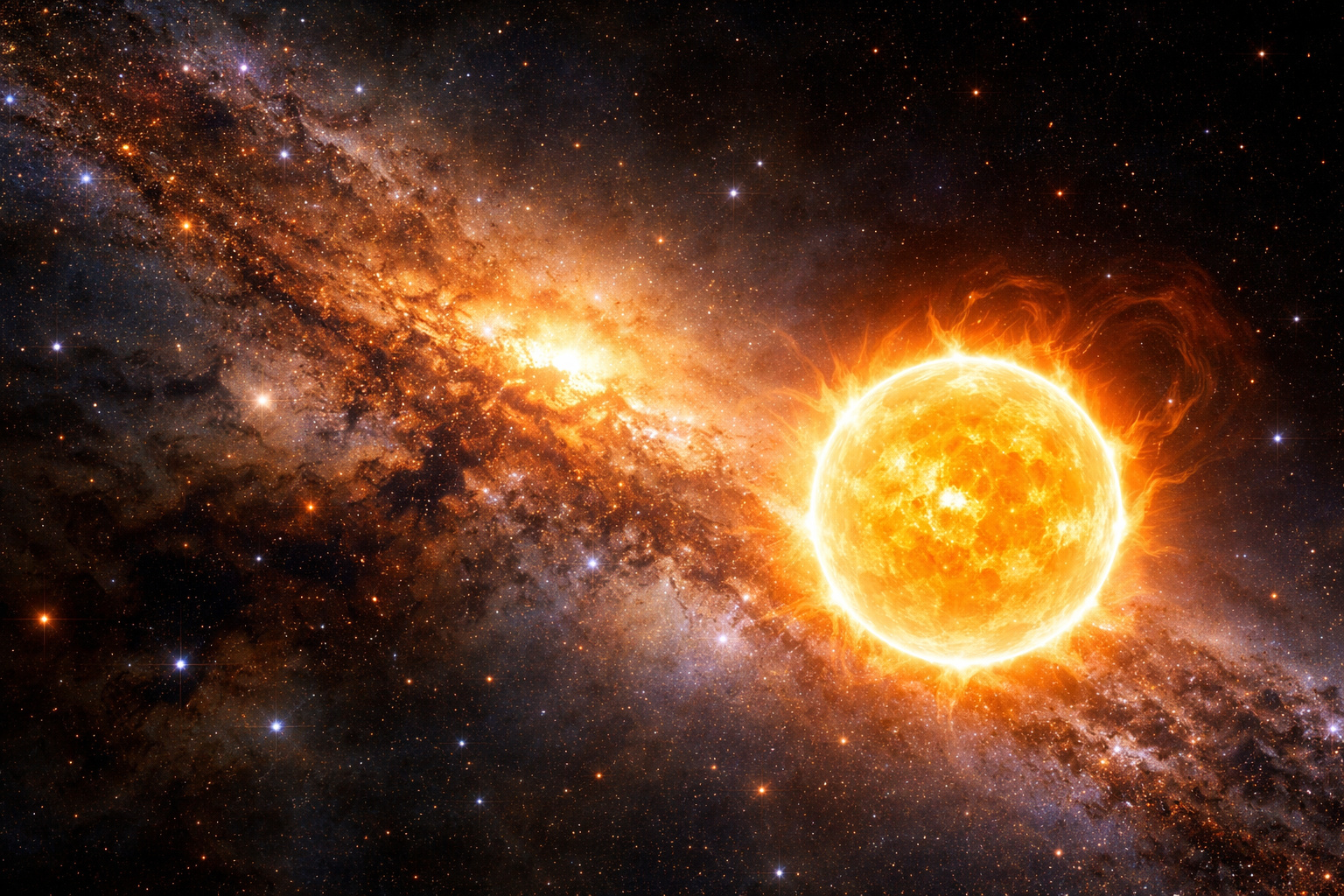
Published Research In Astronomy & Astrophysics Indicates That The Sun May Have Formed Near The Galactic Center And Then Migrated To Outer Regions Of The Milky Way
New astronomical research suggests that the Sun was not born where it currently is within the Milky Way. According to two scientific studies published in 2024 in the journal Astronomy & Astrophysics, our star may have formed closer to the galactic center. Later, billion years later, the Sun is believed to have gradually migrated to a more distant region of the galaxy.
Moreover, this displacement may have occurred along with other stars similar to the Sun. Consequently, researchers have begun to consider a process of collective stellar migration within the Milky Way. Thus, the current position of the Solar System may not reflect the location where the Sun actually was born.
Therefore, this hypothesis raises new questions about the history of the Solar System within the galaxy. At the same time, scientists continue to analyze astronomical data to better understand this possible displacement over billions of years.
-
Brazilian Company Launches Retro Smartphone with 48 MP Camera, T9 Keyboard, and Privacy Features for Social Media-Free Use

-
Self-Taught Chinese Farmer Builds 5-Ton Submarine from Scrap, Launches It in Anhui River
-
Invisible Induction Technology Enables Wireless Power for Blenders, Coffee Makers, and Air Fryers, Reducing Countertop Cables

-
Smart Outdoor Lighting Transforms Gardens into Living Spaces with Weather Resistance and App-Controlled Scenes





Gaia Satellite Data Helps Reconstruct The History Of The Sun
To understand this possible displacement, scientists analyzed data from the Gaia satellite, a scientific mission launched in 2013 by the European Space Agency (ESA). This space observatory maps the position, motion, and properties of billions of stars with high precision.
With this information, researchers were able to reconstruct stellar trajectories throughout the history of the galaxy. In this way, it was possible to identify patterns of displacement among stars similar to the Sun.
Thus, the data indicate that a collective movement of stars to more outer regions of the Milky Way occurred between 4 billion and 6 billion years ago. In this scenario, the Sun and other stars may have gradually migrated to the region where they are found today.

Influence Of The Galactic Bar On Stellar Dynamics
Additionally, scientists analyzed the central structure of the Milky Way to better understand this movement. In the nucleus of the galaxy, there is an elongated region formed by stars known as the galactic bar.
This structure exerts a strong gravitational influence on the stars that orbit in the regions near the galactic center. Therefore, changes in the structure of this bar can alter the orbital dynamics of numerous stars.
Consequently, the evolution of the galactic bar may have caused gradual displacements over billions of years. This process may have directly contributed to the migration of the Sun within the galaxy.
Analysis Of Thousands Of Stars Similar To The Sun
To support this hypothesis, researchers analyzed a detailed catalog of 6,594 stars classified as “solar twins”. These stars have temperature, mass, and chemical composition similar to that of the Sun.
These characteristics allow scientists to compare processes of stellar formation and evolution. Moreover, many of these stars have estimated ages between 4 billion and 6 billion years.
This interval coincides with the period when the possible galactic migration would have occurred. Thus, the observed patterns reinforce the hypothesis of a collective displacement of stars within the Milky Way.
Chemical Evidence Points To An Origin Closer To The Galactic Center
In addition to the dynamic analyses, scientists also investigated the chemical composition of the analyzed stars. These analyses revealed similarities suggesting formation in similar regions of the galaxy.
According to the researchers, this evidence indicates that the Sun may have been born much closer to the galactic nucleus than previously thought. This hypothesis arises from the chemical comparison between the Sun and the so-called solar twins.
According to estimates presented in the studies published in the journal Astronomy & Astrophysics, this region may be located more than 10,000 light-years from the center of the Milky Way.
Given this evidence, an intriguing question arises: could other stars near Earth also have undergone similar migrations throughout the history of the galaxy?


Be the first to react!