Portuguese
  Spanish


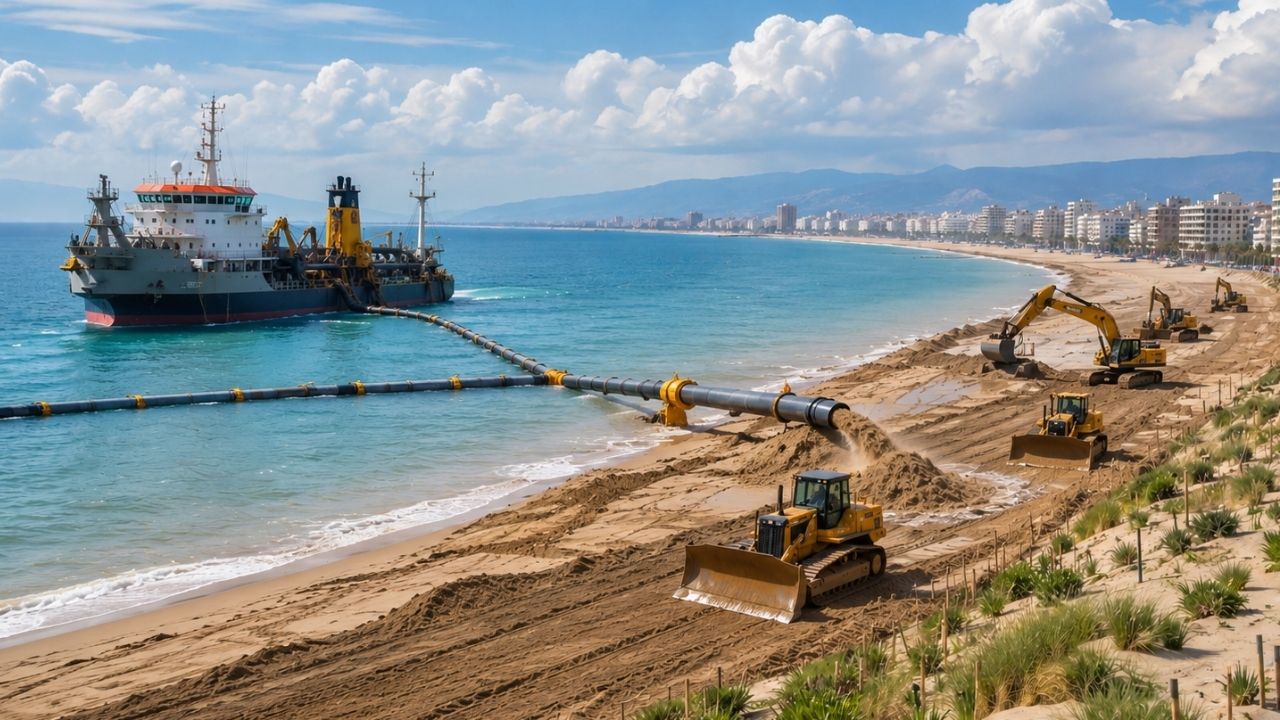


Largest beach restoration in Spain’s history completed by Van Oord south of Valencia, with 3.3 million m³ of sand, dredging, floating and submerged pipelines, dune recovery, and protection of coastal communities near Albufera Park.
Sand in sufficient volume to reshape kilometers of coastline was pumped to the south coast of Valencia, Spain, in a coastal engineering operation completed by Van Oord to restore beaches that had been suffering gradual erosion since 1965.
According to information from Van Oord, a company specializing in dredging, land reclamation, and artificial island construction, the most visual detail of the work lies in the method used: 3.3 million m³ of sand were applied with the support of the dredge HAM 318, Van Oord’s largest trailing suction hopper dredge, while the dredged material was transported to the beach by approximately 1.8 km of floating and submerged pipelines.
Spain’s largest beach restoration returned width to Valencia’s coastline

The intervention was presented as the largest beach restoration in Spain’s history. The project recovered 7 km of coastline south of the city of Valencia, restoring to the beaches a width that had been lost over decades of erosion.
-
Tesla injected an additional $250 million into the German factory, doubled the battery cell target, and opened its own production line for startups.

-
No more TV stuck on the wall: Samsung The Freestyle+, the new projector with over 400 lumens projects on walls, floors, and ceilings, bringing cinema to any corner of the house.

-
A Japanese governor single-handedly stalled the construction of the world’s fastest train for nine years, and only now has he agreed to allow a tunnel excavated at a depth of 1,400 meters.
-
Almost 1 billion euros, two gigafactories, and a million-dollar public investment, Chinese company aims to turn Spanish city into Europe’s new battery hub.


The work was commissioned by the Spanish government and executed by a joint venture formed by Dravo S.A., a subsidiary of Van Oord, and Rover Maritime.
In addition to the replenishment of the sand strip, the project also included the extension of two breakwaters, structures used to reduce wave force and limit the advance of coastal erosion.
Sand pumped through pipelines rebuilt 7 km of beaches in Valencia, widening the coast by up to 150 meters against erosion.
In practice, the operation not only returned sand to the beach. It redesigned part of the coastline to create a more robust physical protection against wear caused by the sea.
3.3 million m³ of sand were applied to widen beaches by up to 150 meters
The most significant figure of the work lies in the volume moved. In total, 3.3 million m³ of sand were applied along the restored section.
With this quantity, the beaches gained a coastal strip of up to 150 meters in width at certain points.
This widening changes the function of the beach. In addition to being a tourist and scenic space, the sand strip now acts as a natural barrier between the sea and lower urban, agricultural, and environmental areas.
The wider the coastal strip, the greater its capacity to absorb part of the wave energy before it reaches vulnerable areas.
Floating and submerged pipelines carried the dredged material 1.8 km to the beach

The most curious part of the project was the logistics used to transport the sand to the coast.
Van Oord mobilized the HAM 318, its largest trailing suction hopper dredge. This type of vessel removes sediments from the seabed and transports them to the application area.
Afterward, the material was pumped to the beach for a distance of approximately 1.8 km, using a combination of floating and submerged pipelines.
This scene summarizes the scale of the work: a dredge at sea, pipes crossing the water, and millions of cubic meters of sand being directed to rebuild an entire coastline.
Dunes reinforced with 75.5 km of sand fences and 44,000 plants

The restoration was not limited to the beach. Another important step was the recovery of the dunes, essential for the natural protection of the coastline.
For this, 75.5 km of sand fences made from a local type of grass were installed. These structures were positioned in a square shape to capture wind-blown sand.
Within these areas, 44,000 seedlings were planted to help fix the soil and strengthen the formation of new dunes.
The goal was to create a system where engineering and nature worked together: the sand rebuilds the beach, the fences help retain the material, and the vegetation stabilizes the environment over time.
Wider beaches protect communities, agricultural areas, and the Albufera Park
The expanded coastal strip has a direct impact on the protection of low-lying communities, as well as agricultural areas near the coast.
The project also contributes to the defense of the Albufera Park, a natural area located between freshwater and the Mediterranean Sea.
This protection is important because coastal erosion can compromise not only the beach, but also fragile ecosystems, local economic activities, and the safety of nearby communities.
By reinforcing beaches and dunes, the work creates a layer of defense against sea encroachment and helps increase the ecological resilience of the region.
Work shows how coastal engineering tries to respond to erosion in the Mediterranean

The Valencia project fits into a larger challenge faced by several coastal regions: the gradual loss of beaches due to erosion.
In areas where the sand strip diminishes, the coastline becomes more exposed to storms, surges, and sea encroachment. Therefore, restoration works have gained prominence as alternatives to protect cities, infrastructure, and ecosystems.
The intervention in Spain also shows a trend of projects that combine dredging, artificial beach nourishment, dune recovery, and environmental reinforcement.
Funding came through the European Commission, within the NextGenerationEU fund, created in 2021 to support recovery, transformation, and resilience in European Union countries.
Valencia transforms sand into natural infrastructure against sea encroachment


The restoration of the beaches south of Valencia shows how sand can function as coastal infrastructure.
Instead of relying solely on walls, concrete, or rigid barriers, the project used sediments, dunes, vegetation, and breakwaters to create a defense more integrated with the natural environment.
The work was completed within the agreed execution period and within budget, according to Van Oord.
The result goes beyond a wider beach. The project recovers part of the coastline lost since 1965, reinforces protection against erosion, and shows how large coastal works can combine heavy engineering and ecological restoration to prepare vulnerable regions for the coming years.
Given the advance of erosion in various coastal regions worldwide, do you believe that works like this, which use sand, dunes, and vegetation as natural defense, can be a smarter solution than concrete barriers? Share your opinion.