






 Portuguese
  Spanish




Stellantis Launches Unique Center In South America To Disassemble And Resell Parts, Expanding The Replacement Market And Reducing Environmental Impact
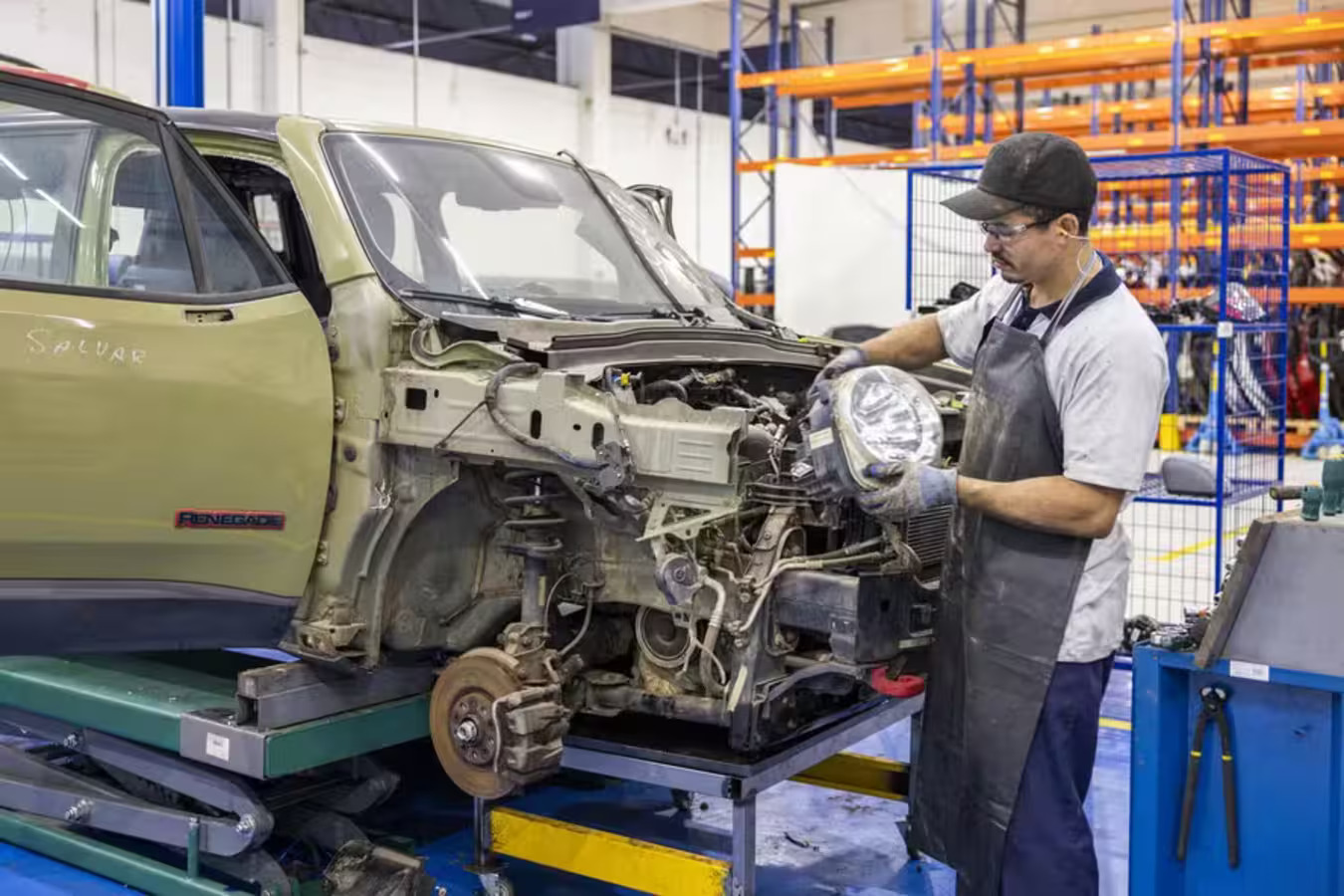
Stellantis, a market leader in Brazil and owner of brands such as Fiat, Jeep, Peugeot, Citroën, and Ram, announced a new step in the automotive sector. The company inaugurated on Thursday (14) in Osasco (SP) the Circular Autopeças, the first vehicle disassembly center of a manufacturer in South America.
The facility will disassemble parts from used cars and reintroduce them into the replacement market. The initiative is not limited to Stellantis models. During the visit, a Honda WR-V and a Chevrolet Onix were seen awaiting the process.
The parts will be resold through a dedicated website, on Mercado Livre, via WhatsApp, and also in a physical store at the same address as the warehouse.
-
Chevrolet Onix 2026 Priced at R$ 86,790 with Discounts, Underpricing Citroën C3; Features 1.0 Engine, 6 Airbags, 8″ MyLink, Wi-Fi, and OnStar

-
Fiat Mobi Price Nears $18,000 in Brazil: Entry-Level Hatch with 1.0 Firefly Engine, Manual Transmission, and Stability Control Sees $400 Increase.

-
F1 Puts Drivers in Lego Cars at Silverstone, but Max Verstappen Criticizes the Idea Directly

-
BYD’s All-Electric Sedan with 530 HP and 0-100 km/h in 3.8 Seconds Becomes a Used Car Bargain After Depreciating by R$ 117,000


Operation And Structure
The warehouse will receive test vehicles from Stellantis that would be destroyed as well as models purchased at insurance auctions.
This is the company’s second center in the world with this function, with the first located in Turin, Italy.
Currently, the inventory consists of 2,400 parts, but the goal is to reach 10,000. Among the available items are steering wheels, turn signal levers, radiators, wheels, headlights, taillights, alternators, turbines, electronic modules, and differential axles.
Each part will be photographed and listed on a digital platform. The investment to create Circular Autopeças was R$ 13 million, part of a R$ 32 billion investment announced in 2024. The capacity is to disassemble 8,000 vehicles per year, with plans to employ 150 people by 2027.
Sustainability And Reuse
The project aims to provide a better destination for vehicles after use. According to Stellantis, reconditioned parts generate up to 50% less CO₂ emissions compared to new ones.
In Brazil, about 2 million vehicles reach the end of their life cycle annually. However, only 1.5% receive proper disposal of their parts.
Process Steps
Only legalized vehicles can undergo the process. First, the car is scanned to check its history.
Next, fluids are removed during the decontamination process. Once this step is completed, the vehicle moves to three disassembly boxes.
The parts receive ratings from 0 to 9. Those rated between 0 and 4 are discarded and properly disposed of. Parts rated above 5 are prepared for sale, with prices proportional to their ratings.
According to Alexandre Aquino, vice president of circular economy at Stellantis, a part rated 9 is sold for about half the price of a new one. Parts with high ratings are in excellent condition.
Limitations And Possibilities Of The Disassembly Center
Safety parts cannot be reused and are designated for material separation. The engine can be sold in parts or as a whole.
Recyclability, according to Stellantis, is a factor that can make the vehicle eligible for IPI discounts in programs such as Sustainable Cars and Green IPI.
With Circular Autopeças, the company aims to combine economy, sustainability, and new opportunities in the automotive replacement market.
With information from Auto Esporte.






Parabéns Stellantis
Que rodos fabricantes façam isso e acabem de vez com desmanches irregulares. Ótima iniciativa.