






 Portuguese
  Spanish


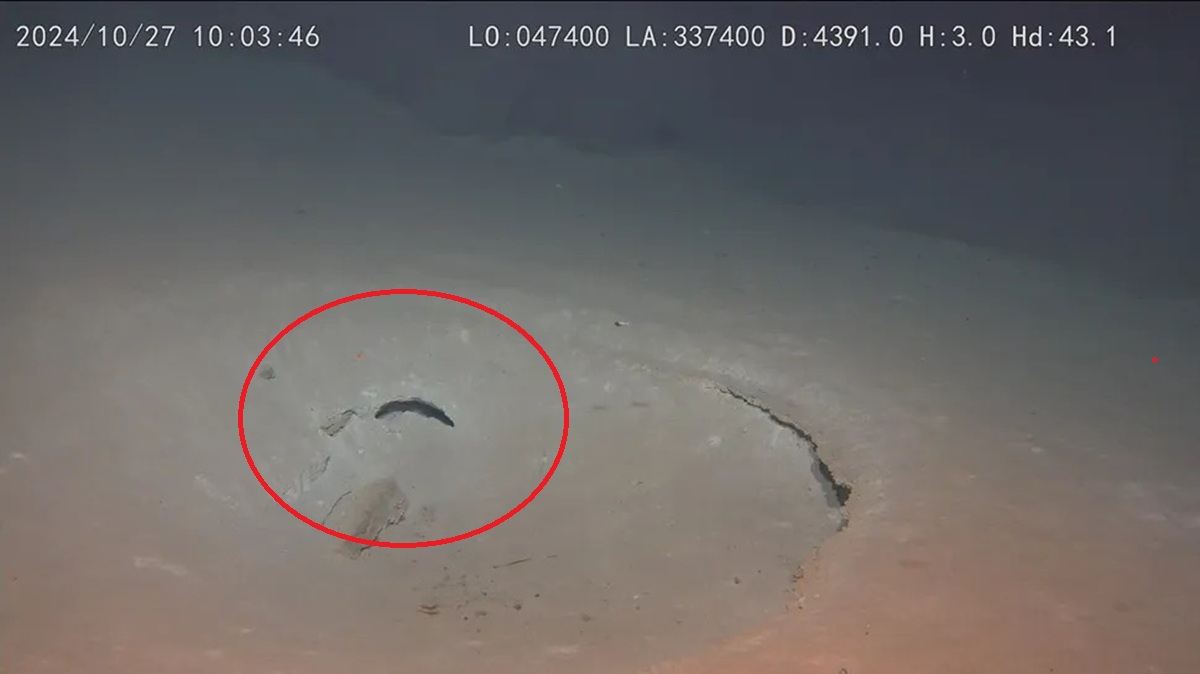

A Chinese Submersible Recorded Unprecedented Images at the Bottom of the Pacific Ocean. The Giant Craters Revealed Hold an Impressive Hydrothermal System Filled with Hydrogen and Surprising Marine Life
Chinese researchers have identified an unprecedented hydrothermal system at the bottom of the Pacific Ocean. Named Kunlun, the field surprised scientists with its size, complexity, and the marine life found in its craters.
Enormous Craters Filled with Hydrogen
The Kunlun system is located northeast of Papua New Guinea and has 20 craters. The largest is about 1,800 meters wide and 130 meters deep. These craters are grouped in a “tubular swarm” and release large quantities of hydrogen.
According to a study published in the journal Science Advances on August 8, this field covers an area of 11 square kilometers, making it hundreds of times larger than the Atlantic system known as the Lost City. Therefore, scientists highlight that this is a unique finding.
-
Chinese Scientists Develop Green Technology Turning Agricultural Waste into 50,000 Tons of Biochar Annually, Now Eyeing Aviation Fuel

-
The World’s First Smartphone, Released in 1994, Would Cost the Equivalent of an iPhone 16 Plus Today
-
Robot Explores Atlantic Ocean Depths, Captures Unprecedented High-Definition Footage of Rare Giant Squid

-
Three 70 kg 17th-century lead ingots found stacked on the North Sea floor during Hornsea 3 wind farm investigation, 120 km off Norfolk coast


Hydrogen and the Origin of Life
The process of serpentinization is central to the phenomenon. In it, seawater reacts with mantle rocks, generating greenish minerals and releasing hydrogen.
As hydrogen can be a source of energy for organisms, researchers believe that Kunlun may help understand how life originated on Earth.
According to the Chinese Academy of Sciences, hydrogen-rich fluids resemble the chemical environment of primitive Earth.
Additionally, the diversity of observed species was impressive. Shrimp, lobsters, anemones, and tube worms thrive in the area, likely fueled by chemosynthesis.
Life Without Solar Light
In the ocean depths, sunlight does not reach. Therefore, life forms do not use photosynthesis.
Instead, they rely on chemosynthesis, a process that transforms chemical substances, such as hydrogen, into energy.
A Chinese team had previously filmed similar communities at 9,500 meters deep in the northwest Pacific. These rare records reinforce how much of the seafloor remains unexplored.
Submarine Expedition
In the new study, scientists used a manned submersible to map Kunlun and investigate four of the largest craters.
Measurements indicated that the system produces more than 5% of all non-living underwater hydrogen on the planet. This figure is noteworthy because it results from a single field.
According to the analysis, the tubular swarm formed in stages. First, the accumulation of hydrogen triggered underground explosions.
Then, fractures appeared at the edges of the craters, releasing hydrogen-rich fluids. Over time, minerals blocked these fissures, allowing for further accumulation and possible smaller explosions.
Differences Compared to Other Systems
Kunlun distinguishes itself from common hydrothermal systems, which are formed by volcanic activity at plate boundaries.
These often feature black smokers, where water can reach 400 degrees Celsius. In contrast, serpentinization systems, like Kunlun and the Lost City, are cooler, with temperatures below 90 degrees.
Another notable factor is the location. The Lost City is close to a mid-ocean ridge, where tectonic plates pull apart.
However, Kunlun is situated within a plate, far from ridges, challenging traditional conceptions of the formation of such fields.
Challenge to Old Assumptions
The study’s co-author, Weidong Sun, emphasized that Kunlun stands out due to its high hydrogen flow, scale, and geological setting.
For him, the discovery proves that hydrogen generation through serpentinization can occur far from ocean ridges, contradicting long-held hypotheses.
Thus, Kunlun opens new perspectives for research on life under extreme conditions. Additionally, it provides a unique natural field for investigating the links between submarine chemical processes and the origin of life.
This finding reinforces how the oceans still hide fundamental mysteries. Kunlun is not only a giant hydrothermal system but also a living laboratory at the bottom of the sea. Every detail, from the colossal craters to the organisms inhabiting them, helps retell the story of life on our planet.


