






 Portuguese
  Spanish
  5 min of reading
  0 comments


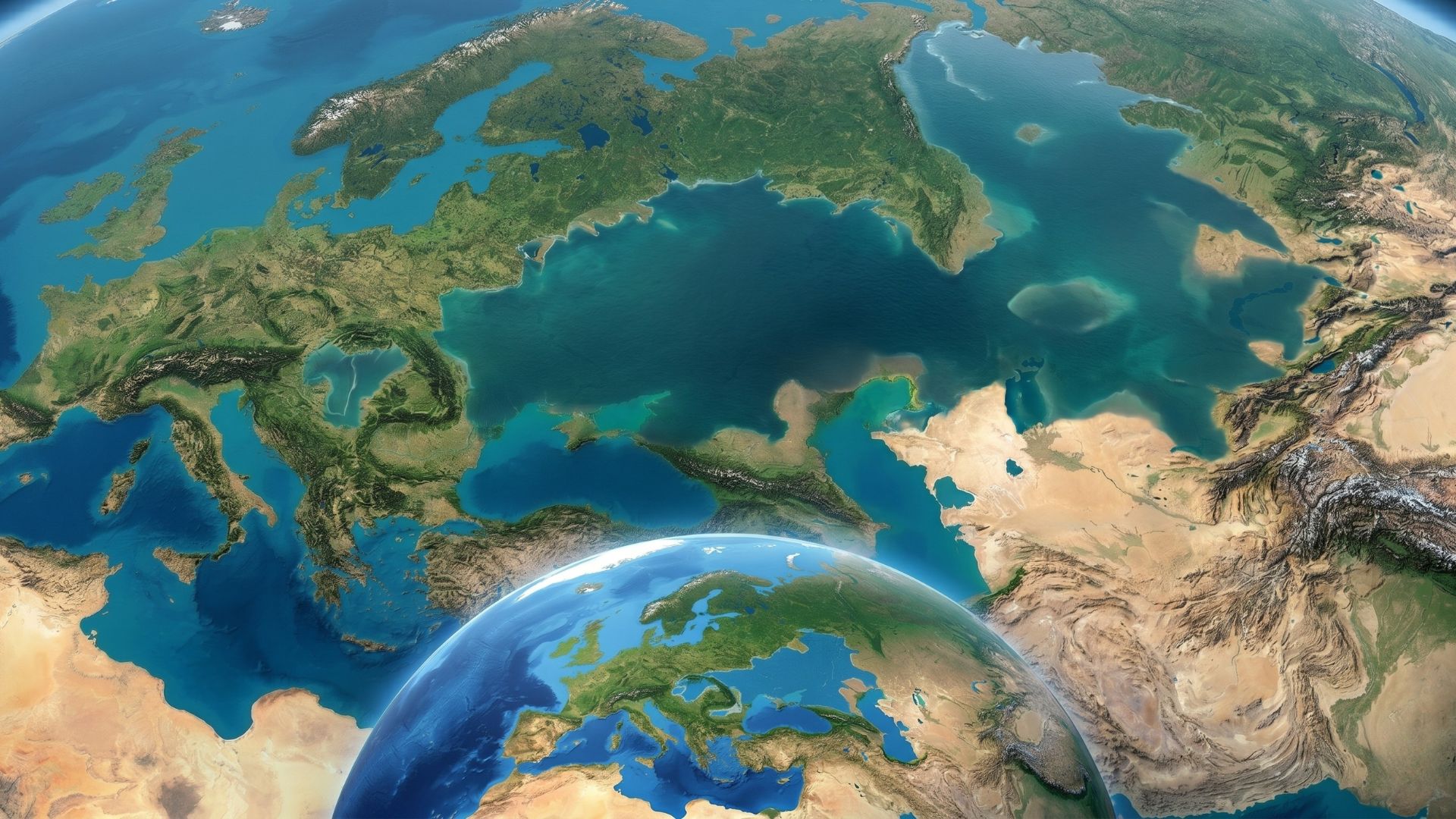
Megalake Paratethys covered 2.8 million km² in Eurasia, lost up to 70% of its surface, and left traces in the Caspian and Black Sea.
Seven researchers affiliated with institutions in the Netherlands, Brazil, Russia, Romania, and Germany reconstructed the history of a body of water so large that it surpasses any known modern lake. The Paratethys, an ancient isolated sea of Eurasia, once covered about 2.8 million km² and stored more than 1.8 million km³ of brackish water, a volume more than ten times greater than all current lakes combined.
The study shows that this aquatic world, separated from the ocean by tectonic movements, did not disappear simply. Between phases of expansion and collapse, the largest lake in Earth’s history lost up to 70% of its surface, experienced a drop in level of up to 250 meters, and exposed approximately 1.75 million km² of dry bottom, transforming part of Eurasia into a post-apocalyptic landscape of salt, mud, and extinctions.
Paratethys was the largest lake in Earth’s history and occupied an area larger than the current Mediterranean
Paratethys formed when the ancient Paratethys Sea became tectonically isolated from the global ocean during the late Miocene. The uplift of mountain ranges in Central Europe blocked marine connections and transformed an oceanic arm into a gigantic brackish lake in the interior of Eurasia.
-
Public school students in Sergipe create an early autism screening kit for vulnerable communities without a doctor, in the year Brazil won 8 awards at the world’s largest science fair.

-
Engineering students create a low-cost 3D-printed wheelchair for dogs and help the paralyzed dog Bili, who was born without legs, walk again for R$ 448.
-
Man creates ingenious hack with pipes buried 2.4 meters deep and transforms snow into a tropical fruit greenhouse; system created by a retired mailman uses ground heat, produces oranges and lemons in Nebraska’s winter and has already turned into more than 700 kits sold.
-
An African fish is terraforming lakes by altering sediments, increasing turbidity, and changing the food chain: the silent advance of the tilapia Oreochromis niloticus




At its peak, this body of water extended from the Eastern Alps to Central Asia. On a modern map, it would occupy regions now associated with Eastern Europe, Black Sea, Caspian, Caucasus, Russia, and Kazakhstan.
The size is daunting because the lake was about 2.8 million km², approximately 10% larger than the current Mediterranean in area. Even so, it was relatively shallow compared to large oceanic seas.
Megalake Paratethys stored more than 1.8 million km³ of brackish water and created a unique fauna
Paratethys was not just a giant lake. It was an isolated ecosystem, with brackish waters and species that evolved separately from the oceans.
During its period of greatest stability, between about 11.6 million and 9.75 million years ago, the megalake developed an endemic fauna. Among the animals associated with this environment was the Cetotherium riabinini, a dwarf whale about 3 meters long, considered one of the smallest whales known in the fossil record.

This isolation turned the Paratethys into a natural evolutionary laboratory. Whales, dolphins, seals, mollusks, and other organisms were trapped in a closed system, vulnerable to any strong changes in climate, salinity, and water level.
Climate collapse caused the largest lake on Earth to lose up to 70% of its surface
The most dramatic point of the research lies in the late Miocene regressions. Between about 9.75 million and 7.65 million years ago, the Paratethys underwent severe cycles of filling and drying.
In the most extreme episodes, the lake lost about one-third of its water volume and up to 70% of its surface. This means that a gigantic area, once covered by water, turned into a dry bottom exposed to evaporation, salt, and erosion.
The drop in water level reached 250 meters. On a geological scale, it was a brutal transformation: what was once a continuous aquatic environment fragmented into smaller basins, with peripheral areas of fresher water and a much more saline central region.
Dry bottom of 1.75 million km² created a landscape of salt and extinction in Eurasia
The loss of up to 70% of the area means that approximately 1.75 million km² of former lakebed were exposed. It is a surface comparable to the sum of large national territories, transformed into a continental geological scar.

This partial drying altered the water chemistry and increased salinity in isolated areas. Many species that had evolved in that closed environment did not survive the change.
The Paratethys ceased to be a large aquatic refuge and began to function as an environmental trap. The endemic fauna, adapted to specific conditions, faced salinization, habitat loss, and ecosystem fragmentation.
Caspian, Black Sea, and Aral are modern remnants of a vanished aquatic world
The Paratethys no longer exists, but its remnants still appear on the current map. The Caspian Sea, the Black Sea, and the ancient Aral Sea system are considered modern remnants of this immense aquatic domain of Eurasia.
The history of the megasea helps explain why these regions still carry delicate environmental characteristics. The Black Sea, for example, has deep waters poor in oxygen and rich in hydrogen sulfide, a condition that refers to stratified and fragile environments.
The Caspian, the largest current lake on the planet, also faces modern risks of retreat. Therefore, understanding the Paratethys is not just revisiting an ancient catastrophe, but observing how large continental water masses can react to climatic and hydrological changes.
Study also helps to understand salt, oil, and ancient closed basins
The reconstruction of the Paratethys has importance beyond paleontology. Closed, brackish environments subject to intense evaporation are fundamental to understanding the formation of salt deposits and complex sedimentary systems.

Researchers associated with the study point out parallels between the history of the Paratethys and ancient basins linked to the formation of saline layers. This type of environment is of direct interest to petroleum geology, including by analogy with systems associated with pre-salt.
In the Brazilian case, the comparison does not mean that the environments are identical, but it helps scientists understand how lakes, isolated seas, extreme salinity, and sediment burial can create geological records of high scientific and economic value.
Largest lake on Earth shows how climate changes can reorganize entire continents
The great lesson of the Paratethys lies in scale. An aquatic system larger than the Mediterranean did not disappear all at once, but was dismantled by cycles of isolation, evaporation, level drop, and reconnection.
The research shows that hydrological crises in large closed basins are not limited to water. They can alter fauna, sediments, salinity, landscape, regional climate, and even connections between ecosystems separated by thousands of kilometers.
The largest lake that ever existed on Earth has become a brutal geological reminder: when the climate changes and the water recedes, even continental seas can turn into desert, salt, and fossil.





Be the first to react!