Portuguese
  Spanish


A 1983 Chevrolet Fleetside drew attention by running without gasoline, using a gasifier installed in the body to transform wood chips into fuel gas. The truck, equipped with a 5.7-liter V8 engine, is said to have traveled over 100,000 km on this system and reached 125 km/h in a closed test.
A Chevrolet, powered by wood, became a rare example of old technology applied to a conventional V8 engine. The 1983 vehicle is said to have surpassed 100,000 kilometers without gasoline, using gas generated from wood chips.
The Chevrolet that became a small mobile power plant
The truck belongs to the father of the creator of the channel Jp Prat Projects and draws attention for not relying on major internal changes to the engine. Under the hood is a Chevrolet block of 350 cubic inches, equivalent to about 5.7 liters.
The engine was manufactured in 1972 but continues to run in an uncommon configuration. The main adaptation is not inside the V8. It is in the body, behind the cabin.
-
Workshop Converts Giant Tractor Tire Tricycle into a Three-Wheel Drive Hybrid with 36,000-Watt Electric Motor Capable of Climbing Hills

-
Sales of Brazil’s Cheapest Electric Car Halted Before First Deliveries: E-Motors Suspends Emova Easy Due to Import Tax Increase and Rising Freight Costs

-
Nissan Discontinues Qashqai SUV Amid Cost-Cutting, Chinese Competition, and Product Line Review

-
BYD Patents Revolutionary System Using Computer Vision to Detect Animals Under Cars Before Starting, Preventing Tragedies





There, a bulky system transforms solid biomass into gaseous fuel. It is this gas that powers the engine, replacing gasoline in a project that mixes traditional mechanics and technology known for more than a century.
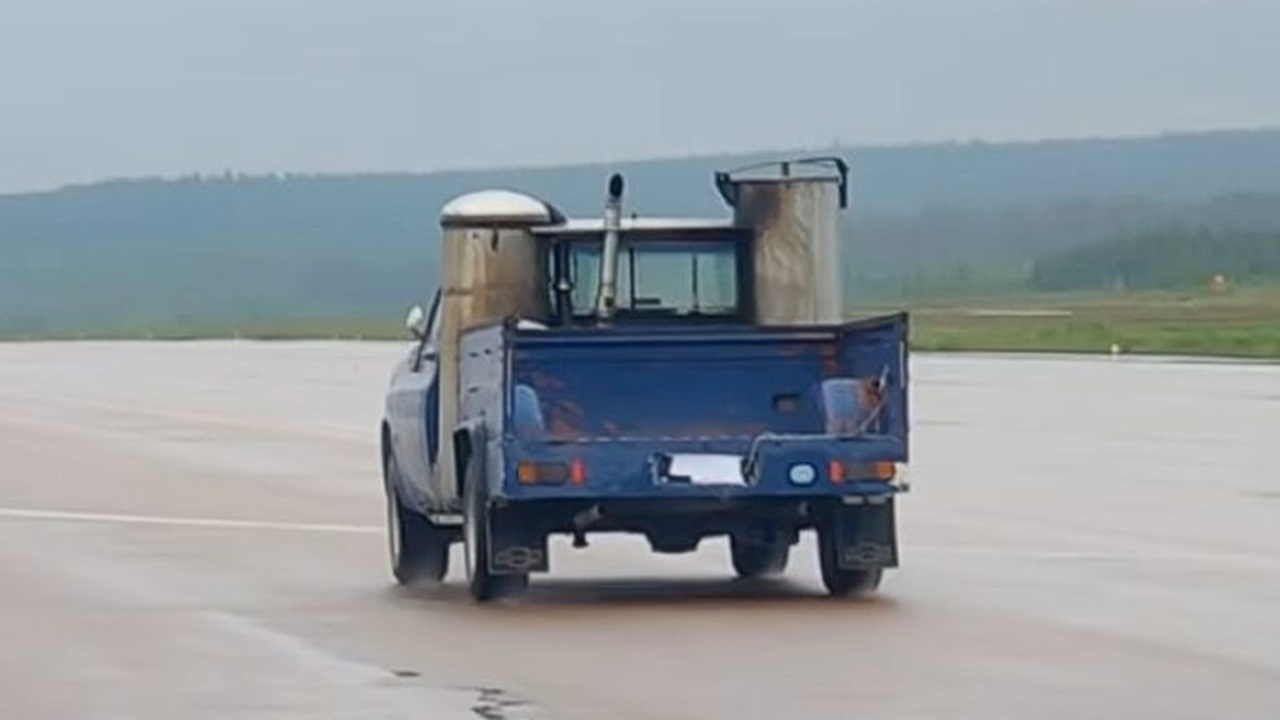
How wood becomes fuel
The operation depends on a biomass gasifier. The wood chips are placed in a metal reactor and heated with a controlled amount of oxygen.
As complete combustion is limited, the wood does not turn into just heat, ash, and exhaust gases. The process generates a combustible mixture known as wood gas or poor synthesis gas.
This mixture mainly contains carbon monoxide, hydrogen, carbon dioxide, methane, and nitrogen. The composition varies according to humidity, temperature, and gasifier design.
Carbon monoxide and hydrogen account for an important part of the energy harnessed. However, before reaching the intake, the gas needs to be cooled and filtered.
Filters retain ashes, soot, and other particles. A valve regulates the flow before it enters the engine. The challenge is to keep everything running over long distances.
Closed track test reached 125 km/h
To measure performance, the team took the truck to an airport. The vehicle traveled 211 kilometers to the location, where there was a closed track for a speed attempt over one mile, about 1.61 kilometers.
During the test, the Chevrolet reached 125 km/h. Jp Prat Projects presents the mark as a speed record for a wood gas-powered vehicle in this type of trial.
Comparison requires caution. There is no widely recognized international category that facilitates measuring this result against other similar experimental vehicles.
Consumption shows the main limitation
During the round trip, combined with the test, the reported consumption was approximately 36.5 kilograms of wood for every 96.6 kilometers.
In conversion, this represents about 37.8 kilograms per 100 kilometers. The number helps explain why this solution does not directly compare to the practicality of liquid fuels.
Gasoline concentrates a lot of energy in a small volume. Wood, on the other hand, takes up more space to deliver equivalent autonomy. Therefore, an important part of the bodywork is usually used to store the fuel.
In the speed test, the bags of wood were carried in a trailer pulled by another vehicle. The decision reduced the weight of the Chevrolet during the attempt on the track.
Starting requires time and cleaning
A Chevrolet, powered by wood, does not operate like a regular car. Before setting off, accumulated ashes must be removed, and the filters need to be checked to prevent soot from reaching the engine.
After that, the gasifier is started. In this project, paper is used to begin combustion at the bottom of the reactor. When the necessary temperature is reached, the production of fuel gas stabilizes.
The procedure takes 5 to 10 minutes. Only then can the V8 be started. According to the owners, it does not require auxiliary gasoline but demands frequent maintenance and careful filtering.
Idea grew during World War II
Wood gas vehicles are not new. During World War II, the shortage of gasoline and diesel led several European countries to use gasifiers in cars, trucks, buses, and agricultural machinery.
The solution allowed the use of wood, coal, and other solid fuels when petroleum derivatives were restricted. With the end of the war and the return of cheap liquid fuels, these systems largely disappeared.
They were heavy, required constant cleaning, and delivered less power. Today, interest has returned due to energy security, utilization of forest waste, and reduction of fossil fuel consumption.
Why this should not become standard
The experiment proves that it is technically possible to move a vehicle using wood. This does not mean that the technology is suitable to replace gasoline in millions of cars.
The volume of biomass, startup time, maintenance, and lower available power make daily use difficult. Mass use could also put pressure on forest resources.
Gasification tends to make more sense in fixed installations, rural properties, isolated communities, forest industries, and decentralized systems, especially when there is waste close to local consumption.