






 Portuguese
  Spanish


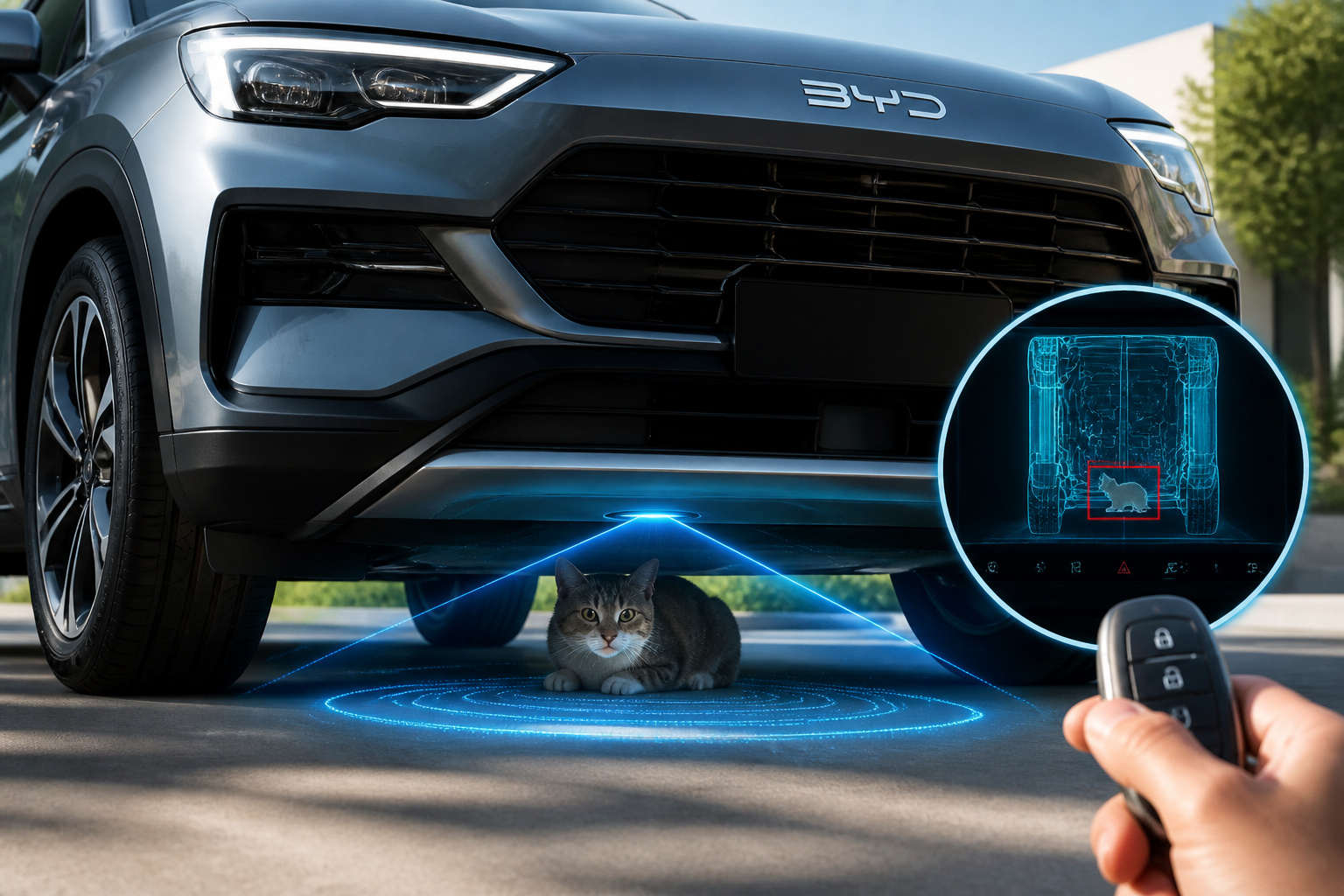

BYD has registered a computer vision system that monitors the area under the car before starting and can identify people or animals hidden there. The patent expands the brand’s focus on safety but does not yet have a timeline for application in production vehicles.
BYD has registered a patent for a system that observes the underside of the car before starting and attempts to identify people or animals hidden there. The idea is to use computer vision to reduce the risk of accidents in a situation that often goes unnoticed, especially with the vehicle stationary.
The application was published by the National Intellectual Property Administration of China on June 12, under the code CN122200729A, according to CarNewsChina. The document does not mention an immediate launch, nor does it provide a timeline for implementation in street models.
In practice, the system starts with a reference image of the car’s underside, captured when the vehicle is turned off. Then, new images are compared with this standard to locate changes in the monitored area before any more detailed analysis.
-
Study Reveals Why Cars Are More Expensive to Produce and Buy in Brazil Compared to Mexico, Highlighting Taxes, Logistics, and Industrial Costs as Key Factors.

-
BMW Completes $1.7 Billion Investment in the U.S. for Electric Vehicle Production, Positions South Carolina for New Generation as Rivals Reassess EV Race
-
Toyota to Open New Factory in Brazil by November 2026 with $2.2 Billion Investment, Creating 2,000 Jobs, and Ending Corolla Production in Indaiatuba

-
Brazilian Factory Restores Truck Engines and Parts, Reducing Raw Material Use by Up to 85% After 80 Years in Business




How BYD wants to see what is out of the driver’s reach
The central point of the patent is simple to understand: the car stores a base image of its own floor and then compares real-time images to see if something has changed. If there is a difference, that section becomes the focus of the next analysis.
Instead of processing the entire region all the time, the system separates only the altered parts. The logic, according to the application description, is to reduce unnecessary work and concentrate computational resources on possible new objects or movements below the vehicle.
After this screening, the system extracts information from image characteristics, checks if there is a living organism there, and evaluates the state of the detected target.
The challenge is to separate real danger from shadow, dirt, and false movement
Detecting life under a car is more difficult than it seems. The space beneath the vehicle gathers shadows, variable lighting, dirt, debris, uneven terrain, and fixed parts that do not change between one check and another.
It is precisely this mixture that can confuse conventional systems, which often cannot differentiate a real biological movement from any change in the environment.
With the comparison between a base image and the current scene, BYD tries to build a type of customized map for each parked car. The reading starts with identifying the change and only then moves on to recognizing what is there, be it an animal, a person, or another living target.
The patent adds to other monitoring systems of the brand
The new application does not appear in isolation. BYD also recently revealed another invention to detect forgotten occupants inside the vehicle, using radar channel impulse response data, frequency domain features, and angle of arrival analysis.
Together, the two solutions point in the same direction: protecting both the interior and the exterior of the car, especially in situations where the driver’s attention may fail before departure.
In recent months, the company has also published a solid-state battery patent with sulfide and launched its first 1,500 kW ultra-fast charging station in Germany, as part of a European network plan with 3,000 points.
Patent reinforces focus on safety, but not yet a product
Despite the progress on paper, the patent registration does not mean that the system is already in production. The document does not provide information on application in a specific vehicle, launch schedule, or commercialization plan.
The clearest reading, for now, is that BYD is expanding its package of vehicle monitoring and safety technologies. For the market, this shows that the competition between automakers is also happening in areas that the consumer does not always see immediately, but that can prevent silent accidents and change the routine of parked cars.
If the technology will reach the brand’s models and in how much time, is still the next answer the sector will await. Meanwhile, the patent already raises an important alert about a safety front that still receives little attention. Comment and share your opinion on this type of feature in the cars of the future.


