Portuguese
  Spanish


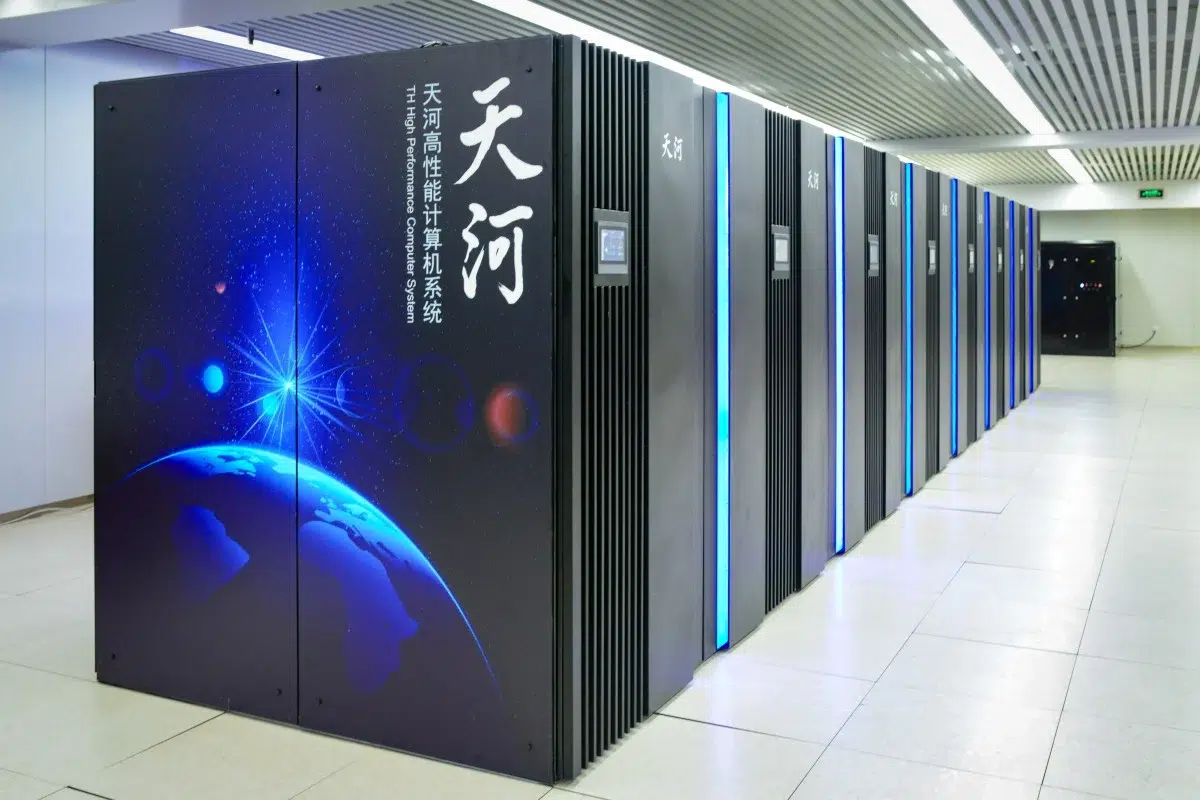

China Surprises Again With A Supercomputer That Tops The Global Computing Efficiency Ranking, Highlighting Its Superiority In Technology And Innovation
The advancement of artificial intelligence (AI) and exascale computing (high-performance computing) has brought new prominence to China, which once again leads a global ranking of computing efficiency. The prototype Tianhe Exa-node, developed by the National University of Defence Technology (NUDT), secured first place in the latest Green Graph500 list, which evaluates energy consumption and performance of supercomputers focused on big data.
Victory Of The Tianhe Exa-node Prototype
The Green Graph500 is an international platform that measures the energy efficiency of supercomputers, based on the MTEPS/W metric (millions of edges traversed per second per watt). This metric assesses the system’s capability to handle large volumes of data efficiently.
The Tianhe Exa-node Prototype achieved an impressive mark of 6,320 MTEPS/W, establishing itself as the leader in the category. This performance surpassed the previous version of the Tianhe, which reached 4,385 MTEPS/W in 2021, and the Eniad from the University of Pennsylvania, which placed third with 2,057 MTEPS/W.
-
Hisense Unveils 615-Liter PureView Fridge with Transparent Door, Smart Display, Voice Control, and UV Purification to Compete with LG and Samsung

-
Are Cleaning Staff in Large Buildings Becoming Obsolete? Autonomous Robots Now Clean Airports, Hospitals, and Shopping Centers for Hours, as Companies Invest in Automating Repetitive Tasks

-
Xiaomi Launches Compact Photo Printer with Bluetooth, Extra Black Ink, and Augmented Reality Photo Printing
-
Teen Invents AI-Powered Traffic Light to Assist Elderly Pedestrians by Extending Crossing Time




The result reflected not only the technological capability of the system but also China’s commitment to energy sustainability, a crucial aspect for the future of high-performance computing.
The Tianhe In The Era Of Exascale Supercomputing
The Tianhe Exa-node Prototype is part of an ambitious Chinese project to lead in exascale computing, marked by systems capable of performing 1 exaFLOP (one quintillion operations per second). Developed as an experimental model, it tests and optimizes essential components such as processors, memory, and interconnect networks to achieve this unprecedented capability.
The journey of Tianhe began in 2010, with the launch of the Tianhe-1, the first Chinese supercomputer to top the TOP500 list of the fastest supercomputers in the world. Its evolution continued with the Tianhe-2, which kept China as a global leader for several years. In 2018, the exascale prototype was presented, demonstrating the viability of locally developed hardware and software, a strategy that reduced dependence on foreign technologies.
Why Energy Efficiency Matters?
In an increasingly sustainability-focused world, the energy efficiency of supercomputers has become a criterion as important as their speed. Large systems consume massive amounts of energy, leading to economic and environmental concerns.
By leading the Green Graph500, the Tianhe Exa-node Prototype stands out as an advanced solution to the growing demands for big data processing in sectors such as science, industry, and national security. Its ability to perform complex calculations sustainably could serve as a model for future innovations worldwide.
Global Competition
The race for supremacy in exascale computing is far from being just technological. The United States, Japan, and Europe are also developing systems capable of reaching the exascale mark. In 2022, the US unveiled the Frontier, recognized as the first operational exascale supercomputer. However, China continues to challenge this dominance with advanced and efficient systems like the Tianhe.
Experts point out that, in addition to technical performance, China’s technological independence is a decisive factor. The chips and technologies used in the Tianhe are developed locally, in response to trade restrictions imposed by other countries.
The Future Of Computing
The success of the Tianhe Exa-node Prototype represents more than a technical milestone. It reflects China’s strategic advancement in an area that will shape the future of science, security, and the global economy. With the growing demand for big data and AI solutions, efficiency and sustainability will remain key factors.
Leading the Green Graph500 reaffirms China’s role as a technological powerhouse, ready to shape the next era of high-performance computing. The world, in turn, watches closely as this race for technological supremacy progresses.