Portuguese
  Spanish


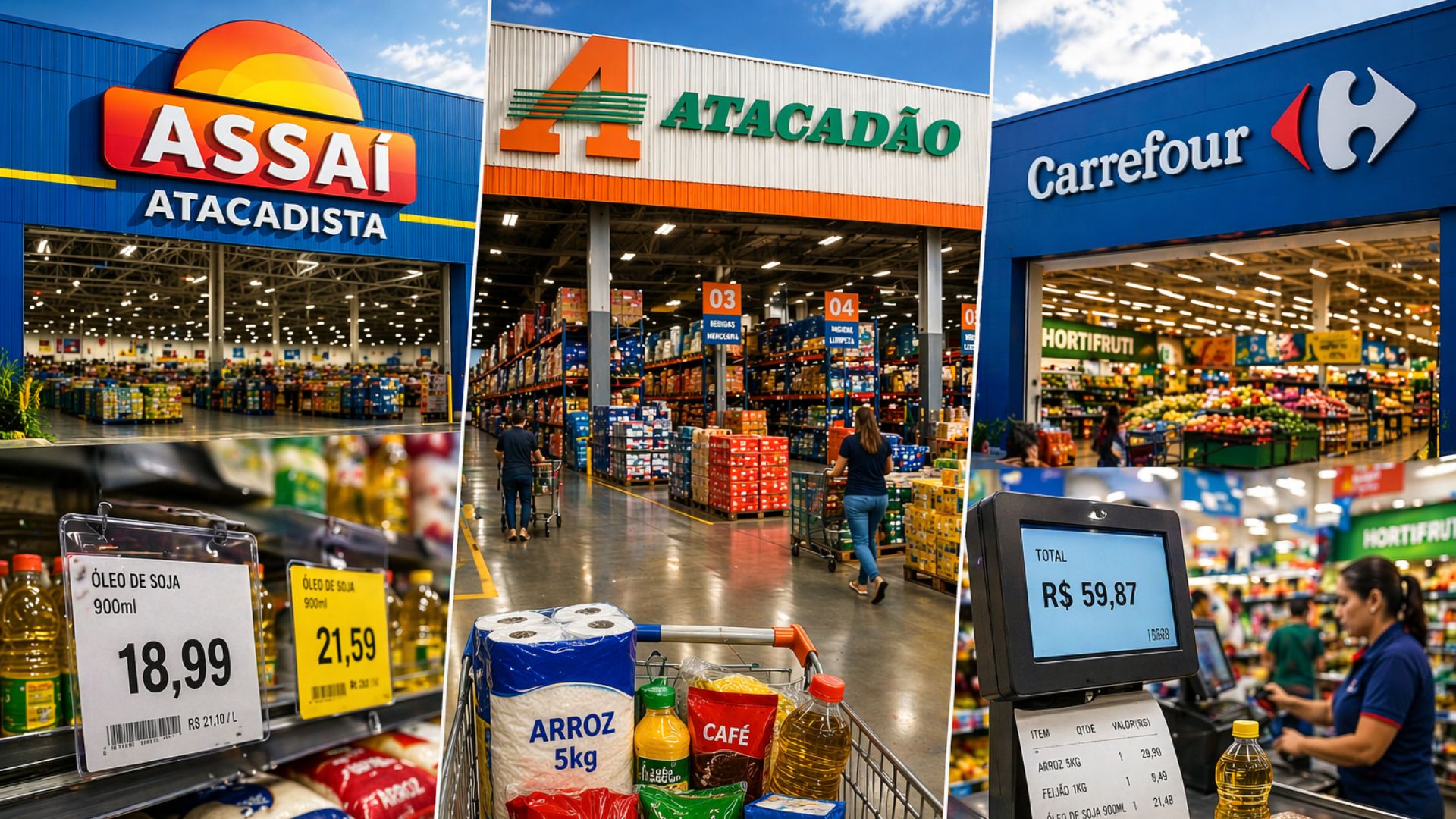

More active oversight, old rules under pressure, and greater demands for transparency put large supermarket chains in the spotlight in 2026, with a direct impact on how prices are displayed, promotions are communicated, and consumers deal with discrepancies at the checkout.
Large food retail chains, including Assaí, Atacadão, and Carrefour, are facing greater pressure in 2026 to comply with transparency rules already outlined in consumer legislation, particularly regarding price display, clarity of offers, and correction of discrepancies identified at the checkout.
Although there have been reports about an unprecedented package of regulations for the sector, the official basis available so far points to a stricter enforcement of existing duties that remain applicable to all retail commerce.
In practice, this means that large supermarkets are still required to inform prices correctly, clearly, precisely, prominently, and legibly, without pushing the task of discovering the price onto the consumer solely through the optical reader, the app, or at the checkout.
-
To erect the “Baleia” building on the richest avenue in Brazil, he bought 35 houses, paying with trips to Disney, a truck, and even an apartment, waited over 20 years, and today the complex is valued at R$ 2.5 billion.

-
The land belonged to her great-great-grandfather and was worth R$ 25 per square meter during the pandemic; the couple sold 250,000 m² for the nearly R$ 30 billion project that is transforming the “neighbor of Jericoacoara,” and today a house in the region goes for R$ 4.2 million.

-
Labor shortage reaches the truck drivers’ area: Brazil is already facing a deficit of 120,000 drivers, 65.1% of transport companies feel the impacts, and Mercedes-Benz strengthens training in the face of the new generation of technological trucks.
-
An important sector in Brazil is suffering from a labor shortage, requiring the qualification of 14 million workers by 2027, leading companies to invest R$ 5 million to train professionals and address the technical deficit.




The duty of transparency is not new, but it has gained greater relevance in light of the recurring oversight by state consumer protection agencies and the actions of the National Consumer Defense System in field operations and public guidance on basic rights.
Price rules in supermarkets follow existing legislation
The backbone of this demand lies in old and still valid regulations.
Law No. 10,962, from 2004, regulates the offering and posting of prices to consumers, while Decree No. 5,903, from 2006, details how this information should be presented and addresses infractions related to the right to information.

In parallel, the Consumer Defense Code guarantees as a basic right access to adequate information about products and services.
Another relevant requirement, incorporated into the CDC by Law No. 14,181, from 2021, is the information of the price per unit of measurement, such as kilogram, liter, meter, or another equivalent reference.
For families making bulk purchases, this rule helps compare packages of different sizes and reduces the chance of an apparent promotion hiding a less advantageous final cost.
In cash-and-carry networks, where the assortment mixes varied volumes and discounts for quantity, this data becomes even more sensitive.
Price difference between shelf and checkout remains a focus
One of the most frequent points of conflict continues to be the difference between the price displayed on the shelf and the one recorded at the time of payment.
In published guidance, the Ministry of Justice reinforced that, when there is a price discrepancy for the same item, the consumer has the right to pay the lowest price indicated.
The guidance also reminds that documenting the discrepancy, with photos, videos, receipts, and invoices, helps in resolving the complaint.
This understanding directly affects large-scale operations, where the updating of labels, flyers, apps, and checkout systems needs to occur in a synchronized manner.
In companies with thousands of items and rotating promotions, the operational risk is higher, and the cost of a recurring error goes beyond the brand’s image.
If the irregularity is confirmed by consumer protection agencies, the supplier can be fined based on the Consumer Defense Code and pricing rules, within the administrative process provided for this type of infraction.
Impact on cash-and-carry networks and discount programs
In the case of groups like Assaí and Atacadão, the challenge is to make the distinction between unit price, price per volume, and any conditions for obtaining the lowest advertised price unequivocal.
In more integrated operations with apps, loyalty programs, and personalized discounts, as occurs in part of the Brazilian food retail, the central requirement remains the same.
Not to hide essential conditions of the offer and not to mislead the consumer about the amount actually charged remains a legal obligation.
Direct effect on the consumer’s wallet

For the consumer, the most concrete effect appears in price comparison and purchase predictability.
When the store properly informs the cash price, the price per unit of measure, and the real conditions of a promotion, the family can better assess whether the economical packaging is worth it, if the discount depends on a minimum quantity, and if the item truly fits within that month’s budget.
This type of transparency reduces noise, but it also decreases invisible losses that, when accumulated, weigh on household expenses.
More frequent inspections also tend to pressure the sector to quickly correct failures, especially during peak periods, such as seasonal dates and weeks with strong promotional appeal.
In February 2026, for example, Procon-SP reported that it had intensified efforts in different segments, including supermarkets, and pointed out irregularities such as the absence of price.
The measure did not create a new rule, but it shows that the enforcement of compliance with regulations is active and distributed in in-person operations.
What to observe when checking out
In light of this scenario, the most effective attitude remains to check the label before placing the product in the cart and to review the receipt while still in the store.
When there is a conditional promotion, the information must be visible. When there is a difference between prices for the same item, it is worth documenting the proof at the time of purchase.
And if the establishment refuses to apply the lowest price indicated, the official guidance is to seek complaint channels and consumer protection agencies.
For large chains, 2026 begins less as a regulatory break and more as a test of operational compliance on a national scale.
The consumer already had these rights, but the circulation of public guidelines, the reinforcement of inspections, and greater attention to promotional practices make the environment more sensitive to labeling errors, poorly explained offers, and discrepancies at checkout, especially in high-turnover formats with tight margins.