Portuguese
  Spanish


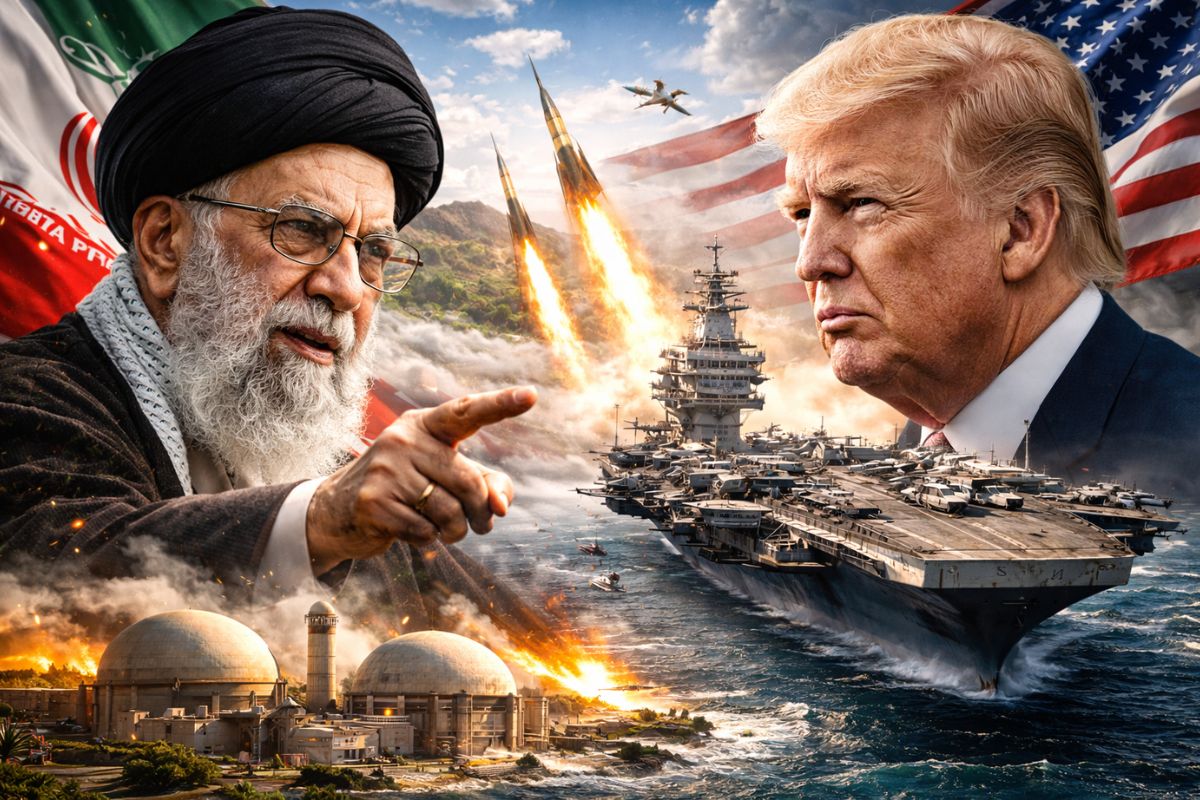

In Public Speech Amid Growing Tensions, Iran Challenges US President, Talks of Sinking Aircraft Carrier in the Region and Refuses to Limit Ballistic Missiles, While Indirect Negotiations Try to Contain the Risk of Escalation in the Middle East
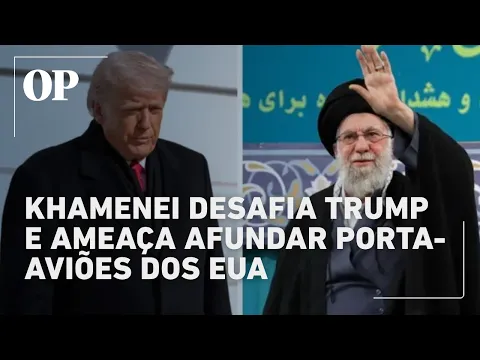
In a speech that raised the temperature in the Middle East, the country’s supreme leader stated that Washington has been unable to weaken the Islamic Republic over decades and will not have the strength to overthrow the regime. In front of the audience, Iran Challenges US President by threatening to sink an American aircraft carrier stationed in the region and claiming military capability to respond to any hostile action.
The remarks come at a time when tensions between the two countries are once again rising, amid the resumption of indirect negotiations over the Iranian nuclear program. On one hand, Iran hardens its tone and keeps its ballistic missile program off the negotiation table. On the other hand, the US president alternates between pressure talks and signals of negotiation while reinforcing military presence in the Middle East.
Speech Directly Challenges the White House
In the speech, the supreme leader presented the history of political confrontations between Tehran and Washington as proof of the resilience of the Iranian regime.
-
Chinese Nuclear Submarine Launches Simulated Warhead Missile in Pacific, Heightening Regional Tensions Amid Naval Drills with Russia Near Qingdao; New Zealand and Papua New Guinea Warn of Persistent Chinese Military Presence

-
Ayatollah Ali Khamenei’s Funeral Draws 15 to 20 Million in Tehran, Calls for Revenge Against Trump After Joint Israel-U.S. Attack

-
U.S. Establishes Permanent Embassy in Jerusalem, Reigniting International Debate Over Israel’s Capital
-
The world has nearly 12,000 nuclear warheads, with the majority held by the United States and Russia; see the figures for China, France, and the United Kingdom.


He emphasized that, despite economic sanctions, diplomatic pressures, and isolation in international forums, the Islamic Republic has remained standing and has expanded its response capability.
It is in this context that Iran Challenges US President explicitly. By mentioning the American aircraft carrier stationed in the region, the leader suggested that the country has means to strike US strategic assets in the event of conflict.
The threat was not detailed, but it was enough to reinforce the message that American military presence near Iranian borders is seen as a direct provocation.
According to the speech, any attempt at attack or forced regime change would meet with a proportional response.
The remarks reinforce the message that confrontation is not limited to the diplomatic sphere and that the risk calculations, for both sides, involve the real military capabilities in a region already marked by successive crises.
Military Pressure Increases as Iran Challenges US President
On the American side, the posture also combines political signaling and displays of strength. The US president maintains a pressure speech, conditioning any relief of measures to concrete advances in negotiations.
At the same time, the country is increasing its presence in the Middle East with aircraft carriers, strategic aircraft, and other military assets capable of projecting power quickly.
This scenario creates a tense equilibrium where Iran Challenges US President in front of internal and external audiences. While Tehran seeks to show that it will not yield under threat, Washington tries to reinforce that it will not accept unlimited advancement of the Iranian program without concessions.
The result is an environment where every gesture is interpreted as a test of limits and every troop movement can be seen as preparation for something larger.
Analysts highlight that the combination of hard rhetoric, nearby military assets, and fragile diplomatic channels increases the risk of misunderstandings, local incidents, and rapid escalations.
In a region with multiple armed actors and ongoing conflicts, a phrase in a speech or a naval maneuver can take on disproportionate dimensions.
Nuclear Program and Ballistic Missiles Off the Table

One of the central points of the speech was the reaffirmation that the ballistic missile program is considered an essential part of national defense.
The supreme leader classified these weapons as a key element of the country’s deterrence capability, indicating that Iran Challenges US President by establishing explicit red lines about what will not be negotiated.
At the same time, indirect negotiations surrounding the nuclear program continue as the main channel of contact, albeit with limited progress.
On one side, Tehran seeks to preserve margins of technological autonomy. On the other, Washington aims to prevent the program from advancing to a point that drastically reduces the international community’s response window.
For observers, the coexistence of diplomatic talks and public threats creates an ambiguous framework. While delegations discuss terms and guarantees, the rhetoric from both sides seeks to maintain pressure on the other party.
In this dynamic, the phrase Iran Challenges US President also serves as a message to internal audiences, reinforcing the image of firmness in the face of a historical adversary.
Regional Risk Grows with Rhetorical Escalation
The escalation of tone between Tehran and Washington affects not only the bilateral relationship. Neighboring countries closely monitor military force movements, fearing that any incident could involve bases, maritime trade routes, and local allies.
The presence of an American aircraft carrier and strategic aircraft in a sensitive area amplifies concerns about miscalculations and chain reactions.
Analysts note that as Iran Challenges US President publicly, pressure from internal and regional groups that reject concessions grows.
At the same time, Washington’s allies in the region demand firm responses, fearing that signs of weakness might encourage bolder actions from rivals.
The result is a chessboard where diplomacy and deterrence walk side by side, but any misinterpreted movement can disrupt the balance.
The rhetorical escalation does not, by itself, mean immediate conflict, but increases the environment’s sensitivity to external shocks, small-scale military incidents, or attacks attributed to groups aligned with one side.
Indirect Negotiations Remain the Main Barrier to Open Conflict
Despite the tense climate, indirect negotiations are still seen as the main barrier against open confrontation.
Instead of direct dialogue between the Iranian leader and the US president, mediators and parallel diplomatic channels try to build formulas that reduce risks, establish minimum commitments, and avoid definitive ruptures.
In this scenario, the way Iran Challenges US President in public speeches can influence the maneuvering room of both sides.
A very aggressive rhetoric complicates concessions, while discreet signals of flexibility in behind-the-scenes talks may open space for partial agreements.
The tension between the discourse for internal consumption and long-term strategic needs is one of the most delicate points of this equation.
Every phrase is monitored by rivals, allies, and public opinion, making any retreat politically costly and visible.
Still, the predominant perception among analysts is that, for now, the diplomatic path remains the least risky alternative given the impact a larger conflict would have on the entire region.
In light of this scenario where Iran Challenges US President with threats and a hardening of nuclear position, do you think that mutual pressure tends to push both countries towards an agreement or towards an even more dangerous confrontation in the Middle East?