






 Portuguese
  Spanish
  5 min of reading
  0 comments


For generations, families in Matopiba harvested rice, beans, and cassava to eat. Now, with soy advancing over the Cerrado, many traditional communities have become market customers, buying the food they used to grow, while they report that pesticides from the crops contaminate the remaining springs.
Those who always made a living from the land now face a bitter irony: they need to go to the market to buy the rice their own family used to harvest. This is the reality for traditional communities spread across Matopiba, the agricultural frontier formed by Maranhão, Tocantins, Piauí, and Bahia, where soy has become queen and pushed aside the real food crops. Reports published throughout 2026 show that this exchange has a name and address.
The impact is seen in the numbers and on the table. Since the region was declared an agricultural frontier in 2015, Matopiba has lost about 142 thousand hectares of rice, 23 thousand of beans, and 75 thousand of cassava, precisely the foods that sustain the Brazilian plate. In their place, soy has advanced, largely destined for export and animal feed. The result is a cruel paradox: more grain produced, less food in the region that produces it.
The food that disappeared from their own fields
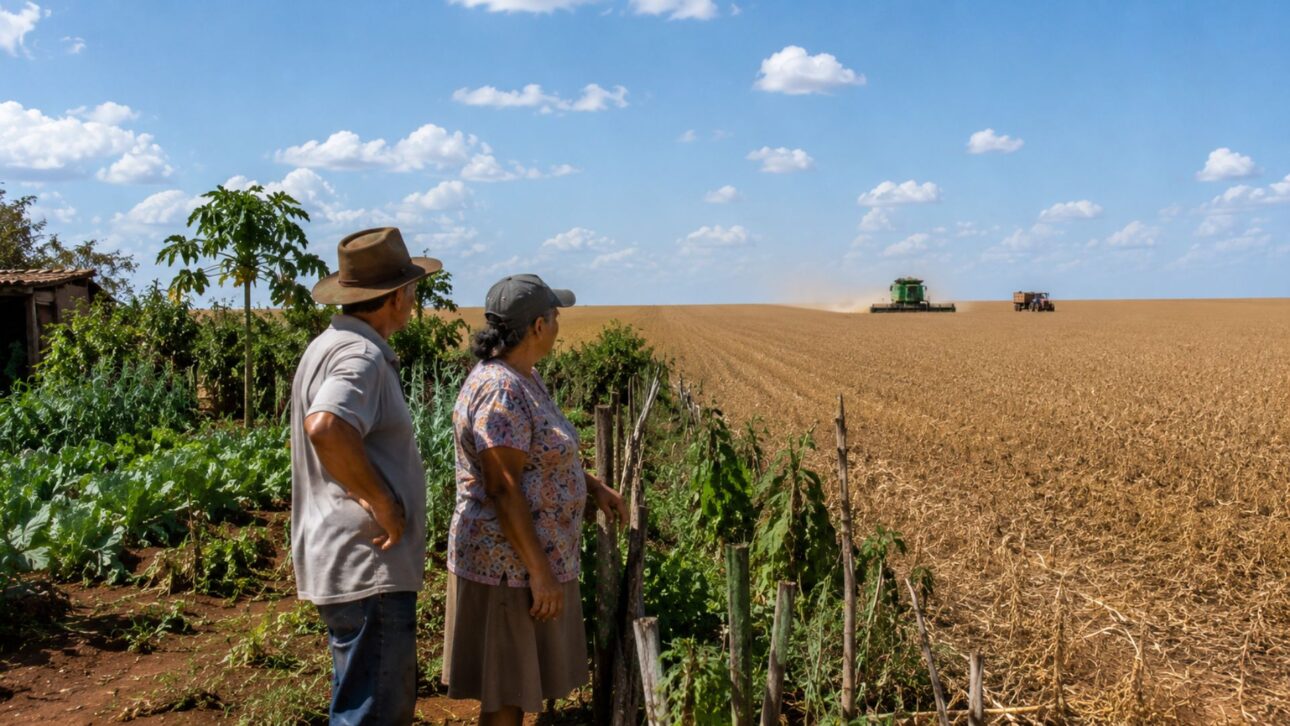
In municipalities like Correntina, in Bahia, farmers who were once self-sufficient now depend on the market for food, buying products without knowing where they come from or how they were grown. The food autonomy that was passed down from generation to generation has been replaced by trips to the store, with limited money.
-
Foreign tree planted to combat drought invades more than 1 million hectares of the Caatinga, encroaches on riparian forests, and turns an old solution for the semi-arid region into a silent threat to biodiversity.

-
Invasive weed that withstands extreme heat advances with climate change, threatens crops on several continents, and raises a global alert about a silent plant capable of dominating soils, suffocating native species, and reshaping entire ecosystems.
-
While other coffees escape the American tariff hike, Brazilian instant coffee is excluded, raising an alert in the sector and may become up to 37.5% more expensive in the United States.
-
Degraded lands could become São Paulo’s new asset to expand planted forests, strengthen wood, cellulose, and biomaterials, as well as keep the state competitive in the international market.


The detail that makes everything more absurd is the destination of the soy. About two-thirds of Brazilian soy is exported, and most of the grains that remain in the country become animal feed, not food on people’s tables. In other words, Matopiba breaks production records while its traditional communities lose access to their own food. The Cerrado, once a pantry for those who lived there, has become a platform for commodities abroad.
How Soy Swallowed the Cerrado
The advance was rapid and heavy. Matopiba already has more than 4.8 million hectares planted with soy, and in recent years most of the expansion of this frontier has occurred over the native vegetation of the Cerrado. In 2024, official monitoring data indicated that the largest share of deforestation in the biome was concentrated precisely in this region, which shows the extent of the pressure on the land.
The logic of occupation hits hard on those who were already there. The formation of a large soy farm usually targets the plateaus, flat and high areas ideal for mechanization and pesticide spraying, and often involves allegations of land grabbing. The problem is that these same plateaus are the water recharge areas of the Cerrado. Surrounded by monoculture, geraizeiros, quilombolas, and other traditional communities become isolated, with no space to plant and without the abundance that the biome offered.
The Water That Arrives Poisoned
If the land has shrunk, the water has worsened. Traditional communities in Matopiba report that the springs that supply their crops now originate within soy farms and arrive compromised. A farmer trying to maintain organic production described the drama of irrigating his area with water that comes from these sources, already contaminated before reaching his plantation.
The poison has known paths. The intense use of pesticides in large crops, in some cases sprayed irregularly by plane, spreads residues through the air and water, affecting neighboring fields and riparian forests. Add to this the lowering of the water table by irrigation pivots, and the picture is complete: less water, worse water, and pesticides where there used to be a clean spring. For these traditional communities, the Cerrado has ceased to be a source of abundant life and has become a territory surrounded by risk.
The Other Side: The Power of Agribusiness
It is necessary to recognize the economic weight of the region, and the defenders of the model do so with data. Matopiba is treated as the last great agricultural frontier on the planet, responsible for a significant share of national grain production and for supporting exports that bring foreign exchange to Brazil. Official projections indicate that the production of soy and other grains should grow even more in the next decade, transforming inland cities and generating jobs.
The defense of agribusiness argues that technology, management, and environmental rules allow for production without destruction, and that much of the expansion occurs in legally suitable areas. The point of contention, however, is not to deny the strength of soy, but to discuss who bears the cost. Between the Cerrado that turns into farmland and the traditional communities that lose food and water, the challenge is to fit the power of agribusiness without erasing those who have lived in Matopiba long before pesticides.
The story of Matopiba is that of Brazil feeding the world, but sometimes forgetting those beside the fields. On one side, soybeans, exports, and the money that drive the Cerrado. On the other, traditional communities that traded the abundance of the farm for the market queue and live with pesticides in the springs.
Is it possible to produce so much without taking the plate from those who have always planted? And you, have you ever stopped to think about where your food comes from, and at what cost, the food that reaches your table? Share your opinion in the comments.
CITED SOURCES
- O Joio e o Trigo — As soy advances, Matopiba reduces hectares of rice, beans, and cassava (Mar/2026)
- O Joio e o Trigo — “I buy, I lease”: how traditional communities are cornered in Piauí (siege on communities)
- Le Monde Diplomatique — Deforestation, land grabbing, and financialization of soy in the Cerrado (water, springs, plateaus, aerial pesticide)
- Agência Brasil — Cerrado Frontier: agro expansion in the water heart of Brazil (water recharge and deforestation)
- Embrapa — Matopiba Theme (counterpoint: production data) (production scale and agricultural frontier)




Be the first to react!